Loading...
Done


A dejected German Grenadier carrying a machine gun on his shoulder in front of a building on fire during the German retreat in Russia. (Photo by Keystone/Getty Images). 1944
Details
27 May 2011 10:35:00


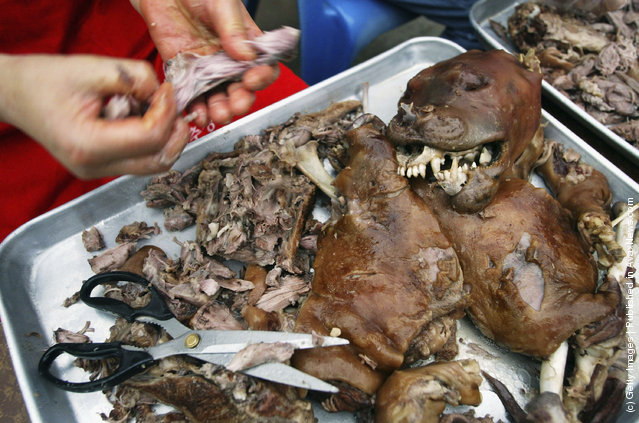
“Dog meat refers to edible parts and the flesh derived from (predominantly domestic) dogs. Human consumption of dog meat has been recorded in many parts of the world, including ancient China, ancient Mexico, and ancient Rome. According to contemporary reports, dog meat is consumed in a variety of countries such as Switzerland, China, Vietnam, the Philippines, and Korea. In addition, dog meat has also been used as survival food in times of war and/or other hardships”. – Wikipedia

Photo: A chef prepares dog meat at a restaurant on July 4, 2005 in Gwacheon, South Korea. Dog meat is a traditional dish in Korea dating back to the Samkuk period (period of the three kingdoms BC 57 – AD 668). Although many recipes existed historically for dog meat, now chefs only make soups, or dishes using boiled or roasted meat. Koreans traditionally eat dog meat on the hottest day of the summer, for it's reputed benefits of virility, invigoration and health. (Photo by Chung Sung-Jun/Getty Images)

Details
24 Jul 2011 13:21:00
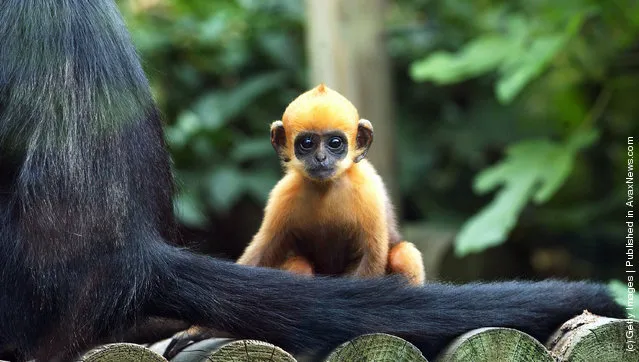
Baby Francois' Langur

“Francois' langur is one of several species of leaf monkeys. Over 50% of its diet is made up of young leaves. It will also consume fruits (17.2%), seeds, flowers, stems, roots, bark and occasionally minerals and insects off of rock surfaces and cliffs. This langur consumes its favorite food, young leaves, at the highest rate during the dry season, April through September, also known as the young leaf-lean period”. – Wikipedia

Photo: An endangered baby Francois' Langur monkey called Laa Laa settles in following her July 6 birth at London Zoo, Regent's Park on August 5, 2004 in London. The bright ginger youngster was born to glossy black parents Max and Shaneka and has the typical orange baby coat which is in stark contrast against the black of her parent's and older brother Grub's fur. (Photo by Steve Finn/Getty Images)
Details
22 Sep 2011 11:28:00
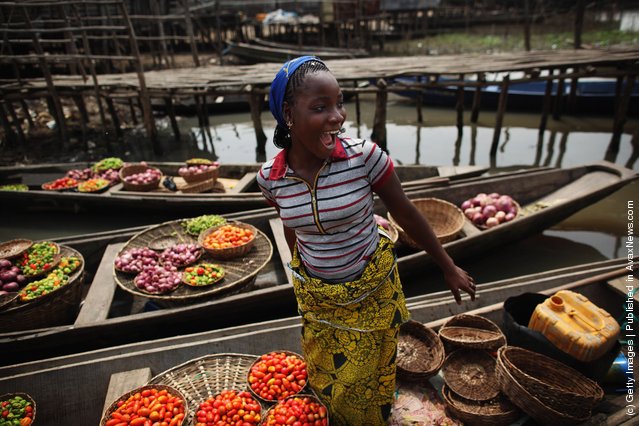
A girl laughs while unloading her boat of produce at a market in Ganvie, near Cotonou, Benin

A girl laughs while unloading her boat of produce at a market in Ganvie on January 6, 2012 in Cotonou, Benin. Often called the Venice of Africa, Ganvie is a stilted fishing village on Lake Nokoue, near Cotonou in Benin, the largest such village in Africa, and home to approximately 20,000 residents. (Photo by Dan Kitwood/Getty Images)
Details
09 Jan 2012 11:31:00
Models dressed as showgirls participates in a fashion show in front of the Welcome to Fabulous Las Vegas sign on the Las Vegas Strip to kick off the pro-mask wearing campaign “Mask Up for Nevada” put on by Experience Strategy Associates amid the spread of the coronavirus on June 25, 2020 in Las Vegas, Nevada. On Wednesday, Nevada Gov. Steve Sisolak signed a directive requiring people to wear face coverings in public places throughout the state beginning on June 26 in response to a four-week upward trend of new daily COVID-19 cases. (Photo by David Becker/Zuma Press)

Models dressed as showgirls participates in a fashion show in front of the Welcome to Fabulous Las Vegas sign on the Las Vegas Strip to kick off the pro-mask wearing campaign “Mask Up for Nevada” put on by Experience Strategy Associates amid the spread of the coronavirus on June 25, 2020 in Las Vegas, Nevada. On Wednesday, Nevada Gov. Steve Sisolak signed a directive requiring people to wear face coverings in public places throughout the state beginning on June 26 in response to a four-week upward trend of new daily COVID-19 cases. (Photo by David Becker/Zuma Press)
Details
28 Jun 2020 00:07:00
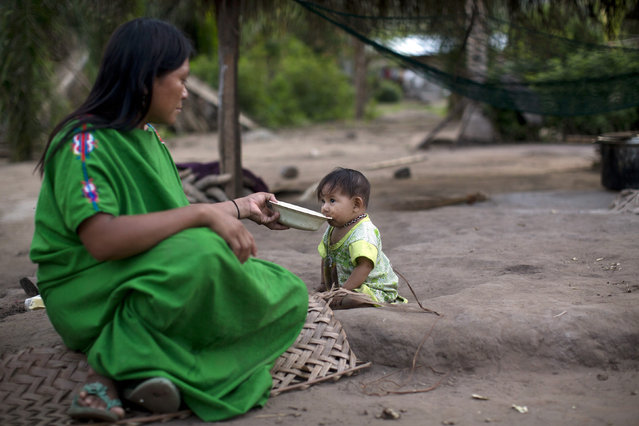
In this November 19, 2015 photo, Ester Melendez feeds banana porridge to her nine-month-old daughter Dina, in Pichiquia, an Ashaninka indigenous community in Peru's Junin region. Incursions and assaults by loggers, miners, colonists and leftist guerrillas have reduced the lands of the Ashaninka people in the Peruvian Amazon, leaving many of the 97,000 members of the group malnourished, despite efforts by the government and independent organizations to help. (Photo by Rodrigo Abd/AP Photo)

In this November 19, 2015 photo, Ester Melendez feeds banana porridge to her nine-month-old daughter Dina, in Pichiquia, an Ashaninka indigenous community in Peru's Junin region. Incursions and assaults by loggers, miners, colonists and leftist guerrillas have reduced the lands of the Ashaninka people in the Peruvian Amazon, leaving many of the 97,000 members of the group malnourished, despite efforts by the government and independent organizations to help. (Photo by Rodrigo Abd/AP Photo)
Details
10 Dec 2015 08:00:00
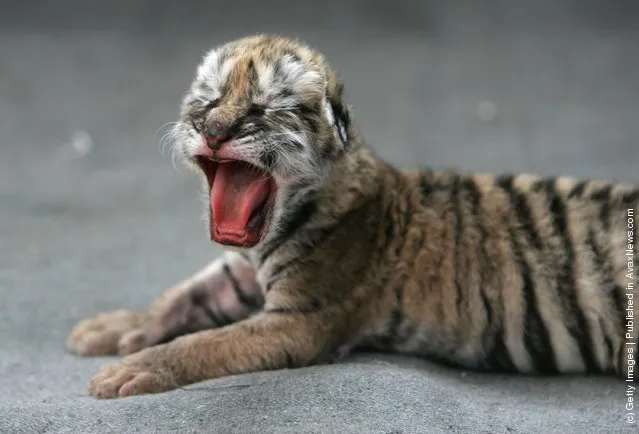
A Siberian tiger cub

A Siberian tiger cub is seen at the Hengdaohezi Breeding Center for Felidae on October 26, 2007 in Harbin of Heilongjiang Province, China. Established in 1986, the breeding center is one of the world's largest captive breeding base for Siberian tigers. Distributed throughout northeastern China, far eastern Russia and North Korea, over 400 Siberian tigers exist in the wild, approximately 20 in China. (Photo by China Photos/Getty Images)
Details
05 Nov 2011 13:34:00
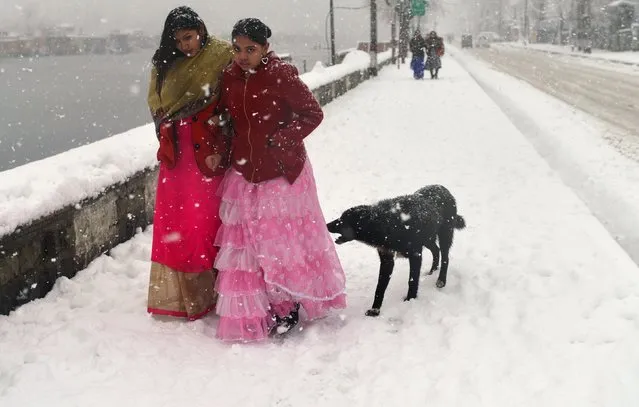
Indian tourists walks during heavy snowfall by Dal Lake in Srinagar on January 6, 2017. (Photo by Tauseef Mustafa/AFP Photo)

Indian tourists walks during heavy snowfall by Dal Lake in Srinagar on January 6, 2017. The sub-zero temperatures has frozen many water bodies in Kashmir and even drinking water taps have frozen at some places. (Photo by Tauseef Mustafa/AFP Photo)
Details
09 Jan 2017 12:32:00