Loading...
Done
This diver almost got sucked into the mouth of a massive whale shark as it feeds on plankton. But far from staring into the jaws of death – the shark, which are the  sea's largest fish, is actually vegetarian. The relieved diver escaped from the encounter unscathed and continued to  enjoy the presence of the incredibly docile animals. The stunning photograph, by Mauricio Handler, was taken during a feeding session where more than 600 of the huge creatures  gathered to feed on tuna spawn. (Photo by Mauricio Handler/Daily Mail/Solent)

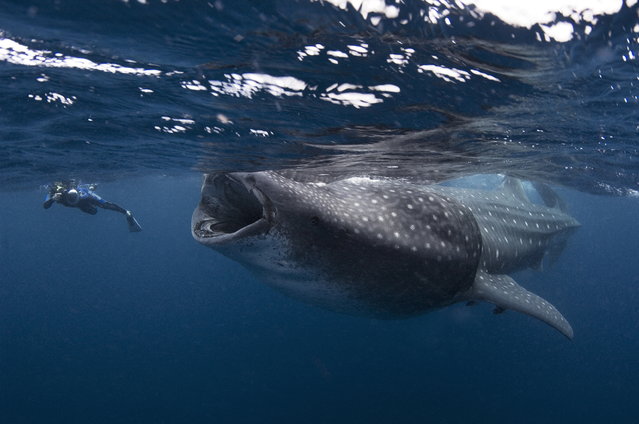
This diver almost got sucked into the mouth of a massive whale shark as it feeds on plankton. But far from staring into the jaws of death – the shark, which are the sea's largest fish, is actually vegetarian. The relieved diver escaped from the encounter unscathed and continued to enjoy the presence of the incredibly docile animals. The stunning photograph, by Mauricio Handler, was taken during a feeding session where more than 600 of the huge creatures gathered to feed on tuna spawn. (Photo by Mauricio Handler/Daily Mail/Solent)
Details
16 Feb 2014 12:23:00
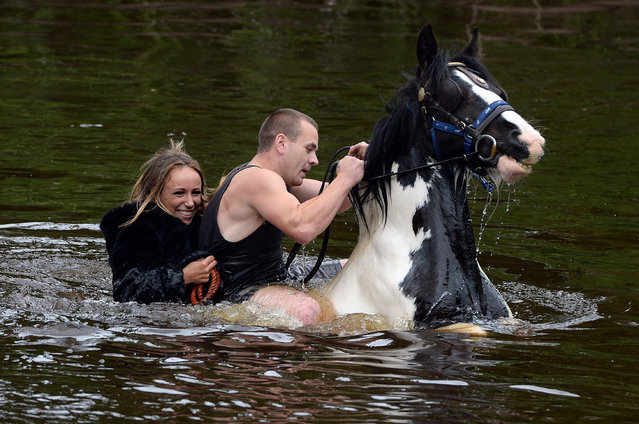
Travellers ride their horse through the river during the Appleby Horse Fair on June 5, 2014 in Appleby, England. The Appleby Horse Fair has existed under the protection of a charter granted by James II since 1685 and is one of the key gathering points for the Romany, gypsy and traveling community. The fair is attended by about 5,000 travellers who come to buy and sell horses. The animals are washed and groomed before being ridden at high speed along the “mad mile” for the viewing of potential buyers. (Photo by Nigel Roddis/Getty Images)

Travellers ride their horse through the river during the Appleby Horse Fair on June 5, 2014 in Appleby, England. The Appleby Horse Fair has existed under the protection of a charter granted by James II since 1685 and is one of the key gathering points for the Romany, gypsy and traveling community. The fair is attended by about 5,000 travellers who come to buy and sell horses. The animals are washed and groomed before being ridden at high speed along the “mad mile” for the viewing of potential buyers. (Photo by Nigel Roddis/Getty Images)
Details
15 Jun 2014 11:33:00
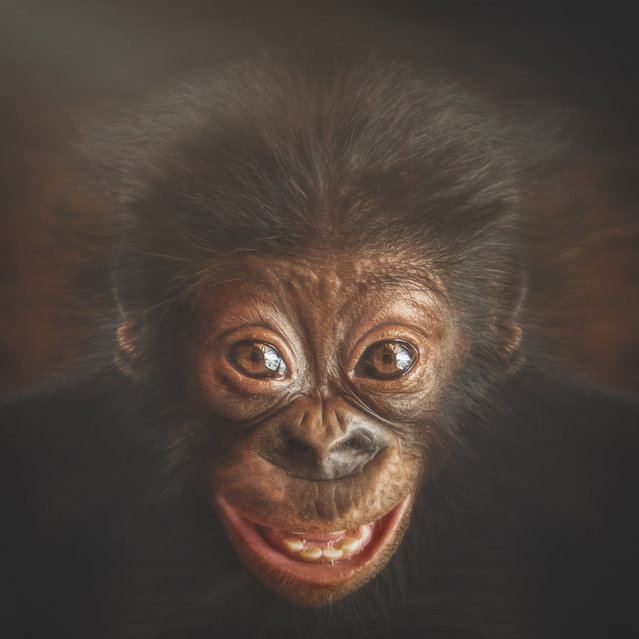
These portraits reveal the incredibly humanlike expressions of a variety of apes.Through piercing eyes and finite facial details, the intimate photographs show the animals looking angry, sad, delighted and pensive. They are the works of Manuela Kulpa – an IT consultant and keen photographer from near Cologne, Germany – who shot the apes predominantly at zoos across Austria, Belgium, the Czech Republic, Germany and the Netherlands. Here: Bonobo, Azibo. (Photo by Manuela Kulpa/Caters News)

These portraits reveal the incredibly humanlike expressions of a variety of apes.Through piercing eyes and finite facial details, the intimate photographs show the animals looking angry, sad, delighted and pensive. They are the works of Manuela Kulpa – an IT consultant and keen photographer from near Cologne, Germany – who shot the apes predominantly at zoos across Austria, Belgium, the Czech Republic, Germany and the Netherlands. Here: Bonobo, Azibo. (Photo by Manuela Kulpa/Caters News)
Details
26 Feb 2016 10:04:00
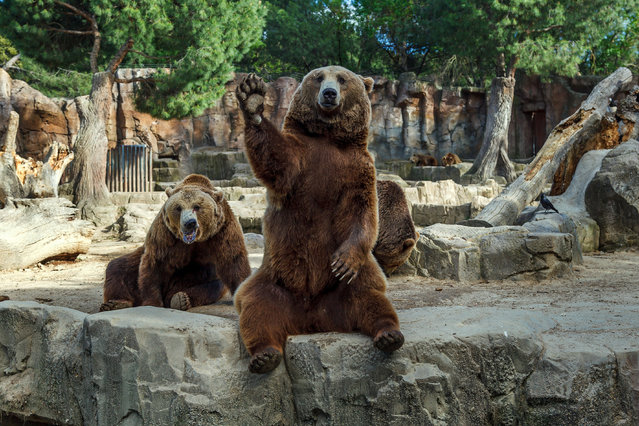
A photographer could bear-ly believe his eyes when a bear started waving at him. The friendly animal wandered to the front of his enclosure before sitting back in full view of zoo guests. He then lifts his powerful paw and excitedly waves in an almost human-like way at his new audience. The hilarious encounter was captured by keen photographer Andrey Slepnev, 31, while on a trip to Madrid Zoo, Spain on March 24, 2016. (Photo by Andrey Slepnev/Caters News)

A photographer could bear-ly believe his eyes when a bear started waving at him. The friendly animal wandered to the front of his enclosure before sitting back in full view of zoo guests. He then lifts his powerful paw and excitedly waves in an almost human-like way at his new audience. The hilarious encounter was captured by keen photographer Andrey Slepnev, 31, while on a trip to Madrid Zoo, Spain on March 24, 2016. (Photo by Andrey Slepnev/Caters News)
Details
11 Oct 2016 11:25:00
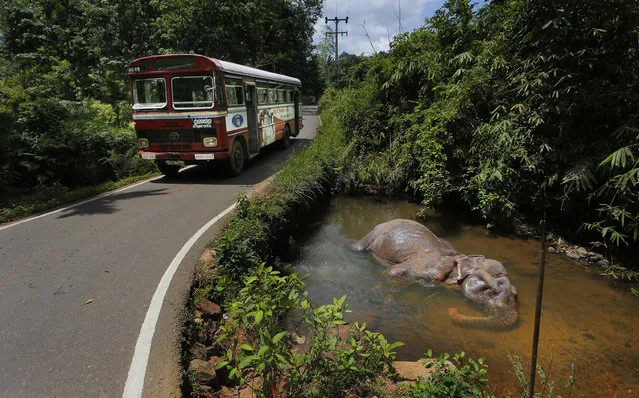
In this July 5, 2016 photo, a tamed elephant rests in a pool of water by a road in Baduraliya, a village outside Colombo, Sri Lanka. Even as the country cracks down on illegal ownership, the enduring demand for elephants has the government planning to set up its own pool of captive animals to be hired out to temples for ceremonies and maintained with budget funds. For Buddhists, who make up 70 percent of the island's 20 million population, elephants are believed to have been a servant of the Buddha and even a previous incarnation of the holy man himself. (Photo by Eranga Jayawardena/AP Photo)

In this July 5, 2016 photo, a tamed elephant rests in a pool of water by a road in Baduraliya, a village outside Colombo, Sri Lanka. Even as the country cracks down on illegal ownership, the enduring demand for elephants has the government planning to set up its own pool of captive animals to be hired out to temples for ceremonies and maintained with budget funds. (Photo by Eranga Jayawardena/AP Photo)
Details
04 Jan 2017 08:10:00
A fennec fox (Vulpes zerda) is groomed in a pet store in central Beijing. Native to the Sahara in North Africa, the species became a popular pet after being depicted as a character in Disney’s 2016 animated movie Zootopia. Individuals can cost between $2,000–$3,000. (Photo by Sean Gallagher/The Guardian)

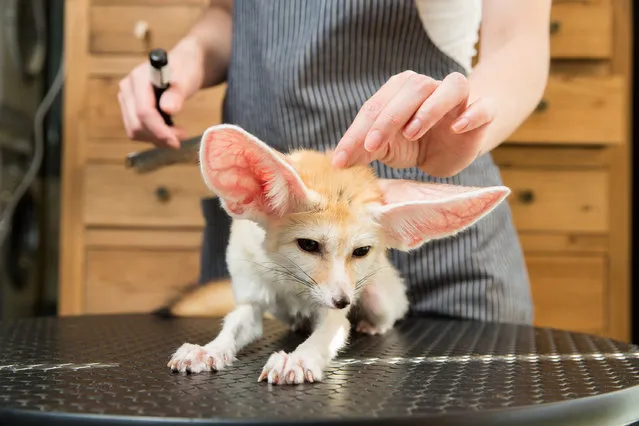
A dramatic rise in owning exotic pets in China is fuelling global demand for threatened species. The growing trade in alligators, snakes, monkeys, crocodiles and spiders is directly linked to species loss in some of the world’s most threatened ecosystems. Here: A fennec fox (Vulpes zerda) is groomed in a pet store in central Beijing. Native to the Sahara in North Africa, the species became a popular pet after being depicted as a character in Disney’s 2016 animated movie Zootopia. Individuals can cost between $2,000–$3,000. (Photo by Sean Gallagher/The Guardian)
Details
23 Sep 2017 08:04:00
In a photo taken on April 2, 2020 a staff member feeds a raccoon at the Table A Raccoon Cafe in Seoul. Business has been devastated by the coronavirus outbreak, with South Koreans staying at home under social distancing guidelines, and tourism disappearing. But unlike other firms, animal cafes have to stay open so that staff can look after their stock. (Photo by Ed Jones/AFP Photo)

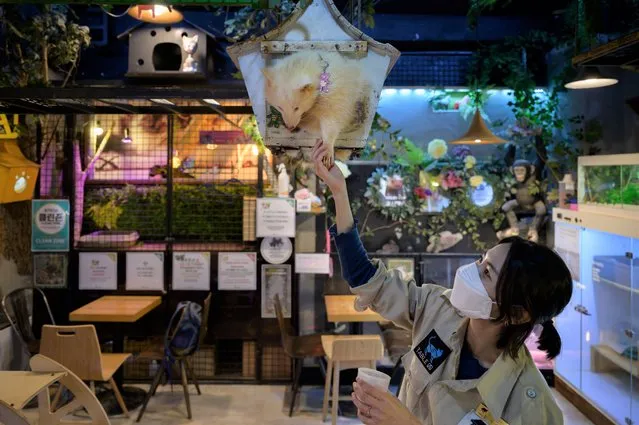
In a photo taken on April 2, 2020 a staff member feeds a raccoon at the Table A Raccoon Cafe in Seoul. Business has been devastated by the coronavirus outbreak, with South Koreans staying at home under social distancing guidelines, and tourism disappearing. But unlike other firms, animal cafes have to stay open so that staff can look after their stock. (Photo by Ed Jones/AFP Photo)
Details
13 Apr 2020 00:05:00
Animal rights activists protest in front of the Toennies meatpacking plant and slaughterhouse in Rheda-Wiedenbrueck, Germany, Saturday, June 20, 2020. Hundreds of new coronavirus cases are linked to the large meatpacking plant, officials ordered the closure of the slaughterhouse, as well as isolation and tests for everyone else who had worked at the Toennies site – putting about 7,000 people under quarantiner. (Photo by Friso Gentsch/dpa via AP Photo)

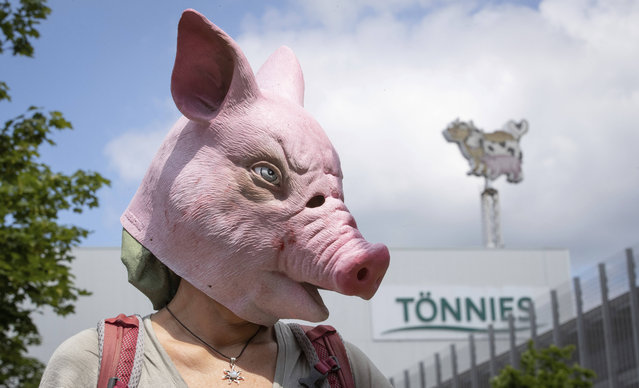
Animal rights activists protest in front of the Toennies meatpacking plant and slaughterhouse in Rheda-Wiedenbrueck, Germany, Saturday, June 20, 2020. Hundreds of new coronavirus cases are linked to the large meatpacking plant, officials ordered the closure of the slaughterhouse, as well as isolation and tests for everyone else who had worked at the Toennies site – putting about 7,000 people under quarantiner. (Photo by Friso Gentsch/dpa via AP Photo)
Details
22 Jun 2020 00:03:00