Loading...
Done
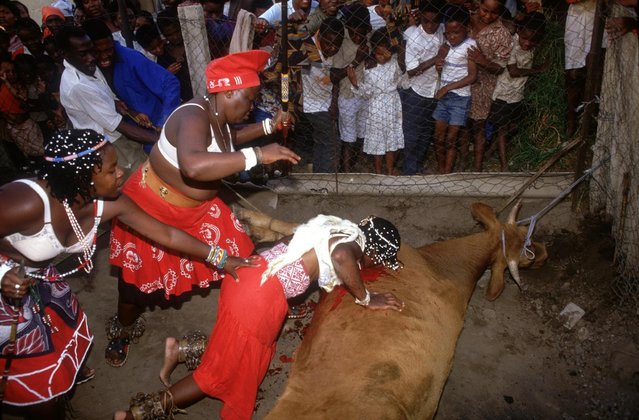
South African Sangomas are wizards and witches who are supposedly chosen by their ancestors to follow a traditional training and go through a rite of passage after which they become Sangomas and can cure and help people. They are so respected and trusted that western medical authorities have actually advised the government of South Africa to develop its cooperation with Sangomas in order to improve hygiene and health among the population. Today is graduation day for Trissa, 25, a Sangoma student in Tembisa, near Pretoria. Thanks to the help of the spirits of her ancestors, she has found a cow that had been hidden. The cow has then been killed by Sangoma Thelma and Trissa is now drinking its blood, thus becoming a Sangoma and changing her name to Nomadlozi. Location: Tembisa, near Pretoria, South Africa. (Photo by Patrick Durand/Sygma via Getty Images)

South African Sangomas are wizards and witches who are supposedly chosen by their ancestors to follow a traditional training and go through a rite of passage after which they become Sangomas and can cure and help people. They are so respected and trusted that western medical authorities have actually advised the government of South Africa to develop its cooperation with Sangomas in order to improve hygiene and health among the population. (Photo by Patrick Durand/Sygma via Getty Images)
Details
24 Feb 2017 00:05:00
A reveller wearing a bearskin costume poses during the Bearskin Parade in Comanesti, Romania, on December 30, 2022. More than two hundred “bears” and dozens of musicians, surrounded by police and tourists, took part in the end-of-the-year parade. Young men and women dressed in real bearskin and traditional costumes paraded to chase away the evil spirits of the coming year. In all regions of Romania similar events exist but it is in this historical region of Moldova that they are the most developed. Comanesti has become the centre, attracting more and more troupes of dancers every year. (Photo by Daniel Mihailescu/AFP Photo)

A reveller wearing a bearskin costume poses during the Bearskin Parade in Comanesti, Romania, on December 30, 2022. More than two hundred “bears” and dozens of musicians, surrounded by police and tourists, took part in the end-of-the-year parade. Young men and women dressed in real bearskin and traditional costumes paraded to chase away the evil spirits of the coming year. In all regions of Romania similar events exist but it is in this historical region of Moldova that they are the most developed. Comanesti has become the centre, attracting more and more troupes of dancers every year. (Photo by Daniel Mihailescu/AFP Photo)
Details
07 Mar 2024 06:20:00
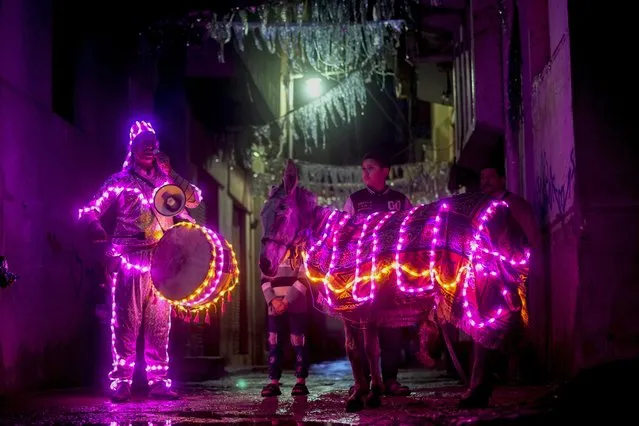
Mohammed El-Dahshan, 38-year-old “Mesaharati”, or dawn caller, accompanies his donkey wrapped with colored led lights to wake Muslims up for a meal before sunrise, during the Islamic holy month of Ramadan, in the Delta city of Dikernis, about 93 miles (150 km) North of Cairo, Egypt early Wednesday, April 12, 2023. Each night, El-Dahshan, sets out after midnight with his donkey banging his drum, chanting traditional religious phrases and calling out on residents by name to wake them in time for the vital pre-dawn meal known as “Suhour”. (Photo by Amr Nabil/AP Photo)

Mohammed El-Dahshan, 38-year-old “Mesaharati”, or dawn caller, accompanies his donkey wrapped with colored led lights to wake Muslims up for a meal before sunrise, during the Islamic holy month of Ramadan, in the Delta city of Dikernis, about 93 miles (150 km) North of Cairo, Egypt early Wednesday, April 12, 2023. Each night, El-Dahshan, sets out after midnight with his donkey banging his drum, chanting traditional religious phrases and calling out on residents by name to wake them in time for the vital pre-dawn meal known as “Suhour”. (Photo by Amr Nabil/AP Photo)
Details
15 May 2023 04:04:00
A young girl makes a “tomato angel” on a tomato covered street during the traditional tomato fight “Tomatina” during the fiestas in Bunol, Spain, 28 August 2013. This year's Tomatina is the first pay festival after Bunol's City Hall sold 15,000 tickets to take part in the tomato throwing. A total of 20,000 people, including 5,000 residents, will throw over 130,000 kg tomatoes. Local authorities decided to sell tickets this year to avoid the overcrowding in previous years in which over 50,000 people took part in the event. (Photo by Biel Alino/EPA)

A young girl makes a “tomato angel” on a tomato covered street during the traditional tomato fight “Tomatina” during the fiestas in Bunol, Spain, 28 August 2013. This year's Tomatina is the first pay festival after Bunol's City Hall sold 15,000 tickets to take part in the tomato throwing. A total of 20,000 people, including 5,000 residents, will throw over 130,000 kg tomatoes. Local authorities decided to sell tickets this year to avoid the overcrowding in previous years in which over 50,000 people took part in the event. (Photo by Biel Alino/EPA)
Details
29 Aug 2013 11:24:00
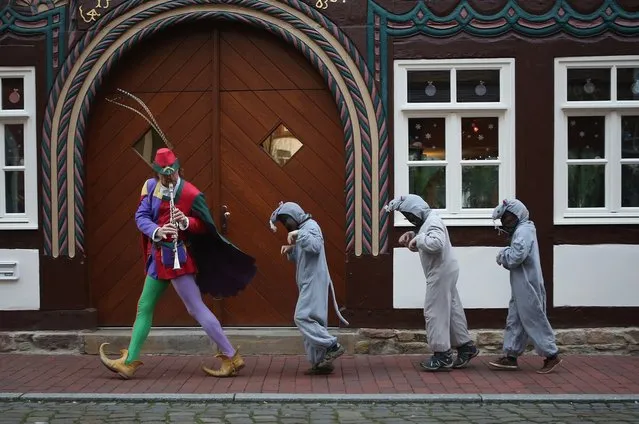
The Pied Piper of Hamelin, actually city tourism employee Michael Boyer, leads local children dressed as rats through a quiet street on November 19, 2012 in Hameln, Germany. The Pied Piper (in German: Der Rattenfaenger), is one of the many stories featured in the collection of fairy tales collected by the Grimm brothers, and the 200th anniversary of the first publication of the stories will take place this coming December 20th. Boyer, a U.S. citizen who has lived in Hameln for 15 years, and city children regularly perform a reenactment of the Pied Piper tale throughout the summer months. The Grimm brothers collected their stories from oral traditions in the region between Frankfurt and Bremen in the early 19th century, and the works include such global classics as Sleeping Beauty, Little Red Riding Hood, Rapunzel, Cinderella and Hansel and Gretel.  (Photo by Sean Gallup)

The Pied Piper of Hamelin, actually city tourism employee Michael Boyer, leads local children dressed as rats through a quiet street on November 19, 2012 in Hameln, Germany. The Pied Piper (in German: Der Rattenfaenger), is one of the many stories featured in the collection of fairy tales collected by the Grimm brothers, and the 200th anniversary of the first publication of the stories will take place this coming December 20th. Boyer, a U.S. citizen who has lived in Hameln for 15 years, and city children regularly perform a reenactment of the Pied Piper tale throughout the summer months. The Grimm brothers collected their stories from oral traditions in the region between Frankfurt and Bremen in the early 19th century, and the works include such global classics as Sleeping Beauty, Little Red Riding Hood, Rapunzel, Cinderella and Hansel and Gretel. (Photo by Sean Gallup)
Details
23 Nov 2012 11:48:00
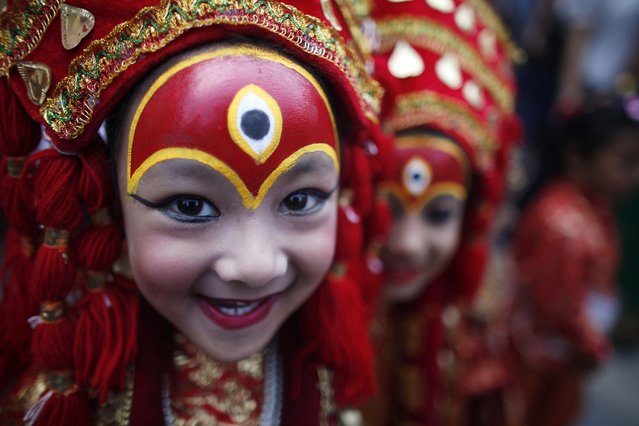
A young Nepalese girl dressed as a Kumari or living Goddess, smiles for camera as she waits for Kumari puja at Hanuman Dhoka, Basantapur Durbar Square in Katmandu, Nepal, Tuesday, Sept 17, 2013. More than hundred girls under the age of nine gathered for Kumari puja, a tradition of worshiping young pre-pubescent girls as manifestations of the divine female energy. The ritual holds a strong religious significance in Newar community. It is a community affair held primarily to save small girls from diseases and bad luck in the years to come. (AP Photo/Niranjan Shrestha)

The festival marks the end of the monsoon season and beginning of autumn. More than hundred girls under the age of nine gathered for the tradition of worshiping young pre-pubescent girls as manifestations of the divine female energy. The ritual holds a strong religious significance in Newar community. It is a community affair held primarily to save small girls from diseases and bad luck in the years to come. Photo: A young Nepalese girl dressed as a Kumari or living Goddess, smiles for camera as she waits for Kumari puja at Hanuman Dhoka, Basantapur Durbar Square in Katmandu, Nepal, Tuesday, September 17, 2013. (Photo by Niranjan Shrestha/AP Photo)
Details
18 Sep 2013 09:33:00
A man dressed up as the devil jumps over babies lying on a mattress in the street during “El Colacho”, the “baby jumping festival” in the village of Castrillo de Murcia, near Burgos on June 18, 2017. Baby jumping (El Colacho) is a traditional Spanish practice dating back to 1620 that takes place annually to celebrate the Catholic feast of Corpus Christi. During the act – known as El Salto del Colacho (the devil's jump) or simply El Colacho – men dressed as the Devil jump over babies born in the last twelve months of the year who lie on mattresses in the street. (Photo by Cesar Manso/AFP Photo)

A man dressed up as the devil jumps over babies lying on a mattress in the street during “El Colacho”, the “baby jumping festival” in the village of Castrillo de Murcia, near Burgos on June 18, 2017. Baby jumping (El Colacho) is a traditional Spanish practice dating back to 1620 that takes place annually to celebrate the Catholic feast of Corpus Christi. During the act – known as El Salto del Colacho (the devil's jump) or simply El Colacho – men dressed as the Devil jump over babies born in the last twelve months of the year who lie on mattresses in the street. (Photo by Cesar Manso/AFP Photo)
Details
20 Jun 2017 07:29:00
A dhobi, or a washerman washes cloths on the banks of the River Gomti in Lucknow, India, Saturday, September 12, 2020. Dhobis are traditional laundry workers who wash clothes by hand and dry them in the sun, an occupation which has been in existence for generations. Most cities in India have a Dhobi Ghat, or washermen's area, where the city's pile of clothes is laundered. This practice is still popular in India, despite of modern technology. Around 1,000 families work in Lucknow's Dhobi Ghat. However, in light of the novel coronavirus, their wages have decreased drastically. With each family earning around US$100-200 per month. (Photo by Rajesh Kumar Singh/AP Photo)

A dhobi, or a washerman washes cloths on the banks of the River Gomti in Lucknow, India, Saturday, September 12, 2020. Dhobis are traditional laundry workers who wash clothes by hand and dry them in the sun, an occupation which has been in existence for generations. Most cities in India have a Dhobi Ghat, or washermen's area, where the city's pile of clothes is laundered. This practice is still popular in India, despite of modern technology. Around 1,000 families work in Lucknow's Dhobi Ghat. However, in light of the novel coronavirus, their wages have decreased drastically. With each family earning around US$100-200 per month. (Photo by Rajesh Kumar Singh/AP Photo)
Details
25 Sep 2020 00:03:00