Loading...
Done
Wooden Churches - Travelling In The Russian North By Richard Davies Part 2

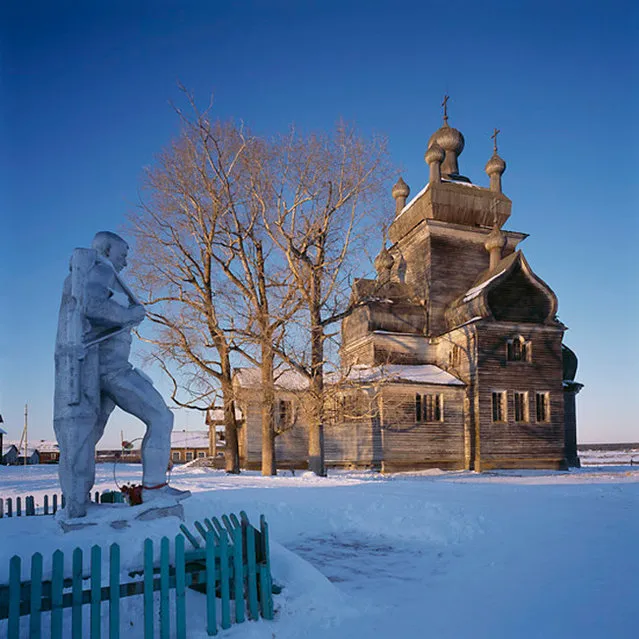
While communism, collectivism, worms, dry rot and casual looting failed to destroy the majestic wooden churches of Russia, it may be ordinary neglect that finally does them in. Dwindled now to several hundred remaining examples, these glories of vernacular architecture lie scattered amid the vastness of the world’s largest country. Just over a decade ago, Richard Davies, a British architectural photographer, struck out on a mission to record the fragile and poetic structures. Austerely beautiful and haunting, “Wooden Churches: Traveling in the Russian North” (White Sea Publishing; $132) is the result. Covering thousands of miles, Mr. Davies described how he and the writer Matilda Moreton tracked down the survivors from among the thousands of onion-domed structures built after Prince Vladimir converted to Christianity in 988.

See also: Wooden Churches Part1
Details
28 Nov 2013 12:13:00
Girls, who are part of Afghan Mobile Mini Circus for Children (MMCC), participate in a juggling competition in Kabul, Afghanistan August 12, 2015. (Photo by Ahmad Masood/Reuters)

Girls, who are part of Afghan Mobile Mini Circus for Children (MMCC), participate in a juggling competition in Kabul, Afghanistan August 12, 2015. The MMCC, founded by David Mason from Denmark, teaches cooperation and creativity to children scarred by years of war in Afghanistan. Despite the dangers, the project has grown so popular that it now runs centres in ten provinces and has hundreds of regular students. The circus makes visits to internally displaced persons' camps, schools, orphanages, and holds annual festivals. The children are taught the skills of juggling clubs, walking on stilts and acrobatics. (Photo by Ahmad Masood/Reuters)
Details
01 Sep 2015 12:47:00
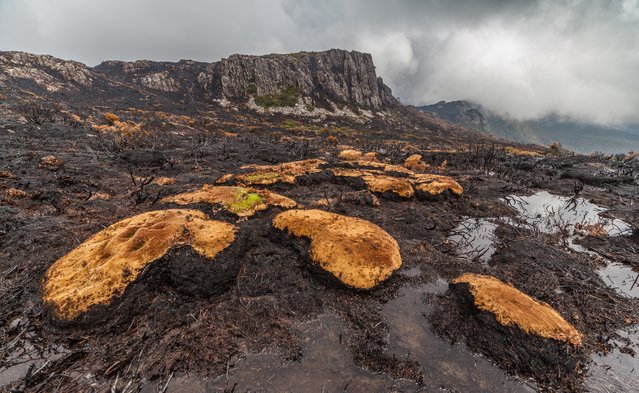
Pictures from Tasmania’s central plateau, shot by wilderness photographer Dan Broun, show the extraordinary damage wrought by more than a week of bushfires following lightning strikes in Australia’s southernmost state on January 13. 2016. The world heritage area was home to a range of unique alpine flora including pencil pines, king billy pines and cushion plants, some more than 1,000 years old. (Photo by Dan Broun)

Pictures from Tasmania’s central plateau, shot by wilderness photographer Dan Broun, show the extraordinary damage wrought by more than a week of bushfires following lightning strikes in Australia’s southernmost state on January 13. 2016. The world heritage area was home to a range of unique alpine flora including pencil pines, king billy pines and cushion plants, some more than 1,000 years old. Now more than 10,000ha of land has been incinerated, and ecologist say that, unlike eucalyptus trees, the ancient flora will not recover. (Photo by Dan Broun)
Details
02 Feb 2016 13:56:00
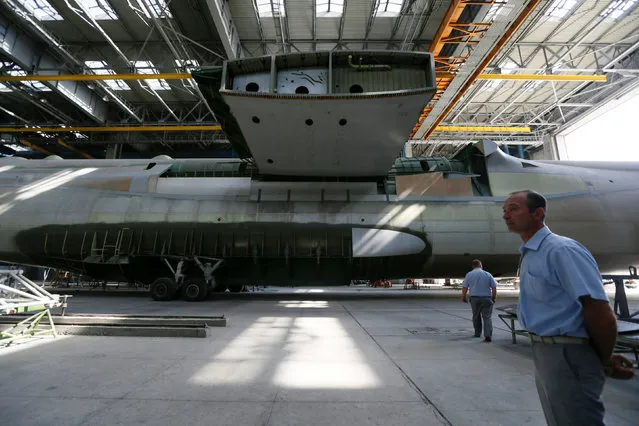
Employees stand near an airframe for the second Antonov-225 Mriya plane at Antonov aircraft plant in Kiev, Ukraine, September 7, 2016. Ukraine hopes to attract $500 million of investment from China to complete an updated version of the world's biggest aircraft, the Antonov-225 Mriya, the president of manufacturer Antonov said on Wednesday. The Antonov-225 is a cargo plane designed as part of the former Soviet Union's space programme. The only one completed is still in use and can carry up to 250 tonnes up to 4,000 km (2,485 miles). Work to manufacture a second plane was started in 1988 and never completed, but Antonov has now found a potential investor in the Aerospace Industry Corporation of China (AICC). (Photo by Valentyn Ogirenko/Reuters)

Employees stand near an airframe for the second Antonov-225 Mriya plane at Antonov aircraft plant in Kiev, Ukraine, September 7, 2016. Ukraine hopes to attract $500 million of investment from China to complete an updated version of the world's biggest aircraft, the Antonov-225 Mriya, the president of manufacturer Antonov said on Wednesday. (Photo by Valentyn Ogirenko/Reuters)
Details
08 Sep 2016 10:07:00
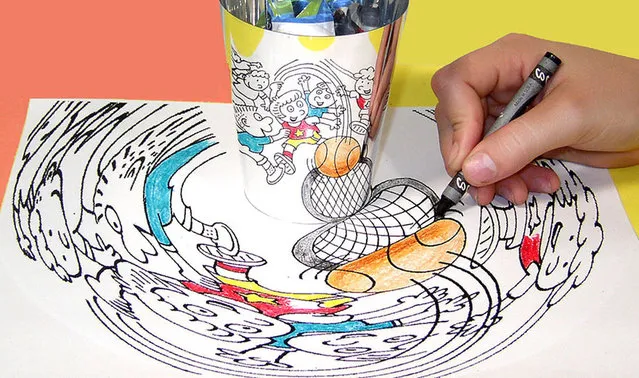
Anamorphic Art By Jonty Hurwitz

The truth can never be seen right away. Only by looking from a certain angle can we view the true nature of things. At other times, only with the help of some special object can we discern order in chaos. Anamorphosis is a form of art that allows us to see an object only by viewing it from a certain angle or by using cylindrical or conical mirror. Unsurprisingly, the first person in history to ever use this type of technique was the Leonardo Da Vinci. During late Renaissance period this technique was popularized as a children’s toy. Now, however, few people use this form of imagery due to its intricacy. Istvan Orosz, born in 1951, is one of the few people who specialize in anamorphosis. In our opinion, his most stunning piece of art is the one where a shipwreck scene turns into a portrait when viewed through a cylindrical mirror. (Photo by Jonty Hurwitz)
Details
05 Jan 2015 13:07:00
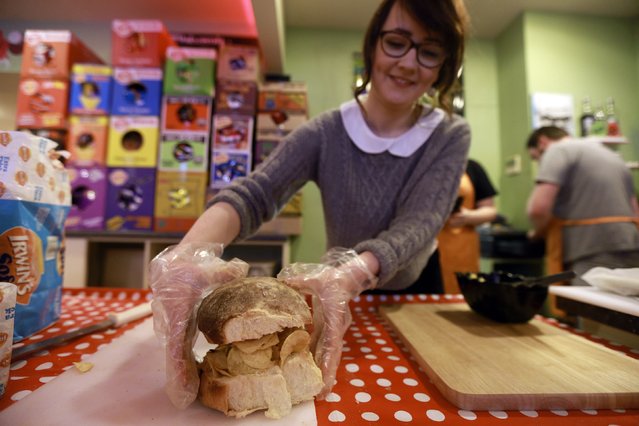
A member of staff prepares herself a crisp sandwich in the Simply Crispy sandwich cafe in Belfast, northern Ireland January 12, 2015. The sandwich shop which opened on Monday is the world's first crisp sandwich cafe, local media reported. The idea of a crisp sandwich cafe started as a joke article on a website called Ulster Fry.(Photo by Cathal McNaughton/Reuters)

A member of staff prepares herself a crisp sandwich in the Simply Crispy sandwich cafe in Belfast, northern Ireland January 12, 2015. The sandwich shop which opened on Monday is the world's first crisp sandwich cafe, local media reported. The idea of a crisp sandwich cafe started as a joke article on a website called Ulster Fry. The hilarious piece poked fun at recent ridiculous foody trends like the cereal café that opened in London last year. What was once a satirical joke has now become reality, after Belfast cafe owner Andrew McMenamin decided to make it happen. Customers will be able to choose their bread and crisps and add cheese or ham to their sandwich, which will be served with soup and chips. (Photo by Cathal McNaughton/Reuters)
Details
13 Jan 2015 13:41:00
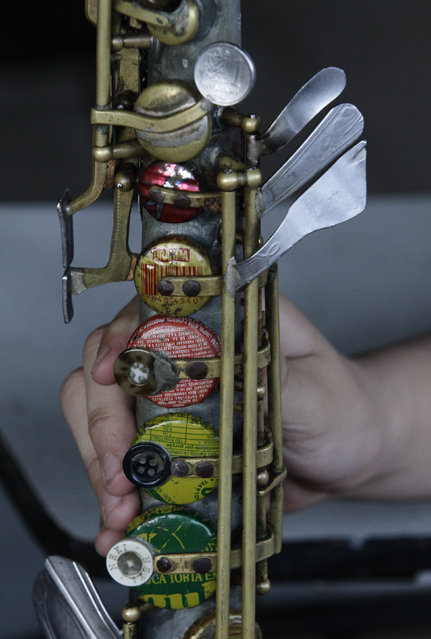
A student of the Orchestra of Recycled Instruments of Cateura holds an instrument made from recycled material by craftsman Nicolas Gomez, in Cateura, near Asuncion, May 9, 2013. The orchestra is the brainchild of its conductor Favio Chavez, who wanted to help the children of garbage pickers at the local landfill, and the instruments are made from salvaged materials by craftsman Gomez. (Photo by Jorge Adorno/Reuters)

A student of the Orchestra of Recycled Instruments of Cateura holds an instrument made from recycled material by craftsman Nicolas Gomez, in Cateura, near Asuncion, May 9, 2013. The orchestra is the brainchild of its conductor Favio Chavez, who wanted to help the children of garbage pickers at the local landfill, and the instruments are made from salvaged materials by craftsman Gomez. The orchestra now involves 30 schoolchildren who have toured countries in Latin America, North America and Europe to play music ranging from Beethoven and Mozart to the Beatles and Paraguayan folk songs. (Photo by Jorge Adorno/Reuters)
Details
12 Jul 2013 09:23:00
During the recession and looking for work she began sketching birds on the inside of books, seeing the practice as a creative way to mutate the pages into something fresh. Bluebird drawing on an AT&T bill. (Photo by Paula Swisher/Caters News)

“Artist Paula Swisher has come up with a quirky way of lessening the stress of household bills - by doodling highly intricate birds on each one. Swisher, 37, has drawn hundreds of birds in her lifetime and puts her love of ornithology down to the nature walks she went on as a youngster. Looking for work during the recession, she began sketching birds on the inside of books, seeing the practice as a creative way to mutate the pages into something fresh. But now she's made the transition from books to bills – while admittedly making a playful commentary on the predatory banking businesses”. – Caters News. (Photo by Paula Swisher/Caters News)
Details
02 May 2014 11:36:00