Revelers celebrate during fireworks marking the start of the New Year on Copacabana beach on January 1, 2017 in Rio de Janeiro, Brazil. (Photo by Mario Tama/Getty Images)
Noah, 10, cools himself off in his garden during hot weather in Hertford, Britain, June 25, 2020. The UK is experiencing a summer heatwave, with temperatures in many parts of the country expected to rise above 30°C and weather warnings in place for thunderstorms at the end of the week. (Photo by Andrew Couldridge/Reuters)
Participants pose for photographs as they take part in a “Hat Walk” during London Hat Week in London, Britain on April 7, 2019. (Photo by Simon Dawson/Reuters)
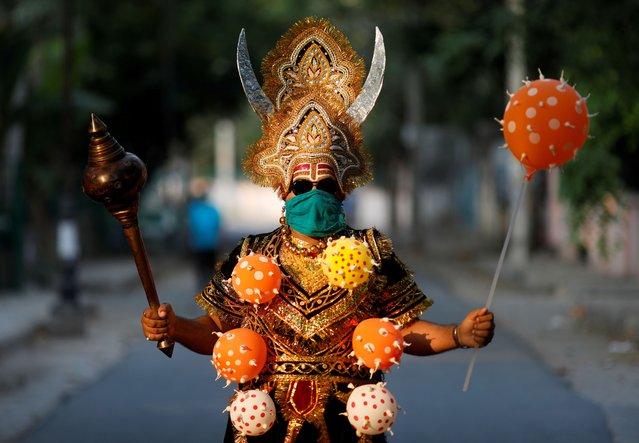
A local resident dressed as Yamraj or Hindu god of death, wearing a novel coronavirus-themed balloon necklace, gestures as he poses during an awareness about social distancing and staying at home organised by Delhi police during a nationwide lockdown to slow the spreading of the coronavirus disease (COVID-19), in New Delhi, India, April 28, 2020. (Photo by Adnan Abidi/Reuters)
Ethnic Miao women wearing traditional costumes take part in a parade during the traditional Lusheng (reed-pipe wind instrument) festival in Gulong, Guizhou province, China November 15, 2017. (Photo by Reuters/China Stringer Network)
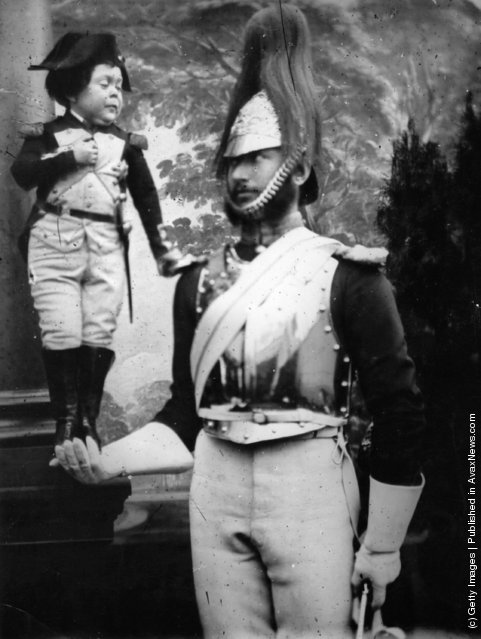
“Tom Thumb is a character of English folklore. The History of Tom Thumb was published in 1621, and has the distinction of being the first fairy tale printed in English. Tom is no bigger than his father's thumb, and his adventures include being swallowed by a cow, tangling with giants, and becoming a favourite of King Arthur. The earliest allusions to Tom occur in various 16th century works such as Reginald Scot's Discovery of Witchcraft (1584) where Tom is cited as one of the supernatural folk employed by servant maids to frighten children”. – Wikipedia
Photo: Portrait of the dwarf, Tom Thumb standing on the hand of a Guardsman. Charles Sherwood Stratton (1838 – 1883) was nicknamed General Tom Thumb by P T Barnum, the circus owner. (Photo by London Stereoscopic Company/Getty Images). Circa 1875
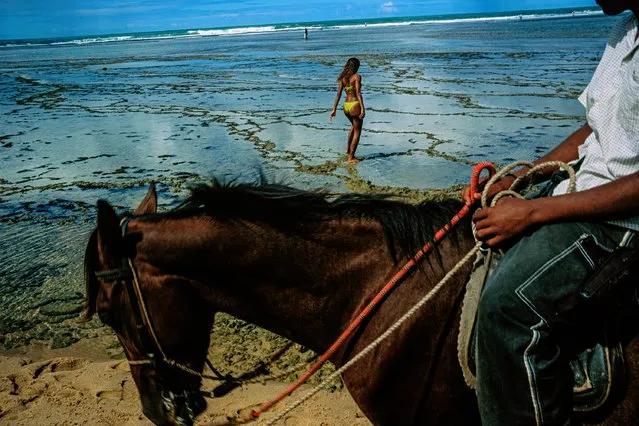
Praia du Forte, Bahia. “This was the lead picture for a National Geographic story on Bahia, because it was both mysterious as well as a “geography” picture showing where the slaves arrived from Nigeria. Beach pictures seem like they should be easy to take, but for me they are actually quite difficult. Too easy to fall into cliche. When I saw the kid coming on the horse, I quickly ran to see if I could make something with a woman in a bikini that was not a bikini shot”. (Photo by David Alan Harvey/The Guardian)