Loading...
Done
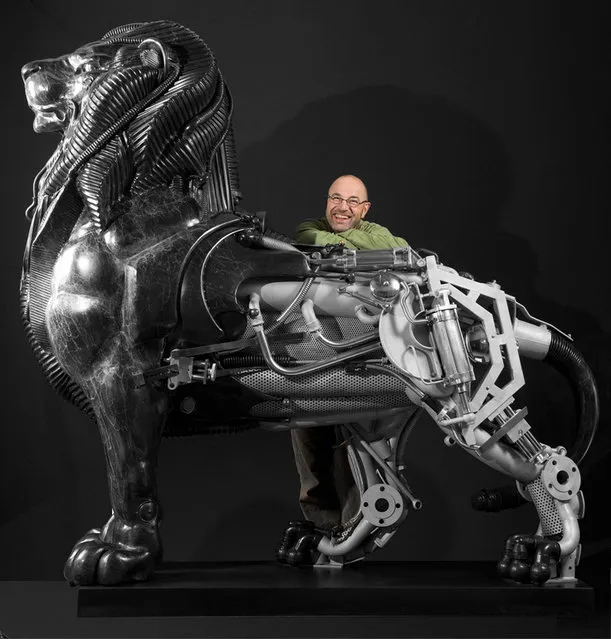
Steampunk Sculptures By Pierre Matter

French sculptor Pierre Matter was born in 1964. “A mystical child, then a tormented teenager, he studied mathematics half-heartedly. It was only logical that he headed naturally, though initially in an erratic manner, for the mysterious universe of artistic creation. His slow progression in this field led him to try out many kinds of expression and material, from oil to gouache to ink, from comic strips to canvas, and also bas-relief in stone.”
Details
14 Aug 2013 15:28:00
Coal Mining In India's Jharia

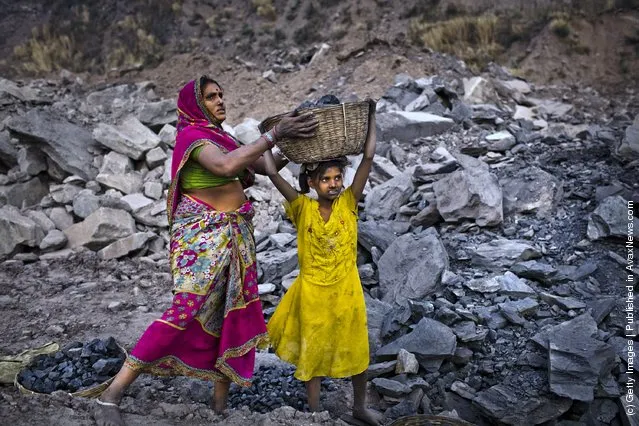
7 year old Soni has a basket of coal lifted onto her head by her mother, 28 year old Savita, after having scavenged coal illegally from an open-cast coal mine in the village of Bokapahari on February 08, 2012 near to Jharia, India. (Photo by Daniel Berehulak /Getty Images)
Details
15 Feb 2012 11:06:00


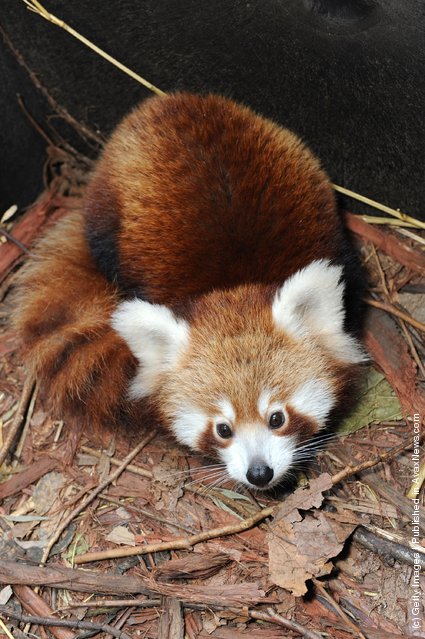
“The red panda (Ailurus fulgens, or shining-cat), is a small arboreal mammal native to the eastern Himalayas and southwestern China. It is the only species of the genus Ailurus. Slightly larger than a domestic cat, it has reddish-brown fur, a long, shaggy tail, and a waddling gait due to its shorter front legs. It feeds mainly on bamboo, but is omnivorous and may also eat eggs, birds, insects, and small mammals. It is a solitary animal, mainly active from dusk to dawn, and is largely sedentary during the day”. – Wikipedia

Photo: In this handout image provided by Taronga Zoo, Seba, a baby Red Panda, explores his new home at Taronga Zoo on April 7, 2011 in Sydney, Australia. The Red Panda cub was born at Christmas and is the 45th to be born at the zoo since 1977. (Photo by Peter Hardin/Taronga Zoo via Getty Images)
Details
07 Apr 2011 08:51:00
Professional wrestler Cristal (Crystal) poses for a photograph in her trainig place on February 09, 2018 in Mexico city, Mexico. (Photo by Omar Torres/AFP Photo)

To mark the occasion of International Women' s Day on March 8, 2018 AFP presents a series of photos depicting women performing roles or working in professions more traditionally held by men. Here: Professional wrestler Cristal (Crystal) poses for a photograph in her trainig place on February 09, 2018 in Mexico city, Mexico. (Photo by Omar Torres/AFP Photo)
Details
12 Mar 2018 00:01:00
Spectacular images offering insight into the lives of the Huaorani people in the Ecuadorian Amazon have been revealed showing how they use traditional methods to hunt monkeys for food. The stunning pictures were taken by conservation photographer Pete Oxford from Torquay, Devon in the Ecuadorian Amazon. “The Huaorani Indians are a forest people highly in tune with their environment. Many are now totally acculturated since the 1950s by missionaries”, said Pete. “Today they face radical change to their culture to the proximity of oil exploration within their territory and the Yasuni National Park and Biosphere Reserve, they are vastly changed. Some still live very traditionally and for this shoot, through my Huaorani friend, a direct relative of those photographed he wanted to depict them as close to their original culture as possible. They still largely hunt with blow pipes and spears eating a lot of monkeys and peccaries”. The Huaorani are also known as the Waorani, Waodani or the Waos and are native Amerindians. Their lands are located between the Curaray and Napo rivers and speak the Huaorani language. Pete says that during his visit he was welcomed into the group and hopes that ancient cultures can be saved. Here: The tribe were seen celebrating after a hunter returned to camp with a wild pig. (Photo by Pete Oxford/Mediadrumworld.com)

Spectacular images offering insight into the lives of the Huaorani people in the Ecuadorian Amazon have been revealed showing how they use traditional methods to hunt monkeys for food. The stunning pictures were taken by conservation photographer Pete Oxford from Torquay, Devon in the Ecuadorian Amazon. Here: The tribe were seen celebrating after a hunter returned to camp with a wild pig. (Photo by Pete Oxford/Mediadrumworld.com)
Details
20 Jan 2017 07:58:00
An adorable baby owl has proved to be a real heart-breaker thanks to its heart-shaped head. Although Griffin the Lesser Sooty Owl might look like a feather duster, the tiny eight-week old chick will soon be ready to fly. And the heart outline that surrounds his giant eyes and beak means he is set to be the star of the bird show at Taronga Zoo, Sydney. (Photo by Caters News Agency)

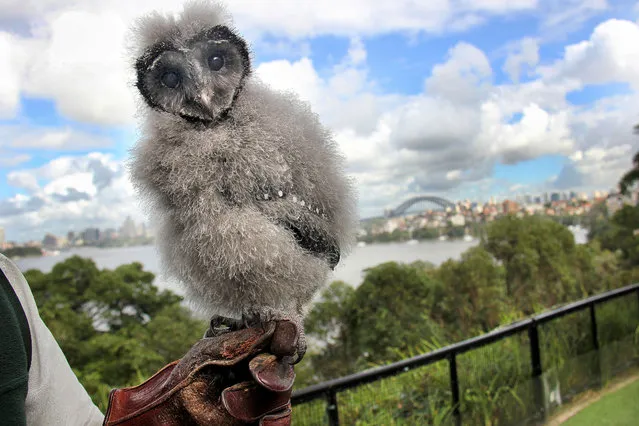
An adorable baby owl has proved to be a real heart-breaker thanks to its heart-shaped head. Although Griffin the Lesser Sooty Owl might look like a feather duster, the tiny eight-week old chick will soon be ready to fly. And the heart outline that surrounds his giant eyes and beak means he is set to be the star of the bird show at Taronga Zoo, Sydney. (Photo by Caters News Agency)
Details
16 May 2015 13:51:00
Men cover their heads from the sun while riding on a motorcycle during a hot day in Cairo, Egypt, August 17, 2015. A heatwave killed at least 61 people across Egypt from Sunday to Tuesday and caused nearly 600 people to be admitted to hospital, Egypt's health ministry said on state news agency MENA on Wednesday. (Photo by Amr Abdallah Dalsh/Reuters)

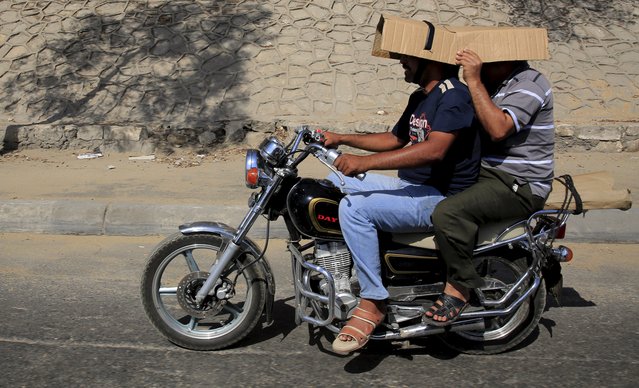
Men cover their heads from the sun while riding on a motorcycle during a hot day in Cairo, Egypt, August 17, 2015. A heatwave killed at least 61 people across Egypt from Sunday to Tuesday and caused nearly 600 people to be admitted to hospital, Egypt's health ministry said on state news agency MENA on Wednesday. (Photo by Amr Abdallah Dalsh/Reuters)
Details
18 Aug 2015 13:47:00
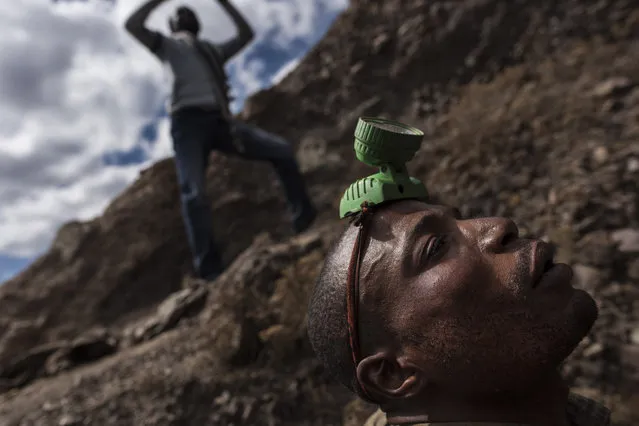
A “creuseur”, or digger, a plastic lantern on his head, readies to enter a copper and cobalt mine in Kawama, Democratic Republic of Congo on June 8, 2016. Cobalt is used in the batteries for electric cars and mobile phones. Working conditions are dangerous, often with no safety equipment or structural support for the tunnels. The diggers say they are paid on average US$2-3/day. (Photo by Michael Robinson Chavez/The Washington Post)

A “creuseur”, or digger, a plastic lantern on his head, readies to enter a copper and cobalt mine in Kawama, Democratic Republic of Congo on June 8, 2016. Cobalt is used in the batteries for electric cars and mobile phones. Working conditions are dangerous, often with no safety equipment or structural support for the tunnels. The diggers say they are paid on average US$2-3/day. (Photo by Michael Robinson Chavez/The Washington Post)
Details
30 Dec 2016 10:29:00