Loading...
Done
Simon – a friendly fox, who often approaches tourists in the exclusion zone, asking for food. (Photo by Vladimir Mitgutin/Caters News Agency)

This fascinating photo series looks at the bleak isolation of Chernobyl as never before. Employing infrared filters, photographer Vladimir Mitgutin is able to bring out details of decay – an abandoned bus, a radar system, an amusement park, a doll, a sports hall, a piano – frozen in time. Here: Simon – a friendly fox, who often approaches tourists in the exclusion zone, asking for food. (Photo by Vladimir Mitgutin/Caters News Agency)
Details
12 Feb 2018 00:02:00
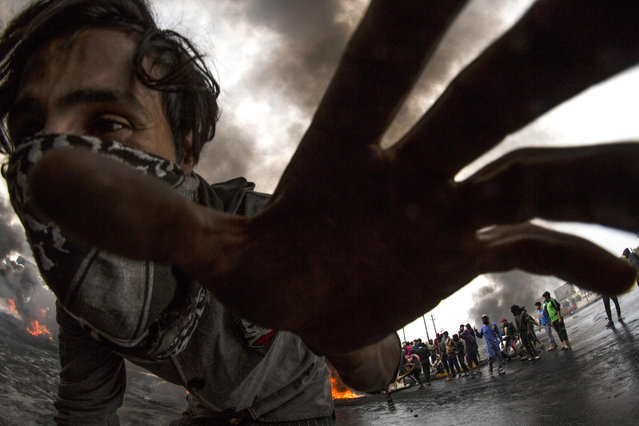
An Iraqi demonstrator runs as others burn tyres to cut-off roads in the southern city of Basra on November 25, 2019. (Photo by Hussein Faleh/AFP Photo)

An Iraqi demonstrator runs as others burn tyres to cut-off roads in the southern city of Basra on November 25, 2019. (Photo by Hussein Faleh/AFP Photo)
Details
27 Nov 2019 00:07:00
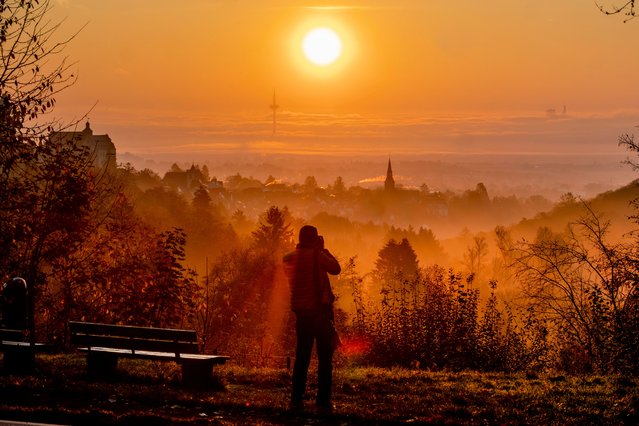
A photographer takes pictures as the sun rises over the city of Kronberg near Frankfurt, Germany, Monday, November 4, 2024. (Photo by Michael Probst/AP Photo)

A photographer takes pictures as the sun rises over the city of Kronberg near Frankfurt, Germany, Monday, November 4, 2024. (Photo by Michael Probst/AP Photo)
Details
02 Jan 2025 03:18:00
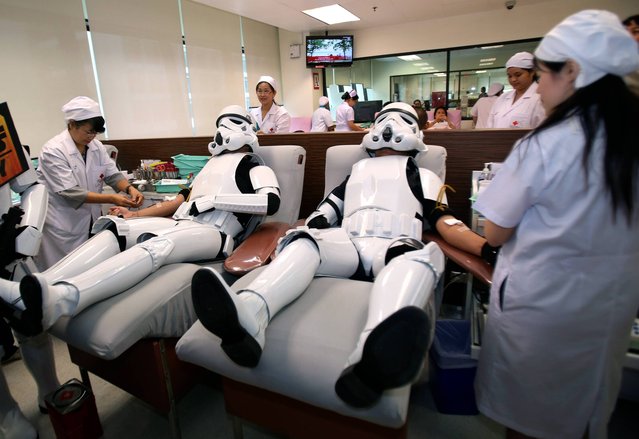
Udomsak Ratanotayo, left, and Suttinan Boonsomkiat wear storm trooper costumes while donating blood at the Thai Red Cross in Bangkok, Thailand on Monday, April 28, 2014. Thai Star Wars fans will donate blood and give toys at an orphanage as part of a promotional campaign. (Photo by Sakchai Lalit/AP Photo)

Udomsak Ratanotayo, left, and Suttinan Boonsomkiat wear storm trooper costumes while donating blood at the Thai Red Cross in Bangkok, Thailand on Monday, April 28, 2014. Thai Star Wars fans will donate blood and give toys at an orphanage as part of a promotional campaign. (Photo by Sakchai Lalit/AP Photo)
Details
03 May 2014 15:21:00
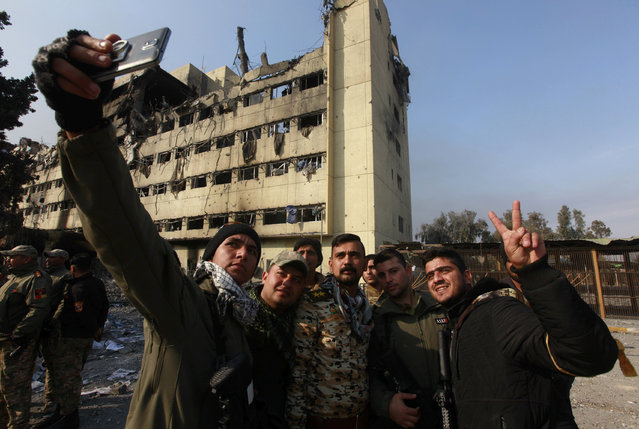
Iraqi rapid response forces take a selfie picture outside a hospital damaged by clashes during a battle between Iraqi forces and Islamic State militants in the Wahda district of eastern Mosul, Iraq, January 8, 2017. (Photo by Alaa Al-Marjani/Reuters)

Iraqi rapid response forces take a selfie picture outside a hospital damaged by clashes during a battle between Iraqi forces and Islamic State militants in the Wahda district of eastern Mosul, Iraq, January 8, 2017. (Photo by Alaa Al-Marjani/Reuters)
Details
09 Jan 2017 11:58:00
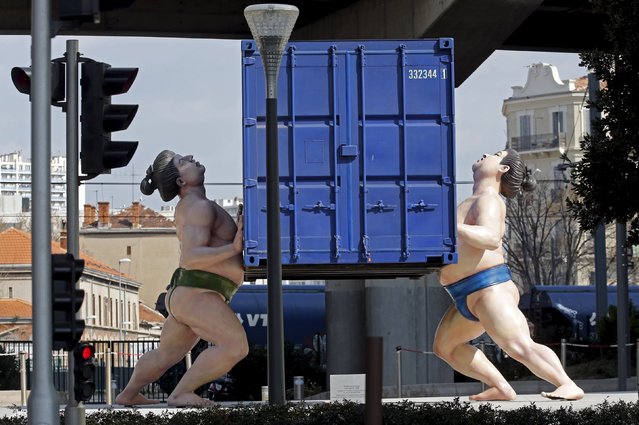
The sculpture “It Takes Two to Tango” by Scottish sculptor David Mach is seen in front of the headquarters of the CMA-CGM shipping company office tower in the port of Marseille, France, March 15, 2016. (Photo by Jean-Paul Pelissier/Reuters)

The sculpture “It Takes Two to Tango” by Scottish sculptor David Mach is seen in front of the headquarters of the CMA-CGM shipping company office tower in the port of Marseille, France, March 15, 2016. (Photo by Jean-Paul Pelissier/Reuters)
Details
16 Mar 2016 14:20:00
Children of Indian laborers play on make-shift swings in Amritsar, India, May 12, 2015. (Photo by Narinder Nanu/AFP Photo)

Children of Indian laborers play on make-shift swings in Amritsar, India, May 12, 2015. (Photo by Narinder Nanu/AFP Photo)
Details
16 May 2015 12:12:00
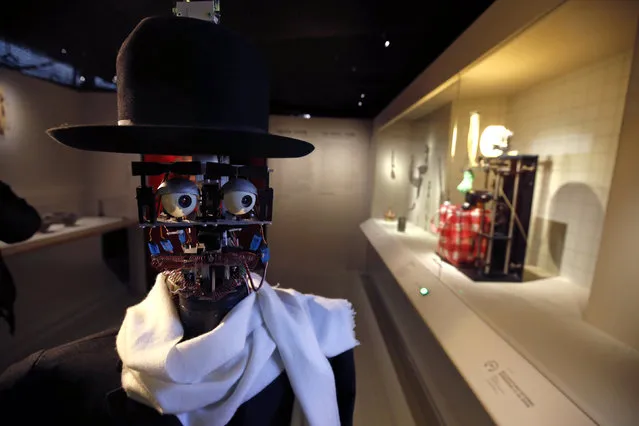
The Berenson robot strolls among visitors during the exhibition “Persona : Oddly Human” at the Quai Branly museum in Paris, France, February 23, 2016. The Berenson robot, developed in France in 2011, is the brainchild of anthropologist Denis Vidal and robotics engineer Philippe Gaussier. Its programming allows it to record reactions of museum visitors to certain pieces of art and then use the data to develop its own unique taste, which allows “Berenson” to judge whether or not it likes a certain work of art within an exhibition. (Photo by Philippe Wojazer/Reuters)

The Berenson robot strolls among visitors during the exhibition “Persona : Oddly Human” at the Quai Branly museum in Paris, France, February 23, 2016. The Berenson robot, developed in France in 2011, is the brainchild of anthropologist Denis Vidal and robotics engineer Philippe Gaussier. Its programming allows it to record reactions of museum visitors to certain pieces of art and then use the data to develop its own unique taste, which allows “Berenson” to judge whether or not it likes a certain work of art within an exhibition. (Photo by Philippe Wojazer/Reuters)
Details
25 Feb 2016 12:26:00