Loading...
Done
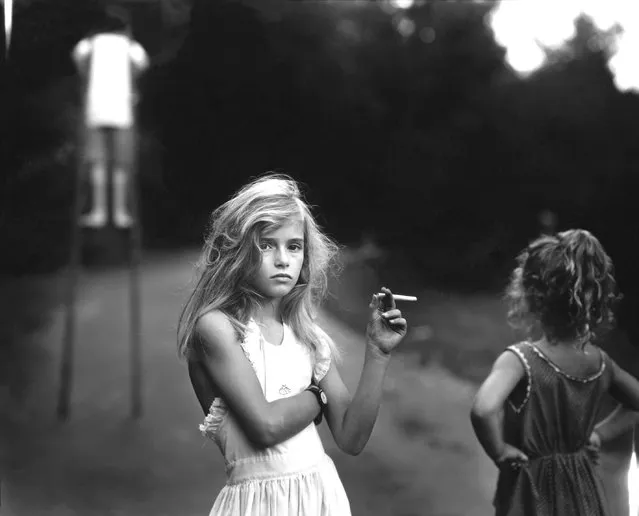
Candy Cigarette, 1989. (Photo by Sally Mann)

“Sally Mann (born in Lexington, Virginia, 1951) is one of America’s most renowned photographers. She has received numerous awards, including NEA, NEH, and Guggenheim Foundation grants, and her work is held by major institutions internationally. Her many books include Second Sight (1983), At Twelve (1988), Immediate Family (1992), Still Time (1994), What Remains (2003), Deep South (2005), Proud Flesh (2009), and The Flesh and the Spirit (2010). A feature film about her work, What Remains, debuted to critical acclaim in 2006. Mann is represented by Gagosian Gallery, New York. She lives in Virginia”.

Photo: Candy Cigarette, 1989. (Photo by Sally Mann)
Details
28 Apr 2012 11:32:00
Brimham rocks, Nidderdale North Yorkshire, England

“A balancing rock, also called balanced rock or precarious boulder, is a naturally occurring geological formation featuring a large rock or boulder, sometimes of substantial size, resting on other rocks, bedrock or on glacial till. Some formations known by this name only appear to be balancing but are in fact firmly connected to a base rock by a pedestal or stem”. – Wikipedia

Photo: “The Brimham Rocks are balancing rock formations located on Brimham Moor in North Yorkshire, England. The rocks stand at a height of nearly 30 metres in an area owned by the National Trust which is part of the Nidderdale Area of Outstanding Natural Beauty”. – Wikipedia. (Photo by Tee Time Tony)
Details
06 May 2012 11:45:00
Is it a leaf? Is it tree bark? No, it’s the Satanic leaf-tailed gecko. Cleverly disguised as a rotting leaf, Madagascar’s camouflage king has red eyes, pointy horns and a taste for night hunting: it’s nature’s most devilish deceiver. (Photo by Thomas Marent/ARDEA)

Is it a leaf? Is it tree bark? No, it’s the Satanic leaf-tailed gecko. Cleverly disguised as a rotting leaf, Madagascar’s camouflage king has red eyes, pointy horns and a taste for night hunting: it’s nature’s most devilish deceiver. The twisted body and veiny skin echo the detail of a dry leaf, which ensures the gecko blends in with its forest home. The mottled tail appears to have sections missing, as though it has withered over time. This mini-monster epitomises survival of the fittest, having adapted gradually to become today’s extraordinary leaf impersonator. (Photo by Thomas Marent/ARDEA)
Details
20 Nov 2015 08:03:00
Passengers hold 500 (bottom) rupee banknotes to buy train tickets at a railway booking counter in Allahabad, India, November 9, 2016. (Photo by Jitendra Prakash/Reuters)

Passengers hold 500 (bottom) rupee banknotes to buy train tickets at a railway booking counter in Allahabad, India, November 9, 2016. People are queuing up outside banks across India to exchange 500 and 1,000 rupee notes after they were withdrawn as part of anti-corruption measures. Indians will be able to exchange their old notes, which stopped being legal tender at midnight on Tuesday, for new ones at banks until 30 December. The surprise move is part of a government crackdown on corruption and illegal cash holdings. Banks were shut on Wednesday to allow them enough time to stock new notes. There are also limits on cash withdrawals from ATMs. The BBC's Yogita Limaye in Mumbai says there have been chaotic scenes outside many banks. (Photo by Danish Siddiqui/Reuters)
Details
10 Nov 2016 12:10:00
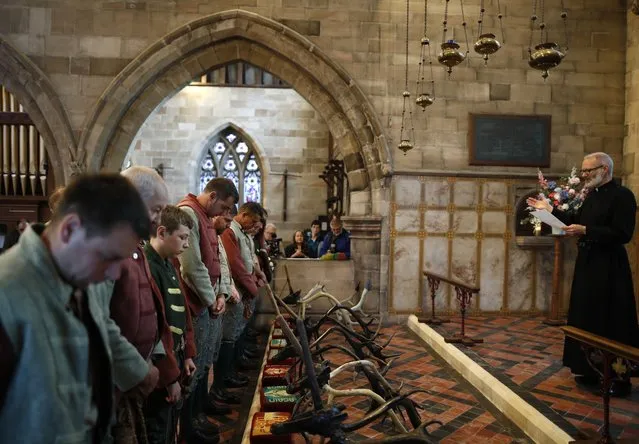
Reverend Simon Davis prays with the dancers before the Abbots Bromley Horn Dance in Abbots Bromley, Britain, September 12, 2016. The Abbots Bromley Horn Dance is an English folk dance dating back to the Middle Ages. The dance takes place each year in Abbots Bromley, a village in Staffordshire, England. The modern version of the dance involves reindeer antlers, a hobby horse, Maid Marian, and a Fool. According to some, the use of antlers suggests an Anglo-Saxon origin along with other native Anglo-Saxon traditions that have survived into modern times in various forms. (Photo by Darren Staples/Reuters)

Reverend Simon Davis prays with the dancers before the Abbots Bromley Horn Dance in Abbots Bromley, Britain, September 12, 2016. The Abbots Bromley Horn Dance is an English folk dance dating back to the Middle Ages. (Photo by Darren Staples/Reuters)
Details
13 Sep 2016 09:36:00
Hong Kong Shop Cats #17. Marcel Heijnen returned to Hong Kong in 2015 and found himself living without a cat for the first time in decades. Soon, though, he was indulging in what he calls “re-tail therapy” and found himself on a first-name basis with a number of cats in his neighbourhood, Sai Ying Pun. (Photo by Marcel Heijnen/Blue Lotus)

When Dutch photographer Marcel Heijnen moved to Hong Kong, the territory’s shop cats instantly caught his eye. While the “feline emperors” are the stars, his shots also offer insights into Hong Kong’s wares, from dried fish to paper. Here: Hong Kong Shop Cats #17. (Photo by Marcel Heijnen/Blue Lotus)
Details
03 Jan 2017 11:04:00
A Palestinian beekeeper uses smoke to calm bees in the process of collecting honey at a farm in Rafah, in the southern Gaza Strip April 11, 2016. (Photo by Suhaib Salem/Reuters)

A Palestinian beekeeper uses smoke to calm bees in the process of collecting honey at a farm in Rafah, in the southern Gaza Strip April 11, 2016. Rateb Samour sees 250 patients a day, whose complaints range from hair loss to cerebral palsy and cancer. He is not a doctor and has never worked in a hospital. Samour inherited the skill of bee-sting therapy from his father. From 2003 the agricultural engineer dedicated all his time to study and develop the alternative-medicine treatment of apitherapy, which uses bee-related products from honey, propolis – or bee glue used to build hives – to venom. (Photo by Suhaib Salem/Reuters)
Details
13 Apr 2016 09:14:00
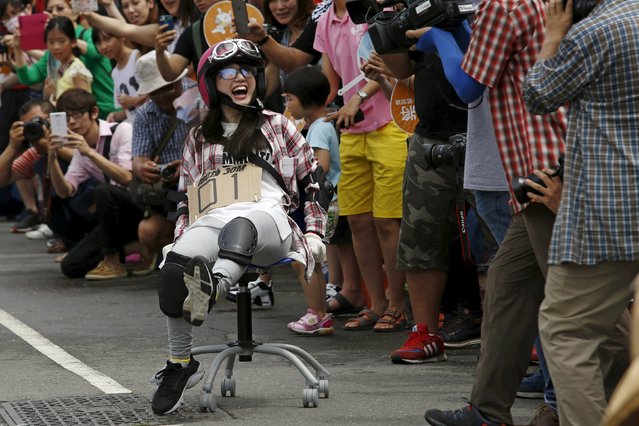
A competitor laughs while taking part in the office chair race ISU-1 Grand Prix in Tainan, southern Taiwan April 24, 2016. (Photo by Tyrone Siu/Reuters)

A competitor laughs while taking part in the office chair race ISU-1 Grand Prix in Tainan, southern Taiwan April 24, 2016. It was the first time such a race was held in Tainan, as part of the “ISU-1 GP” (Grand Prix) that began in Japan in 2010, according to businesses on Jhengsing Street and Haian Road in the city's West Central District and the city's Tourism Bureau, which organized the event. The fastest rider only took six seconds to complete the 30-meter race. (Photo by Tyrone Siu/Reuters)
Details
25 Apr 2016 09:48:00