Loading...
Done
Ajka alumina plant accident

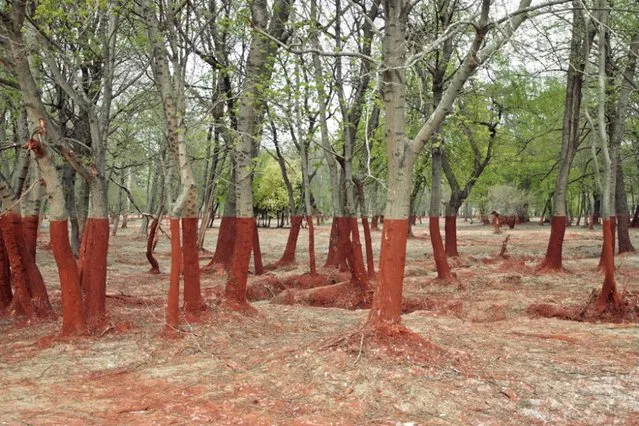
The photograph you see above isn’t the result of Photoshop or infrared photography. Captured by Spanish photographer Palíndromo Mészáros, it shows what the landscape of Ajka, Hungary looked like half a year after the Ajka alumina plant accident — an industrial disaster in which 35 million cubic feet of toxic waste flooded the land to a height of around 6.5 feet. Mészáros lined up the thick red line caused by the sludge with the horizon line to obtain this surreal image.
Details
13 Jul 2012 05:24:00
Camping Luca Vuerich By Giovanni Pesamosca

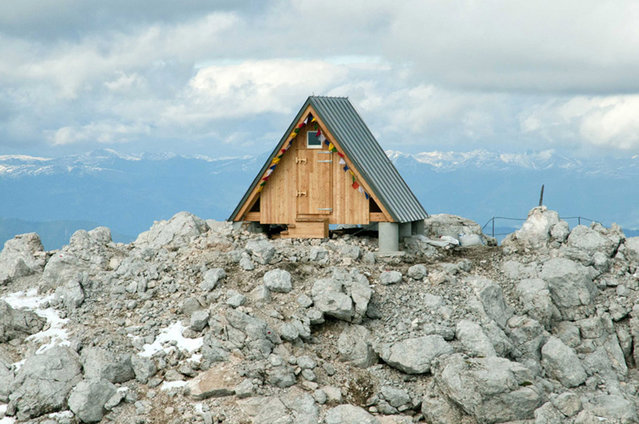
Italian architect Giovanni Pesamosca’s work is reaching scenic new heights. His cabin is perched on the edge of Foronon Buinz in Italy’s Julian Alps. The pre fabricated structure was placed at the spectacular location in memory of deceased climber Luka Vuerich, and is now providing free accommodation complete with jaw dropping panoramic views for up to nine people… the intrepid kind willing to make a long trek to 8303 feet (2531 meters) above sea level.
Details
12 Oct 2014 10:26:00


Cliff Promenade, Netanya

The Cliff Promenade in Netanya is considered to be one of the most beautiful in Israel. It's a nice place for walk, there are marvelous lawns, magnificent observation points, romantic sitting areas in front of the sea, paragliding sites and playgrounds for children. One of the specific features of the promenade, which attracts many people, is mosaic sculpture project "New Wave" created by the sculptor and designer Ruslan Sergeev. At the end of the film you can see The Victory Monument, located next to the promenade.
Details
05 Aug 2014 20:08:00
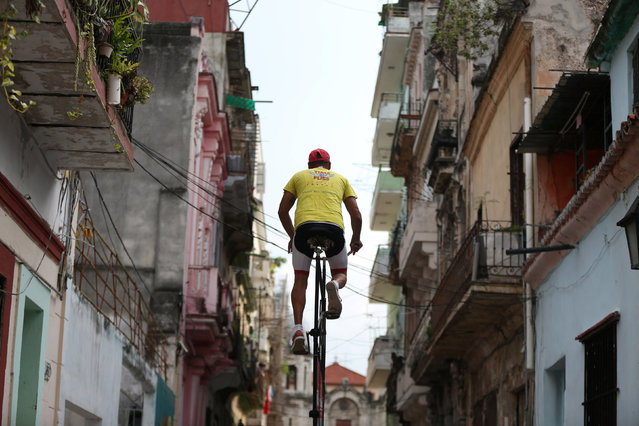
Felix Guirola, 52, rides a homemade bike with an advertising banner in Havana, Cuba, July 20, 2016. (Photo by Alexandre Meneghini/Reuters)

Felix Guirola, 52, rides a homemade bike with an advertising banner in Havana, Cuba, July 20, 2016. The handyman, who loves heights, provides advertising space for companies on homemade bikes that tower up to 7.5 meters (24.61 ft). He rides them around Havana in an ingenious way of getting around strict marketing regulations in the Communist-ruled island. (Photo by Alexandre Meneghini/Reuters)
Details
10 Jan 2017 13:46:00
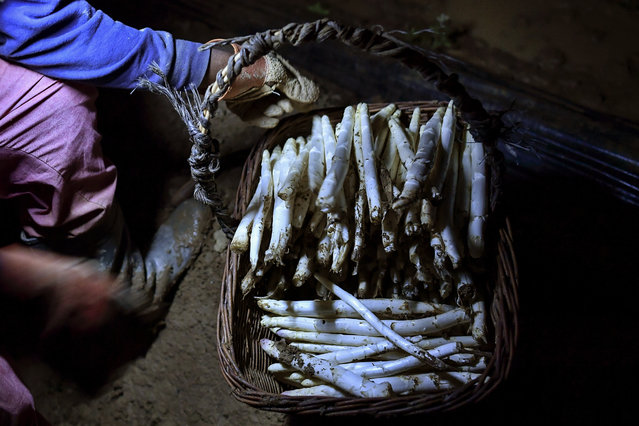
In this Thursday, May 31, 2018 photo, a temporary worker using a lantern collects white asparagus from a field in Caparroso, around 85 km (52 miles) from Pamplona, northern Spain. (Photo by Alvaro Barrientos/AP Photo)

In this Thursday, May 31, 2018 photo, a temporary worker using a lantern collects white asparagus from a field in Caparroso, around 85 km (52 miles) from Pamplona, northern Spain. Dubbed the “white gold” of these northern Spanish farms because of their color and the high price they fetch in markets and restaurants around the world, the stringy delicacy is planted every fall and picked each year between April and June, at the height of the spring. (Photo by Alvaro Barrientos/AP Photo)
Details
09 Jun 2018 00:03:00
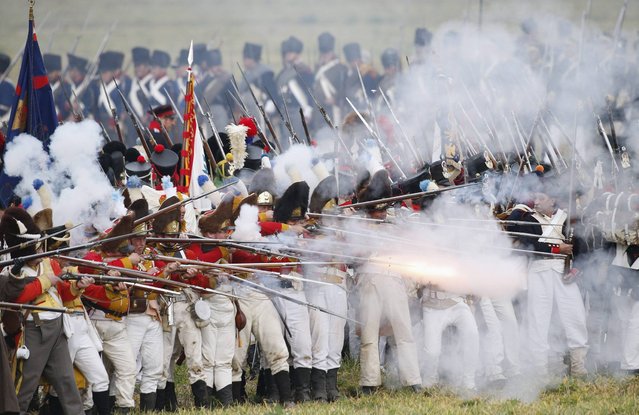
Performers wearing 19th century French military uniforms fire their weapons as they attack Allied forces during a reenactment of the Battle of the Nations, in a field in the village of Markkleeberg near Leipzig October 20, 2013. (Photo by Fabrizio Bensch/Reuters)

Performers wearing 19th century French military uniforms fire their weapons as they attack Allied forces during a reenactment of the Battle of the Nations, in a field in the village of Markkleeberg near Leipzig October 20, 2013. The east German city of Leipzig commemorated the 200th anniversary of the largest battle of the Napoleonic Wars on Sunday by reenacting the Battle of the Nations, with 6,000 military-historic association enthusiasts from all over Europe. The decisive encounter in which tens of thousands of soldiers were killed, took place from October 17-19, 1813, just outside of Leipzig. At the height of the hostilities Napoleon fielded more than 200,000 men against an Allied force of some 360,000 soldiers which included troops from Russia, Austria, Prussia and Sweden. (Photo by Fabrizio Bensch/Reuters)
Details
21 Oct 2013 11:19:00
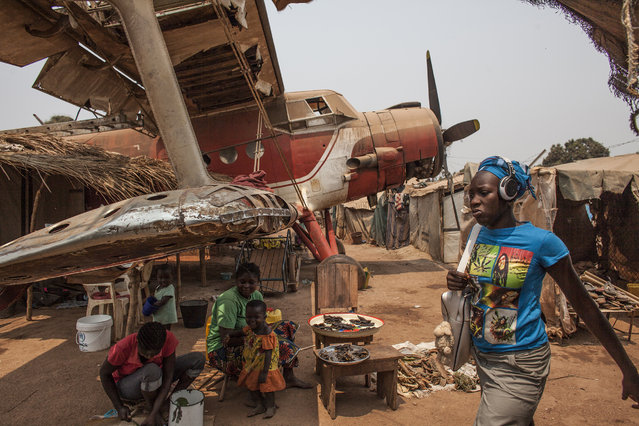
A women sell food under the wing of a plane wreckage being used as housing in M'Poko Internally Displaced Persons camp in Bangui, Central African Republic on Saturday, February 13, 2016. The M'Poko IDP camp, just outside the capitol's airport, currently houses close to 20,000 people displaced due to the ongoing conflict in Central African Republic. The camp was established in late 2013 and contained upto 70,000 people at the height of the crisis in 2014. (Photo by Jane Hahn/The Washington Post)

A women sell food under the wing of a plane wreckage being used as housing in M'Poko Internally Displaced Persons camp in Bangui, Central African Republic on Saturday, February 13, 2016. The M'Poko IDP camp, just outside the capitol's airport, currently houses close to 20,000 people displaced due to the ongoing conflict in Central African Republic. (Photo by Jane Hahn/The Washington Post)
Details
28 Feb 2016 11:09:00


“The Six-Day War or June War, also known as the 1967 Arab-Israeli War or the Third Arab-Israeli War, was fought between June 5 and June 10, 1967, by Israel and the neighboring states of Egypt (known then as the United Arab Republic [UAR]), Jordan, and Syria. The war began with a large-scale surprise air strike by Israel on Egypt. The outcome was a swift and decisive Israeli victory. Israel took effective control of the Gaza Strip and the Sinai Peninsula from Egypt, the West Bank and East Jerusalem from Jordan, and the Golan Heights from Syria. Opinions are divided on whether Israel's attack was an act of aggression or a preemptive strike of a defensive nature”. – Wikipedia

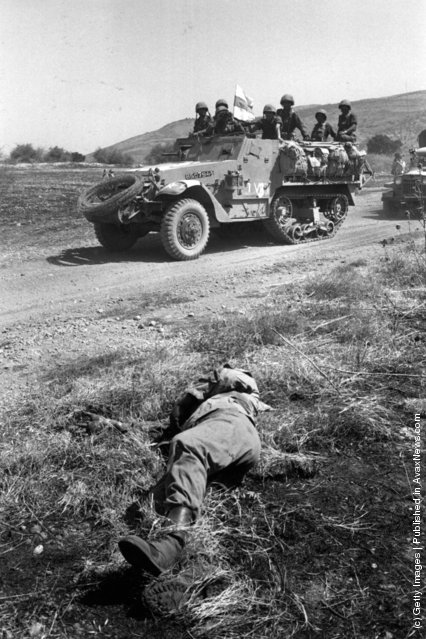
Photo: The corpse of a soldier lying on the line of the Israeli advance into Syria during the Six-Day War. (Photo by Terry Fincher/Getty Images). 1967
Details
21 May 2011 08:29:00