Loading...
Done
Performers line up during the closing ceremony of the 2014 Winter Olympics, Sunday, February 23, 2014, in Sochi, Russia. (Photo by Darron Cummings/AP Photo)

Performers line up during the closing ceremony of the 2014 Winter Olympics, Sunday, February 23, 2014, in Sochi, Russia. (Photo by Darron Cummings/AP Photo)
Details
24 Feb 2014 10:44:00
A helicopter is silhouetted by glowing embers as it makes a water drop at the “Old Fire”, which burned in Calabasas, California, U.S., June 4, 2016. (Photo by Gene Blevins/Reuters)

A helicopter is silhouetted by glowing embers as it makes a water drop at the “Old Fire”, which burned in Calabasas, California, U.S., June 4, 2016. (Photo by Gene Blevins/Reuters)
Details
07 Jun 2016 13:17:00
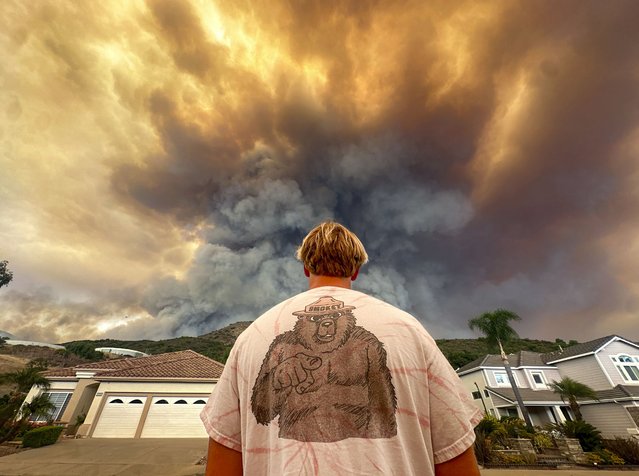
Aidan Thomas wears a Smokey Bear t-shirt as he watches smoke from the Airport Fire rise behind Meander Lane in Trabuco Canyon, Calif., on Monday, September 9, 2024. (Photo by Jeff Gritchen/The Orange County Register via AP Photo)

Aidan Thomas wears a Smokey Bear t-shirt as he watches smoke from the Airport Fire rise behind Meander Lane in Trabuco Canyon, Calif., on Monday, September 9, 2024. (Photo by Jeff Gritchen/The Orange County Register via AP Photo)
Details
15 Feb 2025 03:47:00
Marcello Di Francesco took third place in the Macro category for this picture of an Emperor shrimp (Periclimenes imperator), taken in the waters near Indonesia's Ambon Island

More than 700 underwater images were submitted for the 2012 Annual Underwater Photography Contest, hosted by the University of Miami's Rosenstiel School of Marine & Atmospheric Science. This year, for the first time, the University of Miami set up a “Fan Favorite” category for its underwater photo competition. Internet users could vote for their favorite among five pictures. Todd Aki's photo of a jellyfish took the prize, snaring 599 of the 1,221 votes cast. (Photo by Todd Aki)
Details
22 Apr 2012 12:47:00
Swimmers in fancy dress splash as they participate in the New Year's Day Loony Dook swim at South Queensferry, Scotland January 1, 2015. (Photo by Russell Cheyne/Reuters)

Swimmers in fancy dress splash as they participate in the New Year's Day Loony Dook swim at South Queensferry, Scotland January 1, 2015. (Photo by Russell Cheyne/Reuters)
Details
02 Jan 2015 12:33:00
Sir Argus, centre, with Brian Hayes up, jumps the first during the Guinness Beginners Steeplechase, alongside eventual winner Mars Harper, right, with Sam Ewing up, during day four of the Galway Races Summer Festival at Ballybrit Racecourse in Galway, Ireland on August 3, 2023. (Photo by Seb Daly/Sportsfile)

Sir Argus, centre, with Brian Hayes up, jumps the first during the Guinness Beginners Steeplechase, alongside eventual winner Mars Harper, right, with Sam Ewing up, during day four of the Galway Races Summer Festival at Ballybrit Racecourse in Galway, Ireland on August 3, 2023. (Photo by Seb Daly/Sportsfile)
Details
15 Aug 2023 03:08:00
Protester Lauren Digioia wears police tape during an Occupy Wall Street protest in Union Square in New York City

Protester Lauren Digioia wears police tape during an Occupy Wall Street protest in Union Square on March 19, 2012 in New York City. Protesters affiliated with the movement are gathering in Union Square today following 73 arrests at a six-month anniversary rally at Zuccotti Park over the weekend. (Photo by Mario Tama/Getty Images)
Details
22 Mar 2012 12:23:00
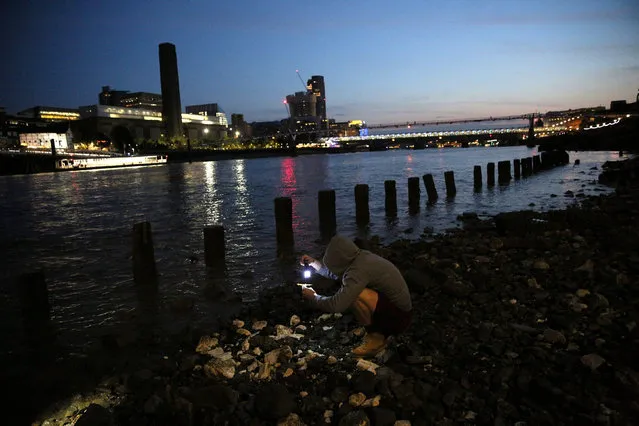
A mudlark uses a torch to look for items on the bank of the River Thames in London, Britain June 06, 2016. Mudlarking is believed to trace its origins to the 18th and 19th century, when scavengers searched the Thames' shores for items to sell. These days, history and archaeology fans are the ones hoping to find old relics such as coins, ceramics, artifacts or everyday items from across centuries. They wait for the low tide and then scour specific areas of exposed shores. "If you're in a field you could be out all day long, with the river you're restricted to about two or three hours," mudlark Nick Stevens said. While many just use the naked eye for their searches, others rely on metal detectors for which a permit from the Port of London Authority is needed. Digging also requires consent. (Photo by Neil Hall/Reuters)

A mudlark uses a torch to look for items on the bank of the River Thames in London, Britain June 06, 2016. Mudlarking is believed to trace its origins to the 18th and 19th century, when scavengers searched the Thames' shores for items to sell. These days, history and archaeology fans are the ones hoping to find old relics such as coins, ceramics, artifacts or everyday items from across centuries. their finds with the Portable Antiquities Scheme. Any item over 300 years old must be recorded. (Photo by Neil Hall/Reuters)

Details
27 Aug 2016 10:43:00