Loading...
Done
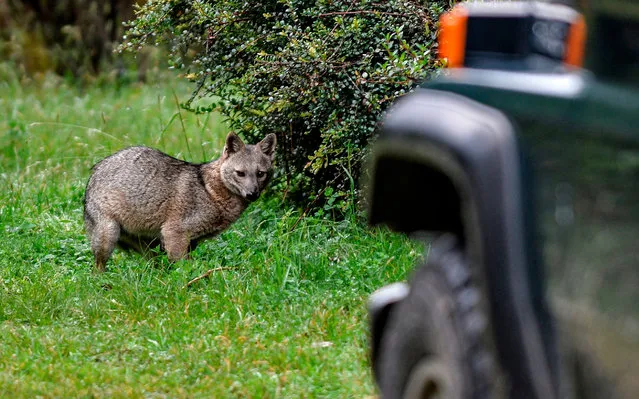
A crab-eating fox (Cerdocyon thous), also known as the forest fox, wood fox, or maikong, is seen in the wild in the municipality of Guasca, some 50 km from Bogota, on May 16, 2020. (Photo by Diana Sánchez/AFP Photo)

A crab-eating fox (Cerdocyon thous), also known as the forest fox, wood fox, or maikong, is seen in the wild in the municipality of Guasca, some 50 km from Bogota, on May 16, 2020. (Photo by Diana Sánchez/AFP Photo)
Details
03 Jun 2020 00:03:00
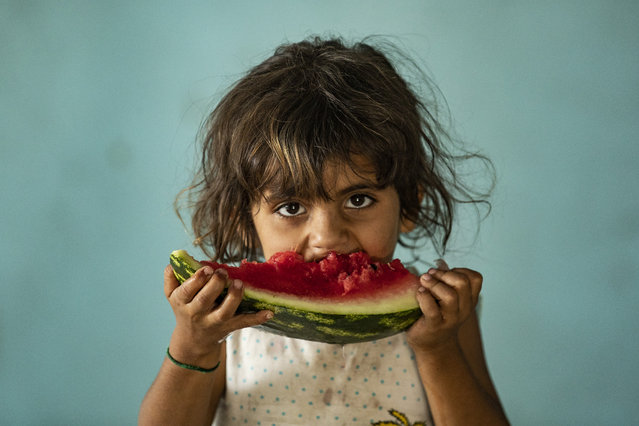
A girl eats a watermelon slice while at a school building where Syrians – displaced from the area of Ras al-Ain by the Turkish offensive on the northeast – are staying in the city of Hasakah, on June 30, 2020. (Photo by Delil Souleiman/AFP Photo)

A girl eats a watermelon slice while at a school building where Syrians – displaced from the area of Ras al-Ain by the Turkish offensive on the northeast – are staying in the city of Hasakah, on June 30, 2020. (Photo by Delil Souleiman/AFP Photo)
Details
11 Jul 2020 00:01:00
Residents of Ezbet Hamada in Cairo's Mataria district gather to eat Iftar, the meal to end their fast at sunset, during the holy fasting month of Ramadan in Cairo, Egypt on April 6, 2023. (Photo by Mohamed Abd El Ghany/Reuters)

Residents of Ezbet Hamada in Cairo's Mataria district gather to eat Iftar, the meal to end their fast at sunset, during the holy fasting month of Ramadan in Cairo, Egypt on April 6, 2023. (Photo by Mohamed Abd El Ghany/Reuters)
Details
15 Apr 2023 03:26:00
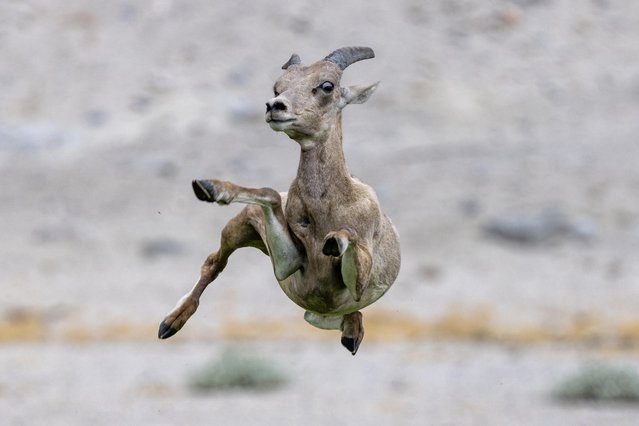
An endangered desert bighorn lamb leaps in play at a park where bighorns are tempted to leave the safety of their native habitat to eat grass and drink water in the summertime on August 9, 2023 near Indio, California. (Photo by David McNew/Getty Images)

An endangered desert bighorn lamb leaps in play at a park where bighorns are tempted to leave the safety of their native habitat to eat grass and drink water in the summertime on August 9, 2023 near Indio, California. (Photo by David McNew/Getty Images)
Details
26 Dec 2023 20:14:00
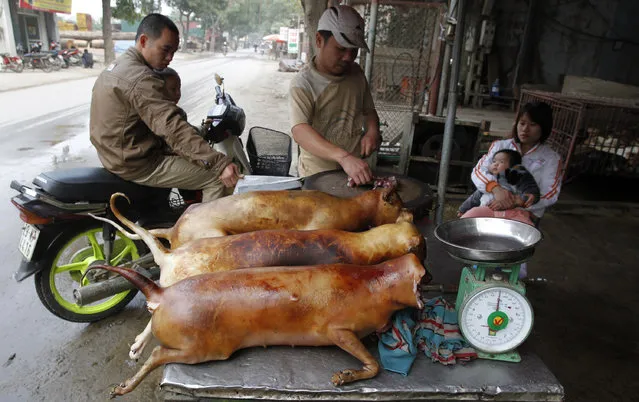
A vendor (C) cuts slaughtered dogs for sale at his roadside stall in Duong Noi village, outside Hanoi December 16, 2011. While animal rights activists have condemned eating dog meat as cruel treatment of the animals, it is still an accepted popular delicacy for some Vietnamese, as well in some other Asian countries. (Photo by Reuters/Kham)

A vendor (C) cuts slaughtered dogs for sale at his roadside stall in Duong Noi village, outside Hanoi December 16, 2011. While animal rights activists have condemned eating dog meat as cruel treatment of the animals, it is still an accepted popular delicacy for some Vietnamese, as well in some other Asian countries. Duong Noi is well-known as a dog-meat village, where hundreds of dogs are killed each day for sale as popular traditional food. Dog-eating as a custom is rooted in Vietnam and was developed as a result of poverty. One kilogram of dog meat costs about 130,000 dongs ($6.2). (Photo by Reuters/Kham)
Details
16 Jul 2013 11:40:00
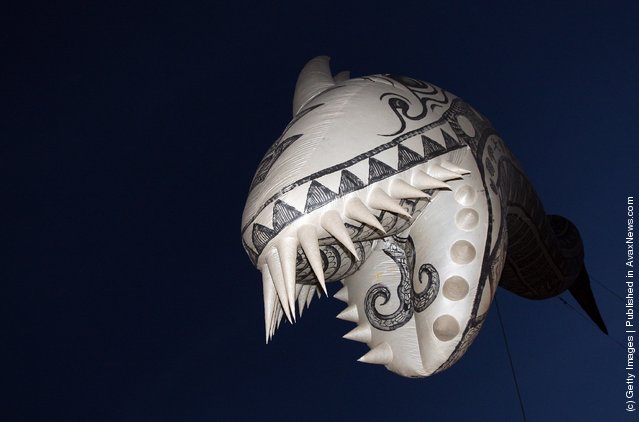
Plasticiens Volants Fly Inflatable Puppets Over Berlin

An inflatable snake hovers during a performance by the French street theater company Plasticiens Volants on September 4, 2011 in Berlin, Germany. The spectale, featuring gigantic flying inflatable fairy-tale creatures and performers on stilts and in costume was a part of celebrations for the 125th anniversary of the Kurfuerstendamm, known locally as the Ku'damm, a shopping boulevard. (Photo by Adam Berry/Getty Images)
Details
05 Sep 2011 12:56:00
Christopher Jonassen’s Alien Landscapes

Is it the surface of the Mars or Venus or an undiscovered planet? Not at all. These pictures aren’t what you think they are. Christopher Jonassen, a Norwegian photographer shot these beautiful and otherworldly series called ‘Devour of frying pan bottoms’, which are visually similar to craters and scars on a planet’s surface. In his series Jonassen refers to a quote of Jean-Paul Satre who said: ‘To eat is to appropriate destruction’ and the meaning of the word ‘devour’, which stands for eating up greedily, destroying, consuming, and wasting.
Details
30 Aug 2013 08:18:00
A South Korean man and a woman eat a live octopus during an event to promote a local food festival in Seoul on September 12, 2013. (Photo by Jung Yeon-Je/AFP Photo)

Live octopus is a delicacy in South Korea but is a known choking hazard, since the still-moving suction cups can cause tentacle pieces to stick in a person's throat. A baby octopus is often consumed whole, while larger varieties are cut up and the still-wriggling tentacles eaten with a splash of sesame oil. Photo: A South Korean man and a woman eat a live octopus during an event to promote a local food festival in Seoul on September 12, 2013. (Photo by Jung Yeon-Je/AFP Photo)
Details
13 Sep 2013 09:40:00