Loading...
Done
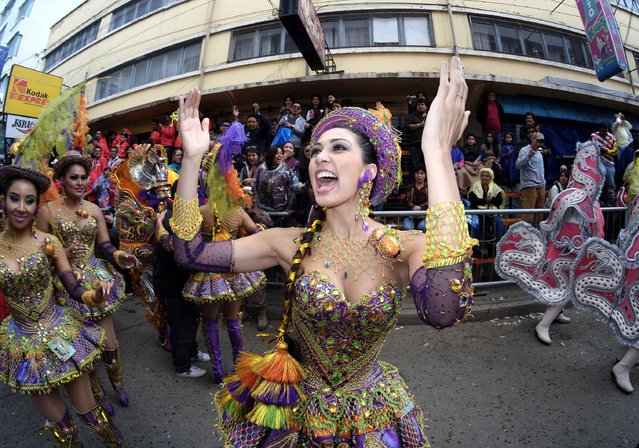
A member of the “Morenada Los Cocanis” group dances during the Carnival parade in Oruro February 14, 2015. (Photo by David Mercado/Reuters)

A member of the “Morenada Los Cocanis” group dances during the Carnival parade in Oruro February 14, 2015. Thousands of dancers and tourists attend the carnival celebrations in Oruro, south of La Paz. (Photo by David Mercado/Reuters)
Details
15 Feb 2015 14:25:00
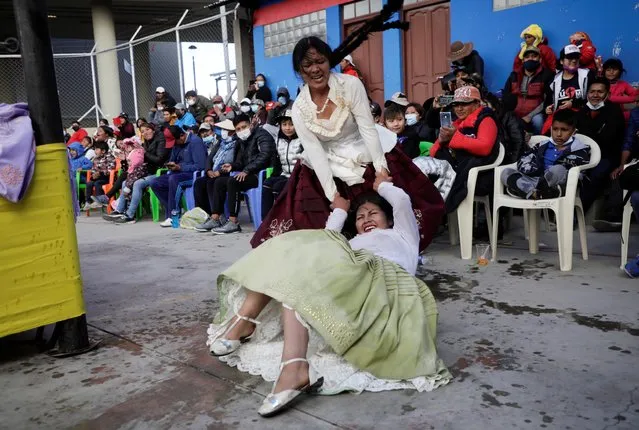
Barbara Quisbert and Susana La Bonita, cholitas wrestlers, fight during their return to the ring after the coronavirus disease (COVID-19) restrictions, in El Alto outskirts of La Paz, November 29, 2020. (Photo by David Mercado/Reuters)

The Fighting Cholitas are a group of female wrestlers who perform in El Alto, Bolivia. Tickets to the exhibitions cost $1. Like the general population of El Alto, which consists almost entirely of Aymara and Quechua residents, the Cholitas are indigenous. They wear braided hair, bowler hats and multilayered skirts in the ring. Here: Barbara Quisbert and Susana La Bonita, cholitas wrestlers, fight during their return to the ring after the coronavirus disease (COVID-19) restrictions, in El Alto outskirts of La Paz, November 29, 2020. (Photo by David Mercado/Reuters)

Details
12 Dec 2020 00:03:00
The Nasir Al-Mulk Mosque

The Nasīr al-Mulk Mosque or Pink Mosque is a traditional mosque in Shiraz, Iran, located in Goade-e-Araban place (near the famous Shah Cheragh mosque). The mosque was built during the Qājār era, and is still in use under protection by Nasir al Mulk's Endowment Foundation. It was built by the order of Mirza Hasan Ali Nasir al Molk, one of the lords of the Qajar Dynasty, in 1876 and was finished in 1888. The designers were Muhammad Hasan-e-Memar and Muhammad Reza Kashi Paz-e-Shirazi. The mosque extensively uses colored glass in its facade, and displays other traditional elements such as panj kāseh-i (five concaves) in its design, it is also named in popular culture as Pink Mosque due to the usage of beautiful pink color tiles for its interior design.
Details
26 Mar 2014 14:04:00
Natalia Lage Rainha de Drums of the Escola de Samba Inocente de Belford Roxo during a presentation in the parade of the Special Group of Carnival in Rio de Janeiro at Avenida Marques de Sapucai, Sambadrome in Rio de Janeiro on April 21, 2021. The Carnival parades that take place in February were postponed to this month of April due to the high number of cases caused during the pandemic caused by COVID-19 (Coronavirus). (Photo by Thiago Ribeiro/AGIF via AFP Photo)

Natalia Lage Rainha de Drums of the Escola de Samba Inocente de Belford Roxo during a presentation in the parade of the Special Group of Carnival in Rio de Janeiro at Avenida Marques de Sapucai, Sambadrome in Rio de Janeiro on April 21, 2021. The Carnival parades that take place in February were postponed to this month of April due to the high number of cases caused during the pandemic caused by COVID-19 (Coronavirus). (Photo by Thiago Ribeiro/AGIF via AFP Photo)
Details
04 Jul 2023 02:14:00
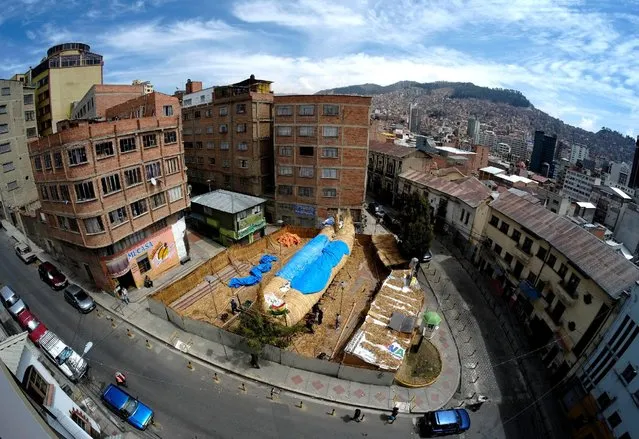
Aerial view of the “Viracocha III”, a boat made only from the totora reed, as it is being prepared to cross the Pacific from Chile to Australia on an expected six-month journey, La Paz, Bolivia, October 19, 2016. An expedition in a boat made only of reeds crafted by indigenous Bolivians is getting ready to cross the Pacific from South America to Australia, in a fresh attempt to prove that ancient mariners were capable of making the journey. Phil Buck, a 51-year-old explorer from the United States, already has led two similar expeditions and will captain the “Viracocha III” set to depart from northern Chile in February on an expected six-month journey. (Photo by David Mercado/Reuters)

Aerial view of the “Viracocha III”, a boat made only from the totora reed, as it is being prepared to cross the Pacific from Chile to Australia on an expected six-month journey, La Paz, Bolivia, October 19, 2016. An expedition in a boat made only of reeds crafted by indigenous Bolivians is getting ready to cross the Pacific from South America to Australia, in a fresh attempt to prove that ancient mariners were capable of making the journey. (Photo by David Mercado/Reuters)

Details
20 Oct 2016 10:53:00
Queen of drums, Sabrina Sato of Unidos de Vila Isabel samba school during the Champions Parade on the last day of Rio de Janeiro 2022 Carnival at Marques de Sapucai Sambadrome on May 01, 2022 in Rio de Janeiro, Brazil. Rio de Janeiro's iconic carnival returns to the sambodrome after a two year suspension and postponements due to the coronavirus pandemic. (Photo by Wagner Meier/Getty Images)

Queen of drums, Sabrina Sato of Unidos de Vila Isabel samba school during the Champions Parade on the last day of Rio de Janeiro 2022 Carnival at Marques de Sapucai Sambadrome on May 01, 2022 in Rio de Janeiro, Brazil. Rio de Janeiro's iconic carnival returns to the sambodrome after a two year suspension and postponements due to the coronavirus pandemic. (Photo by Wagner Meier/Getty Images)
Details
18 Aug 2023 03:38:00
Revellers are sprayed by a water cannon during a street party called “Bloco Das Barbas” in Rio de Janeiro, Brazil on February 18, 2023. Hundreds of street parties traditionally take place every year in the city before and during Rio de Janeiro's carnival. (Photo by Carl de Souza/AFP Photo)

Revellers are sprayed by a water cannon during a street party called “Bloco Das Barbas” in Rio de Janeiro, Brazil on February 18, 2023. Hundreds of street parties traditionally take place every year in the city before and during Rio de Janeiro's carnival. (Photo by Carl de Souza/AFP Photo)
Details
11 May 2024 05:33:00
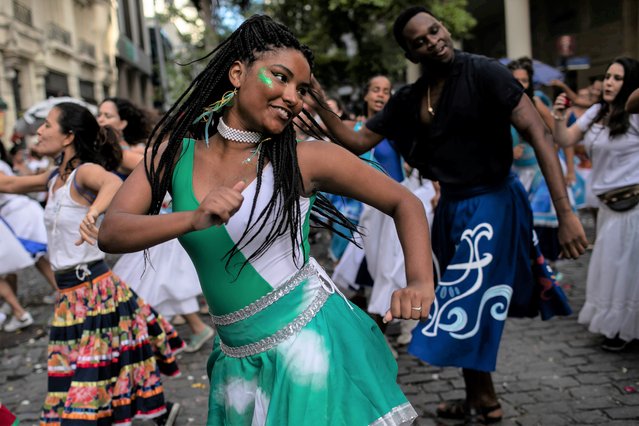
A woman dances during a rehearsal by the group “Tambores de Olokun” in Rio de Janeiro, Brazil, Sunday, April 17, 2022. The Brazilian municipalities of Rio de Janeiro and Sao Paulo postponed the traditional parades of the carnival samba schools to April 22 - 23, as a result of the COVID-19 pandemic. (Photo by Bruna Prado/AP Photo)

A woman dances during a rehearsal by the group “Tambores de Olokun” in Rio de Janeiro, Brazil, Sunday, April 17, 2022. The Brazilian municipalities of Rio de Janeiro and Sao Paulo postponed the traditional parades of the carnival samba schools to April 22 - 23, as a result of the COVID-19 pandemic. (Photo by Bruna Prado/AP Photo)
Details
19 Apr 2022 05:56:00