Loading...
Done
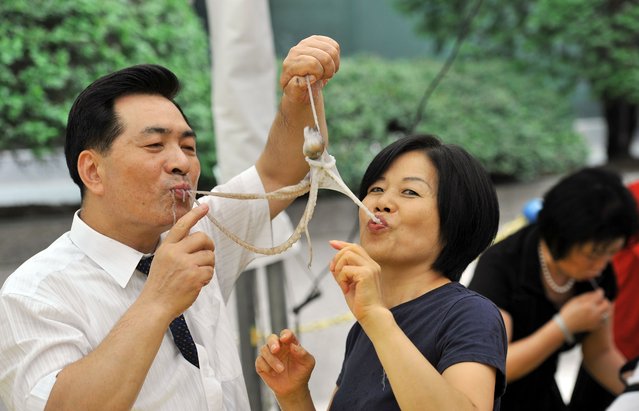
A South Korean man and a woman eat a live octopus during an event to promote a local food festival in Seoul on September 12, 2013. (Photo by Jung Yeon-Je/AFP Photo)

Live octopus is a delicacy in South Korea but is a known choking hazard, since the still-moving suction cups can cause tentacle pieces to stick in a person's throat. A baby octopus is often consumed whole, while larger varieties are cut up and the still-wriggling tentacles eaten with a splash of sesame oil. Photo: A South Korean man and a woman eat a live octopus during an event to promote a local food festival in Seoul on September 12, 2013. (Photo by Jung Yeon-Je/AFP Photo)
Details
13 Sep 2013 09:40:00
One of three young oriental small-clawed otters eats a meatball on June 18, 2015 in a zoo in Dresden, eastern Germany. The oriental small-clawed otter female Fussi gave birth to 3 healthy pups. Its pups now leave their burrow to explore the environment. (Photo by Arno Burgi/AFP Photo/DPA)

One of three young oriental small-clawed otters eats a meatball on June 18, 2015 in a zoo in Dresden, eastern Germany. The oriental small-clawed otter female Fussi gave birth to 3 healthy pups. Its pups now leave their burrow to explore the environment. (Photo by Arno Burgi/AFP Photo/DPA)
Details
29 Jun 2015 12:27:00
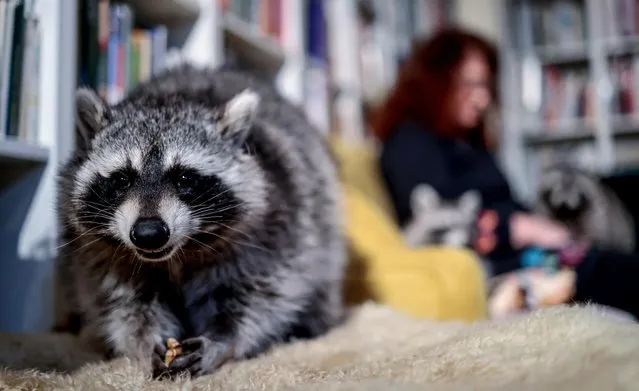
Raccoon Fritzi eats at the home of veterinarian Mathilde Laininger in Berlin, Germany, January 27, 2022. She cares for four raccoons that can no longer be released into the wild. Raccoon Fritzi has an Instagram account with ten thousand followers. (Photo by Hannibal Hanschke/Reuters)

Raccoon Fritzi eats at the home of veterinarian Mathilde Laininger in Berlin, Germany, January 27, 2022. She cares for four raccoons that can no longer be released into the wild. Raccoon Fritzi has an Instagram account with ten thousand followers. (Photo by Hannibal Hanschke/Reuters)
Details
13 Feb 2022 05:18:00
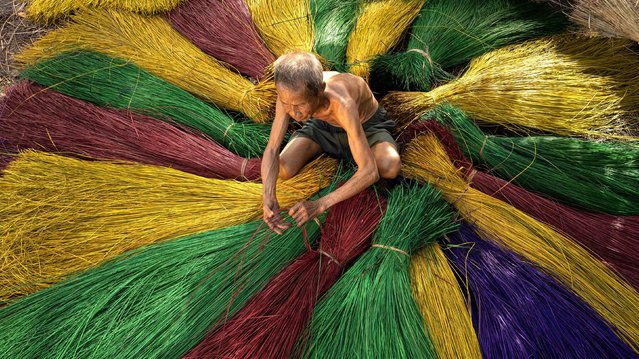
This dyed straw is grown in Ban Dong Saen Suk, Sakon Nakhon province, Thailand on September 28, 2021. Sarawut Intharap, 38, an engineer who capture the image, said: “The straw is entwined together to make mats used for sleeping and eating and they are sold at around £2.50 (3.40 USD) a mat at the local market”. (Photo by Sarawut Intarob/Solent News)

This dyed straw is grown in Ban Dong Saen Suk, Sakon Nakhon province, Thailand on September 28, 2021. Sarawut Intharap, 38, an engineer who capture the image, said: “The straw is entwined together to make mats used for sleeping and eating and they are sold at around £2.50 (3.40 USD) a mat at the local market”. (Photo by Sarawut Intarob/Solent News)
Details
21 Oct 2021 08:43:00
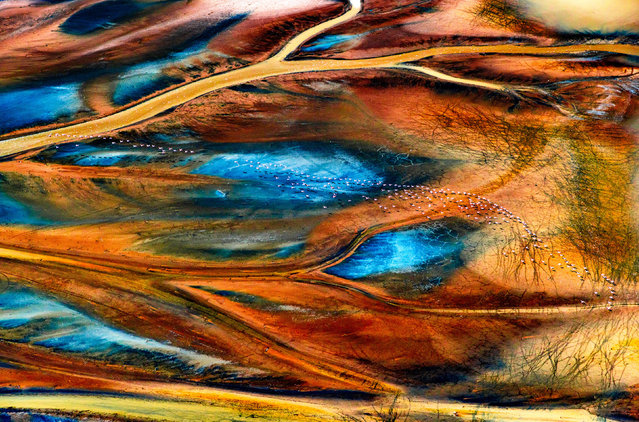
Hundreds of flamingos take flight in the Rift Valley in East Africa early September 2024. The birds gather in the region’s saline lakes to eat the blue-green algae that grows in abundance. The red-orange pigment in the algae is what gives them their distinctive pink plumage. They also use the site to breed. (Photo by Alexandre and Chloe Bes/Naturagency/Solent News)

Hundreds of flamingos take flight in the Rift Valley in East Africa early September 2024. The birds gather in the region’s saline lakes to eat the blue-green algae that grows in abundance. The red-orange pigment in the algae is what gives them their distinctive pink plumage. They also use the site to breed. (Photo by Alexandre and Chloe Bes/Naturagency/Solent News)
Details
23 Sep 2024 02:54:00
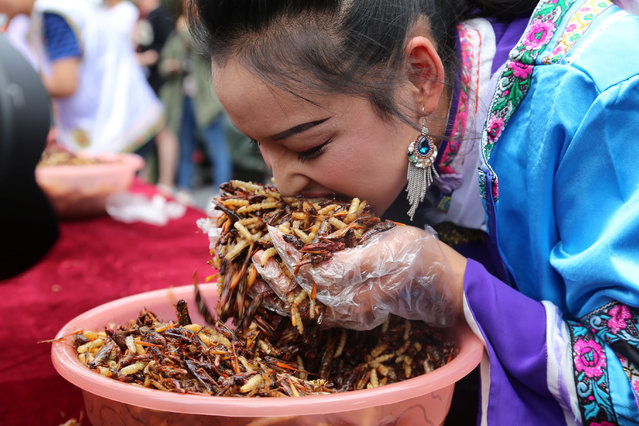
A woman participates in an insect-eating competition at a scenic spot in Lijiang, Yunnan province, China June 25, 2017. (Photo by Reuters/Stringer)

A woman participates in an insect-eating competition at a scenic spot in Lijiang, Yunnan province, China June 25, 2017. Insects have been a part of Yunnan cuisine for centuries, long before their potential as sustainable sources of protein caught the eye of the Western world. Bee larvae, grasshoppers and cicadas are just some items found on menus in the region. (Photo by Reuters/Stringer)
Details
13 Jul 2017 07:41:00
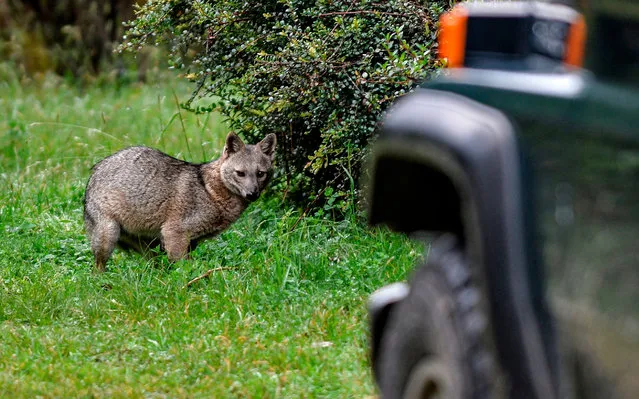
A crab-eating fox (Cerdocyon thous), also known as the forest fox, wood fox, or maikong, is seen in the wild in the municipality of Guasca, some 50 km from Bogota, on May 16, 2020. (Photo by Diana Sánchez/AFP Photo)

A crab-eating fox (Cerdocyon thous), also known as the forest fox, wood fox, or maikong, is seen in the wild in the municipality of Guasca, some 50 km from Bogota, on May 16, 2020. (Photo by Diana Sánchez/AFP Photo)
Details
03 Jun 2020 00:03:00
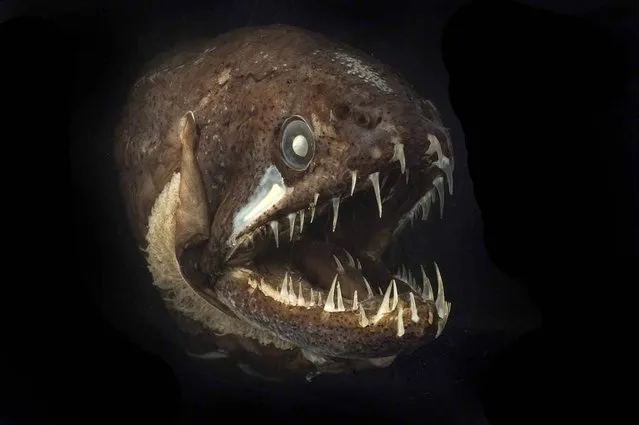
Imagine living in the sea where it is permanently dark, cold, and food is hard to find. For many animals at depth, it may be weeks to months between meals. If you find something to eat, you have to hang on to it

Imagine living in the sea where it is permanently dark, cold, and food is hard to find. For many animals at depth, it may be weeks to months between meals. If you find something to eat, you have to hang on to it. This is why so many deep-sea fishes have lots of big teeth. This dragonfish, spotted off the coast of Australia, even has teeth on its tongue. They would be terrifying animals ... if they weren’t the size of a banana. (Photo by Julian Finn/Museum Victoria)
Details
21 May 2012 12:14:00