Loading...
Done
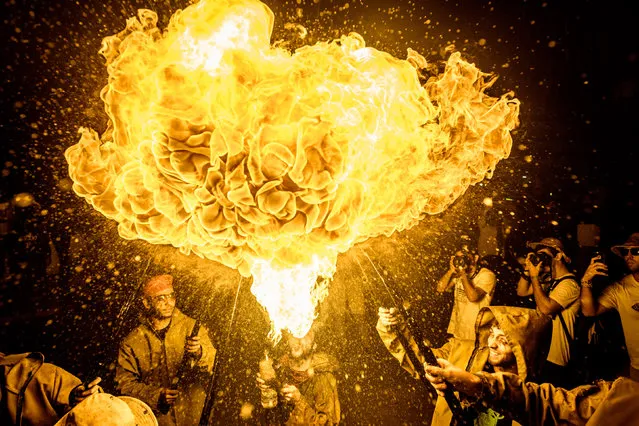
A fire-eater of the “Diables de Terrassa” performs during Sitges' little “Festa Major”, “Santa Tecla” in Sitges, Spain on September 19, 2016. This celebration brings together some of Catalonia’s most emblematic festive traditions. The central axis of the celebrations is the traditional parade, made up of “big-head” carnival figures and characters who dance to music played on different traditional instruments. One of the most popular events is the Correfoc or fire-running, which is also the closing event of the fiesta. The people run and jump over characters dressed up as devils and dragons, carrying fire. (Photo by Matthias Oesterle/ZUMA Press/Splash News)

A fire-eater of the “Diables de Terrassa” performs during Sitges' little “Festa Major”, “Santa Tecla” in Sitges, Spain on September 19, 2016. This celebration brings together some of Catalonia’s most emblematic festive traditions. The central axis of the celebrations is the traditional parade, made up of “big-head” carnival figures and characters who dance to music played on different traditional instruments. One of the most popular events is the Correfoc or fire-running, which is also the closing event of the fiesta. The people run and jump over characters dressed up as devils and dragons, carrying fire. (Photo by Matthias Oesterle/ZUMA Press/Splash News)
Details
20 Sep 2016 09:28:00
A handout image released by the Taronga Zoo shows Veiled Chameleon hatchlings at Taronga Zoo in Sydney, Australia, 11 March 2015. Taronga has welcomed more than 20 baby chameleons, with the last of three clutches of eggs hatching this week. Veiled Chameleons, or Chamaeleo calyptratus, are native to Saudi Arabia and Yemen and can live up to five years. (Photo by EPA/Taronga Zoo)

A handout image released by the Taronga Zoo shows Veiled Chameleon hatchlings at Taronga Zoo in Sydney, Australia, 11 March 2015. Taronga has welcomed more than 20 baby chameleons, with the last of three clutches of eggs hatching this week. Veiled Chameleons, or Chamaeleo calyptratus, are native to Saudi Arabia and Yemen and can live up to five years. (Photo by EPA/Taronga Zoo)
Details
21 Mar 2015 13:13:00
An Indian worker makes a roll of the kite thread being prepared on a roadside on the outskirts of Amritsar, India, 24 November 2020. The kite string or the “Dor”, in the local language, is made of crushed glass, glue, colors, and egg to make it strong enough to hold the kite. With the onset of the winter season, kite flying enthusiasts especially in northern Punjab, ranging from children to aged people, start flying kites as a leisure activity from their homes' rooftops and from open spaces, enjoying warmth of the winter sun at the same time. Kite flying season peaks in Amritsar on Lohri festival which marks the culmination of winter and is celebrated in the month of January every year. (Photo by Raminder Pal Singh/EPA/EFE)

An Indian worker makes a roll of the kite thread being prepared on a roadside on the outskirts of Amritsar, India, 24 November 2020. The kite string or the “Dor”, in the local language, is made of crushed glass, glue, colors, and egg to make it strong enough to hold the kite. (Photo by Raminder Pal Singh/EPA/EFE)
Details
07 Dec 2020 00:01:00
Chicken, fish and eggs lie next to coca paste worth $14,000 Colombian pesos at a local store in Guyabero Region, Guaviare, Colombia, May 24, 2016. (Photo by John Vizcaino/Reuters)

Chicken, fish and eggs lie next to coca paste worth $14,000 Colombian pesos at a local store in Guyabero Region, Guaviare, Colombia, May 24, 2016. As the government nears a historic peace deal with the rebels of the Revolutionary Armed Forces of Colombia (FARC), the nation's authorities are struggling to tame an increase in farming of coca, the raw material used to make cocaine. In the Guyabero Region, where many people work on coca plantations, locals barter coca paste to buy groceries at the local shop. (Photo by John Vizcaino/Reuters)
Details
03 Jun 2016 12:46:00
Stefan Sigmund, 29, from the Transylvanian city of Cluj, attempt to smoke 800 cigarettes through a self designed device in less than five minutes, in central Bucharest Tuesday, January 30, 1996, trying to enter the Guinness Book of Records. It is the last of his several attempts entering the record book which included eating 29 hard boiled eggs in four minutes and leaping into a lake from a height of 41 meters (135 feet) even if the Guinness Book of Records no longer rewards self damaging attempts.  (Photo by AP Photo/Stringer)

Stefan Sigmund, 29, from the Transylvanian city of Cluj, attempt to smoke 800 cigarettes through a self designed device in less than five minutes, in central Bucharest Tuesday, January 30, 1996, trying to enter the Guinness Book of Records. It is the last of his several attempts entering the record book which included eating 29 hard boiled eggs in four minutes and leaping into a lake from a height of 41 meters (135 feet) even if the Guinness Book of Records no longer rewards self damaging attempts. (Photo by AP Photo/Stringer)
Details
01 Mar 2018 00:05:00
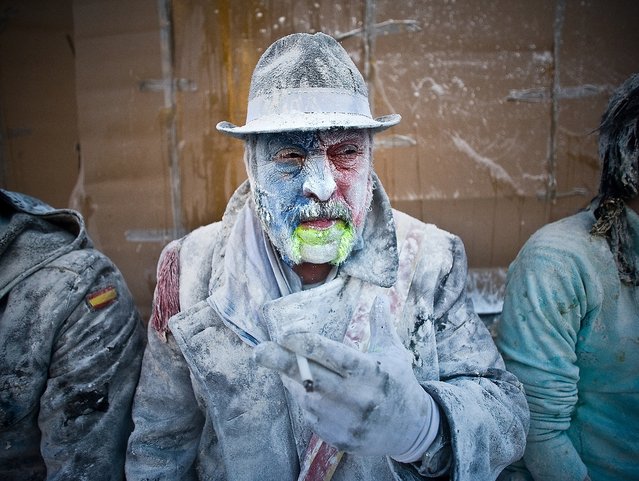
A Reveller smokes during the battle of “Enfarinats”, a flour fight in celebration of the Els Enfarinats festival. (Photo by David Ramos)

It’s a classic tale of dictatorship gone wrong and the fight for freedom. Like in any good battle, there’s fire, albeit from firecrackers, but the ammunition in this one is – flour. It takes place in a Hemingway-esque Spanish village. The battle of “Enfarinats” in celebration of the Els Enfarinats festival, rages on on December 28, 2012 in Ibi, Spain. Citizens of Ibi annually celebrate the festival with a fight using flour, eggs and firecrackers. The battle takes place between two groups, a group of married men called “Els Enfarinats” who take the control of the village for one day pronouncing a number of ridiculous laws and fining the citizens that infringe them and a group called “La Oposicio” who try to restore order. At the end of the day the money collected from the fines is donated to charitable causes in the village. The festival has been celebrated since 1981 after the town of Ibi recovered the tradition but the origins remain unknown.

Photo: A Reveller smokes during the battle of “Enfarinats”, a flour fight in celebration of the Els Enfarinats festival. (Photo by David Ramos)
Details
30 Dec 2012 10:28:00
A catholic faithful smeared in burnt oil, takes part in the opening of the ten-day celebration of the Santo Domingo de Guzman festival in Managua, on August 1, 2019. (Photo by Inti Ocon/AFP Photo)

A catholic faithful smeared in burnt oil, takes part in the opening of the ten-day celebration of the Santo Domingo de Guzman festival in Managua, on August 1, 2019. In Central America the black devil, or El Cadejo, is an evil dog-like spirit with glowing red eyes that locals believe eats new born puppies. (Photo by Inti Ocon/AFP Photo)
Details
06 Aug 2019 00:01:00
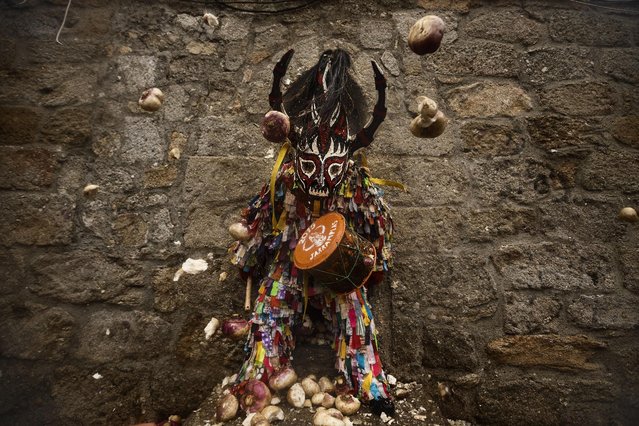
People throw turnips at the Jarramplas as he makes his way through the streets beating his drum during the Jarramplas Festival in Piornal, Spain, Tuesday, January 20, 2015. Jarramplas is a character that wears a costume made from colorful strips of fabric, and a devil-like mask and beats a drum through the streets of Piornal while residents throw turnips as a punishment for stealing cattle. (Photo by Daniel Ochoa de Olza/AP Photo)

People throw turnips at the Jarramplas as he makes his way through the streets beating his drum during the Jarramplas Festival in Piornal, Spain, Tuesday, January 20, 2015. Jarramplas is a character that wears a costume made from colorful strips of fabric, and a devil-like mask and beats a drum through the streets of Piornal while residents throw turnips as a punishment for stealing cattle. The exact origin of the festival are not known, various theories exist from the mythological punishment of Caco by Hercules, to a cattle thief ridiculed and expelled by his neighbors. The Jarramplas Festival takes place every year from the 19th till the 20th of January on Saint Sebastian Day. (Photo by Daniel Ochoa de Olza/AP Photo)
Details
21 Jan 2015 13:42:00