Loading...
Done
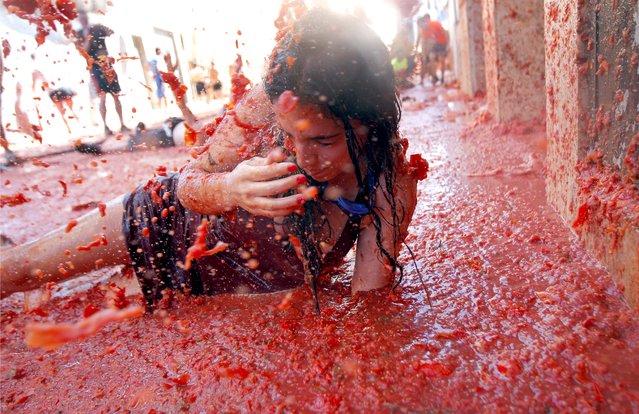
A woman lays in a puddle of tomato juice during the annual “Tomatina” tomato fight fiesta in the village of Bunol, 50 kilometers outside Valencia, Spain, Wednesday, August 27, 2014. The streets of an eastern Spanish town are awash with red pulp as thousands of people pelt each other with tomatoes in the annual “Tomatina” battle that has become a major tourist attraction. (Photo by Alberto Saiz/AP Photo)

A woman lays in a puddle of tomato juice during the annual “Tomatina” tomato fight fiesta in the village of Bunol, 50 kilometers outside Valencia, Spain, Wednesday, August 27, 2014. The streets of an eastern Spanish town are awash with red pulp as thousands of people pelt each other with tomatoes in the annual “Tomatina” battle that has become a major tourist attraction. At the annual fiesta in Bunol on Wednesday, trucks dumped 125 tons of ripe tomatoes for some 22,000 participants, many from abroad to throw during the hour-long morning festivities. (Photo by Alberto Saiz/AP Photo)
Details
28 Aug 2014 11:03:00


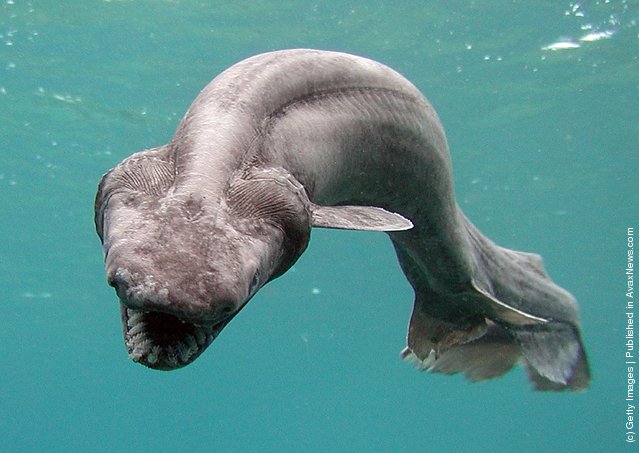
“The frilled shark (Chlamydoselachus anguineus) is one of two extant species of shark in the family Chlamydoselachidae, with a wide but patchy distribution in the Atlantic and Pacific Oceans. This uncommon species is found over the outer continental shelf and upper continental slope, generally near the bottom though there is evidence of substantial upward movements. It has been caught as deep as 1,570 m (5,150 ft), whereas in Suruga Bay, Japan it is most common at depths of 50–200 m (160–660 ft). Exhibiting several “primitive” features, the frilled shark has often been termed a «living fossil»”. – Wikipedia

Photo: A 1.6 meter long Frill shark swims in a tank after being found by a fisherman at a bay in Numazu, on January 21, 2007 in Numazu, Japan. The frill shark, also known as a Frilled shark usually lives in waters of a depth of 600 meters and so it is very rare that this shark is found alive at sea-level. It's body shape and the number of gill are similar to fossils of sharks which lived 350,000,000 years ago. (Photo by Awashima Marine Park/Getty Images)
Details
05 May 2011 10:01:00
Mangli Munda poses on her wedding day with a stray dog in Jharkhand, India on August 30, 2014. An 18-year-old Indian girl has married a stray dog as a part of a tribal ritual designed to ward off an evil spell. (Photo by Barcroft Media/ABACAPress)

Mangli Munda poses on her wedding day with a stray dog in Jharkhand, India on August 30, 2014. An 18-year-old Indian girl has married a stray dog as a part of a tribal ritual designed to ward off an evil spell. Village elders hastily organised the wedding between Mangli Munda and the canine as the teenager is believed to be bringing bad luck to her community in a remote village in Jharkhand state. Mangli's father Sri Amnmunda agreed and even found a stray dog named Sheru as a match for his daughter. And while Mangli was a hesitant bride, she believes that the ceremony will help ensure that her future human husband will have a long life. (Photo by Barcroft Media/ABACAPress)
Details
04 Sep 2014 08:31:00
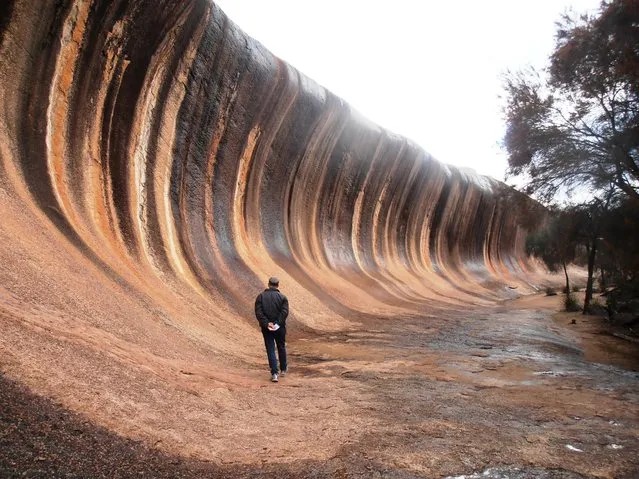
Wave Rock, Arizona

Wave Rock is a natural rock formation that is shaped like a tall breaking ocean wave. The "wave" is about 14 m (46 ft) high and around 110 m (360 ft) long. It forms the north side of a solitary hill, which is known as “Hyden Rock”. This hill, which is a granite inselberg, lies about 3 km (2 mi) east of the small town of Hyden and 296 km (184 mi) east-southeast of Perth, Western Australia. Wave Rock and Hyden Rock are part of a 160 ha (395-acre) nature reserve, Hyden Wildlife Park.
Details
12 Aug 2014 10:21:00
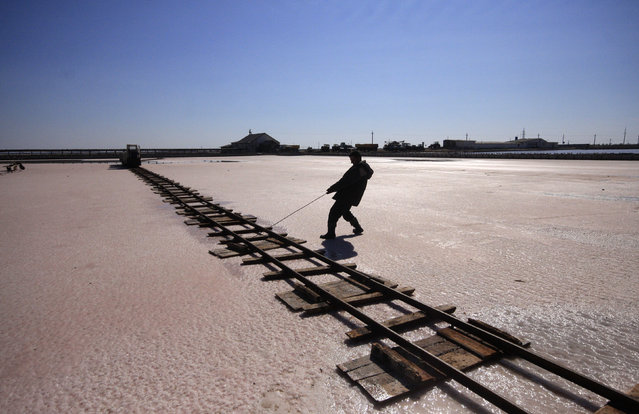
A worker lays rails across the bed of a drained area of a lake used for the production of salt at the Sasyk-Sivash lake near the city of Yevpatoria in Crimea, October 5, 2014. (Photo by Pavel Rebrov/Reuters)

A worker lays rails across the bed of a drained area of a lake used for the production of salt at the Sasyk-Sivash lake near the city of Yevpatoria in Crimea, October 5, 2014. The area has a long tradition of salt production, prepared from salt flats flooded with water from the Black Sea. (Photo by Pavel Rebrov/Reuters)
Details
07 Oct 2014 11:24:00
Photographers: Julien Mauve. Back To Childhood

“Julien Mauve is a Paris based professional web designer, front-end developer and content manager who loves innovation, experimentation and creation. Julien has taken up photography as a hobby. His collection Back to Childhood is all about bringing the long lost memories of early days into the adult life. How he came about that idea? Julien stumbled upon some of his old toys in his grandpa’s attic and felt a connection to every single one of them. Each toy brought back a fond memory”.
Details
06 Apr 2012 20:05:00
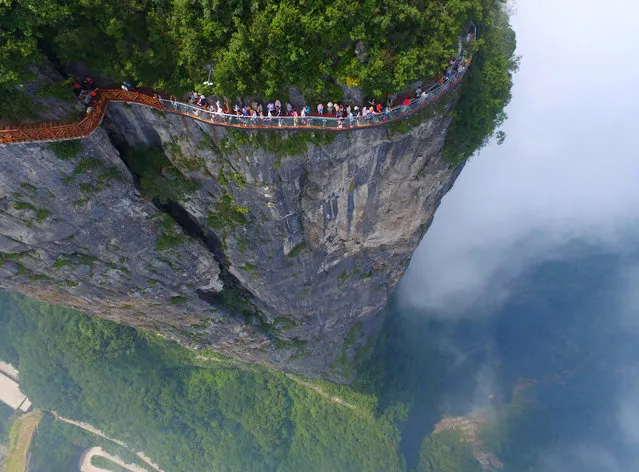
People walk on a sightseeing platform in Zhangjiajie, Hunan Province, China, August 1, 2016. (Photo by Reuters/Stringer)

People walk on a sightseeing platform in Zhangjiajie, Hunan Province, China, August 1, 2016. China has opened a 100-metre-long glass skywalk stretching around a cliff on the side of the Tianmen Mountain. The skywalk provides a view of a 300-metre drop and overlooks Tongtian Avenue, a mountain road with 99 turns that snakes up the mountain. When translated in English, it means “Avenue to the Sky”. (Photo by Reuters/Stringer)
Details
04 Aug 2016 10:39:00
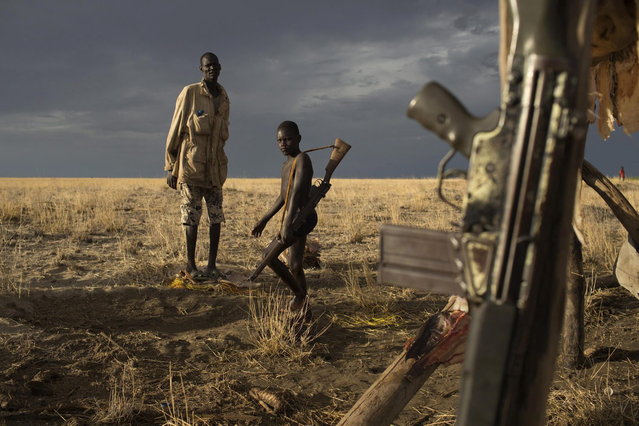
A Turkana man and a boy carrying a gun look on as a G3 battle rifle hangs from a structure used to dry fish at a fishing camp on the shores of Lake Turkana, some kilometres from Todonyang near the Kenya-Ethiopia border in northwestern Kenya October 12, 2013. (Photo by Siegfried Modola/Reuters)

A Turkana man and a boy carrying a gun look on as a G3 battle rifle hangs from a structure used to dry fish at a fishing camp on the shores of Lake Turkana, some kilometres from Todonyang near the Kenya-Ethiopia border in northwestern Kenya October 12, 2013The Turkana are traditionally nomadic pastoralists, but they have seen the pasture that they need to feed their herds suffer from recurring droughts and many have turned to fishing. However, Lake Turkana is overfished, and scarcity of food and pastureland is fuelling long-standing conflict with Ethiopian indigenous Dhaasanac, who have seen grazing grounds squeezed by large-scale government agricultural schemes in southern Ethiopia. The Dhaasanac now venture ever deeper into Kenyan territory in search of fish and grass, clashing with neighbours. Fighting between the communities has a long history, but the conflict has become ever more fatal as automatic weapons from other regional conflicts seep into the area. While the Turkana region is short of basics like grass and ground-water, it contains other resources including oil reserves and massive, newly discovered underground aquifers. (Photo by Siegfried Modola/Reuters)
Details
05 Dec 2013 12:08:00