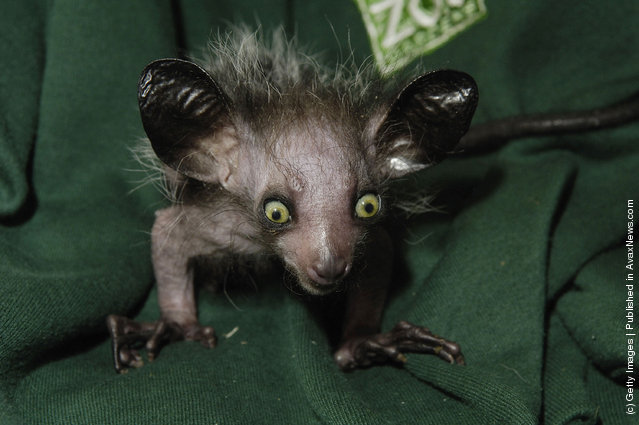
“The aye-aye (Daubentonia madagascariensis) is a lemur, a strepsirrhine primate native to Madagascar that combines rodent-like teeth and a special thin middle finger to fill the same ecological niche as a woodpecker. It is the world's largest nocturnal primate, and is characterized by its unusual method of finding food; it taps on trees to find grubs, then gnaws holes in the wood and inserts its narrow middle finger to pull the grubs out. The only other animal species known to find food in this way is the striped possum. From an ecological point of view the aye-aye fills the niche of a woodpecker as it is capable of penetrating wood to extract the invertebrates within”. – Wikipedia
Photo: In this handout image from Bristol Zoo is seen the first captive bred aye-aye in the UK named “Kintana” (meaning star in Malagasy) April 15, 2005 at Bristol Zoo Gardens, England. The zoo announced today only the second baby aye-aye to be hand-reared in the world (the first was in Jersey Zoo) and has now made his first public appearance since his birth on 11 February 2005. (Photo by Rob Cousins/Bristol Zoo via Getty Images)
A student aims a stick of wood at Bolivarian National Police officers during clashes outside the Central University in Caracas, Venezuela, Thursday, June 9, 2016. Students had planned to march from Venezuela's top university to elections headquarters, but hundreds of police in riot gear blocked the way. Students covered their faces with Venezuelan flags and threw bottles, stones and sticks while police lobbed tear gas. (Photo by Fernando Llano/AP Photo)
A girl from Newar community is pictured with vermillion powder on her forehead as she takes part at the Ihi ceremony in Bhaktapur, Nepal on December 6, 2019. The two-day ceremony begins with purification rituals and ends with “Kanyadan” (giving away the virgin) of the girl by her father. A Newari girl gets married thrice in her life, first with Bel, the fruit of a wood-apple tree, secondly with the sun, and lastly with her future husband. (Photo by Monika Deupala/Reuters)
Police officers look on as protesters block the road with burning tyres and wood, during a mass protest the morning after preliminary results were released for five communes in Conakry on October 21, 2020. African monitors said on October 20, 2020, that Guinea's weekend election was conducted properly, but the political opposition to incumbent Alpha Conde, which has already claimed victory, dismissed it as fraudulent. (Photo by John Wessels/AFP Photo)
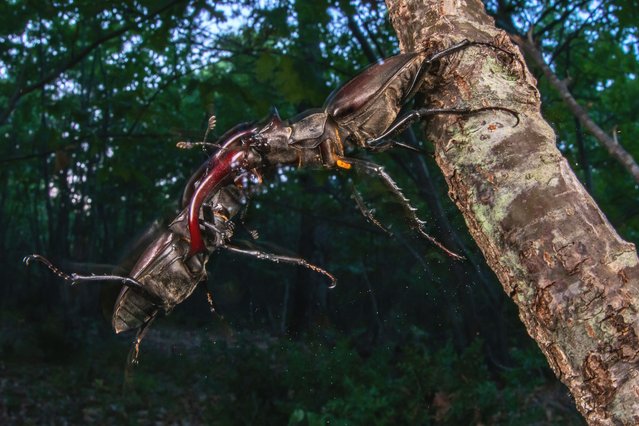
Combat between two male stag beetles, Italy, 2022. During the mating season, male stag beetles (Lucanus cervus) go into a frenzy, with lively but harmless clashes, in which bigger males often have the advantage over smaller ones due to their impressive mandibles. Longer larval development and genetic traits can increase the size of some individuals, but all saproxylic beetles are threatened by poor forest management, logging and dead wood removal to “clean” the forest. (Photo by Iacopo Nerozzi)
Sunrise over a moor viewed from Littaford Tor, Dartmoor, UK, 2016. Autumn visits the windswept moors and granite tors of Dartmoor earlier than the rest of the south-west. While there aren’t many trees here, autumn shades appear in golden ferns and tan heather. Littaford Tors, near Two Bridges and a mile from Princetown, is a short walk and can be combined with a visit to the adjacent Wistman’s Wood. (Photo by Stuart Holmes)