Loading...
Done
Women wearing face-kini masks lie on a beach to rest in Qingdao, Shandong province, China, June 3, 2015. A pale complexion is highly prized as delicate and feminine in China while dark skin suggests tanning caused by farming the fields or other lowly, outdoor work. (Photo by Reuters/Stringer)

Women wearing face-kini masks lie on a beach to rest in Qingdao, Shandong province, China, June 3, 2015. A pale complexion is highly prized as delicate and feminine in China while dark skin suggests tanning caused by farming the fields or other lowly, outdoor work. (Photo by Reuters/Stringer)
Details
16 Jul 2015 11:02:00
“Early morning in Mandawa, rural Rajasthan: it was the morning of Diwali and the streets were swept by smiling women in brightly coloured sarees as I took an early morning cup of chai. Celebrations started later, when darkness fell”. (Photo by Hamish Scott-Brown/Guardian Witness)

“Early morning in Mandawa, rural Rajasthan: it was the morning of Diwali and the streets were swept by smiling women in brightly coloured sarees as I took an early morning cup of chai. Celebrations started later, when darkness fell”. (Photo by Hamish Scott-Brown/Guardian Witness)
Details
20 Dec 2016 12:57:00
Sete Tamang, 20, avalanche survivor, waits to receive the bodies of his colleagues outside a morgue at Teaching Hospital in Katmandu, Nepal, Monday, October 20, 2014. Nepal was wrapping up rescue operations in its northern mountains Monday, saying all the hikers believed to have been stranded on a trekking route by a series of deadly blizzards are now safe. (Photo by Niranjan Shrestha/AP Photo)

Sete Tamang, 20, avalanche survivor, waits to receive the bodies of his colleagues outside a morgue at Teaching Hospital in Katmandu, Nepal, Monday, October 20, 2014. Nepal was wrapping up rescue operations in its northern mountains Monday, saying all the hikers believed to have been stranded on a trekking route by a series of deadly blizzards are now safe. (Photo by Niranjan Shrestha/AP Photo)
Details
20 Oct 2014 08:51:00
This image provided by NASA shoaws the comet PANSTARRS as seen from Mount Dale, Western Australia on March 5, 2013. According to NASA on March 10, it will make its closest approach to the sun about 28 million miles (45 million kilometers) away. As it continues its nightly trek across the sky, the comet may get lost in the sun's glare but should return and be visible to the naked eye by March 12. (Photo by AP Photo/NASA)

It’s time to start watching for Comet PANSTARRS, one of two comets to get excited about in 2013. Photo: This image provided by NASA shoaws the comet PANSTARRS as seen from Mount Dale, Western Australia on March 5, 2013. According to NASA on March 10, it will make its closest approach to the sun about 28 million miles (45 million kilometers) away. As it continues its nightly trek across the sky, the comet may get lost in the sun's glare but should return and be visible to the naked eye by March 12. (Photo by AP Photo/NASA)
Details
13 Mar 2013 08:03:00
Scientists trekking for days to the undisputed furthest north land point on the planet, in October 2024 were greeted by an unexpected welcoming party: a stoat, whom they named Randall. The team were heading to Kaffeklubben Island, also known as Inuit Qeqertaat, off the northern tip of Greenland, about 440 miles from the North Pole, when Randall emerged from a cairn of rocks, showing no fear as he went to investigate them. (Photo by Jeff Kerby/Magnus News)

Scientists trekking for days to the undisputed furthest north land point on the planet, in October 2024 were greeted by an unexpected welcoming party: a stoat, whom they named Randall. The team were heading to Kaffeklubben Island, also known as Inuit Qeqertaat, off the northern tip of Greenland, about 440 miles from the North Pole, when Randall emerged from a cairn of rocks, showing no fear as he went to investigate them. (Photo by Jeff Kerby/Magnus News)
Details
27 Oct 2024 04:30:00
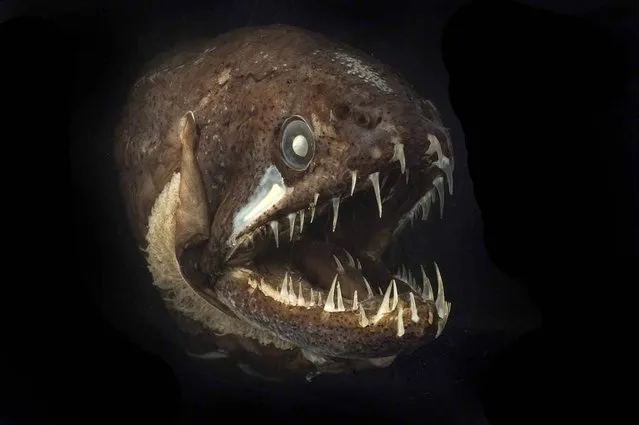
Imagine living in the sea where it is permanently dark, cold, and food is hard to find. For many animals at depth, it may be weeks to months between meals. If you find something to eat, you have to hang on to it

Imagine living in the sea where it is permanently dark, cold, and food is hard to find. For many animals at depth, it may be weeks to months between meals. If you find something to eat, you have to hang on to it. This is why so many deep-sea fishes have lots of big teeth. This dragonfish, spotted off the coast of Australia, even has teeth on its tongue. They would be terrifying animals ... if they weren’t the size of a banana. (Photo by Julian Finn/Museum Victoria)
Details
21 May 2012 12:14:00
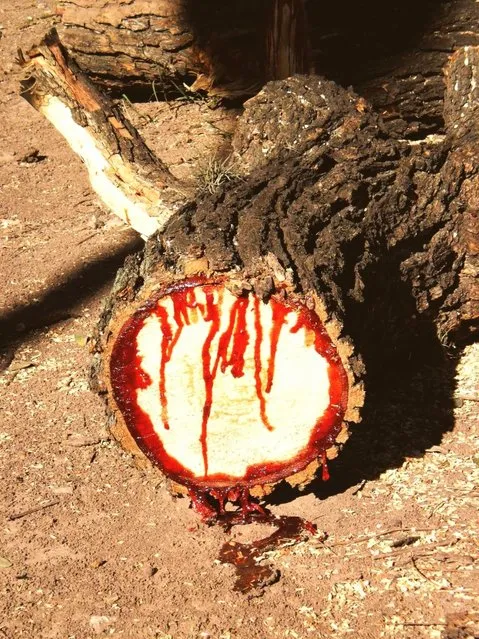
Bloodwood Tree

The bloodwood tree (Pterocarpus angolensis) is a deciduous tree with a high canopy, reaching about 15m in height and has dark bark. The red sap is used traditionally as a dye and in some areas mixed with animal fat to make a cosmetic for faces and bodies. It is also believed to have magical properties for the curing of problems concerning blood, apparently because of its close resemblance to blood. The name bloodwood for these trees stems from the dark red to brown sap that accumulates on wounds on the trunks.
Details
14 May 2014 12:44:00
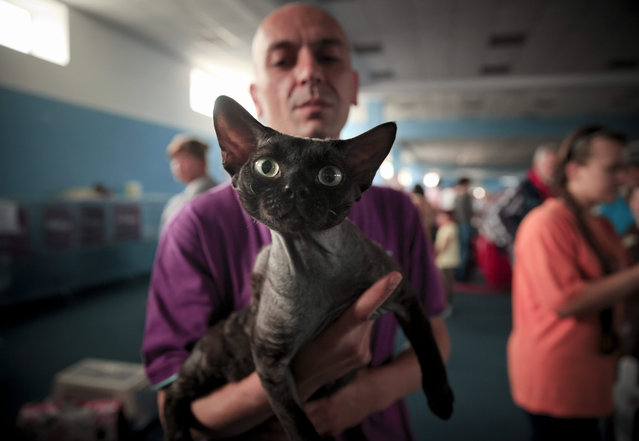
A dark Devon Rex cat is held by its owner during a competition in Bucharest, Romania, Saturday, September 26, 2015. More than 300 cats entered the international feline beauty competition in the Romanian capital. (Photo by Vadim Ghirda/AP Photo)

A dark Devon Rex cat is held by its owner during a competition in Bucharest, Romania, Saturday, September 26, 2015. More than 300 cats entered the international feline beauty competition in the Romanian capital. (Photo by Vadim Ghirda/AP Photo)
Details
28 Sep 2015 08:07:00