Loading...
Done
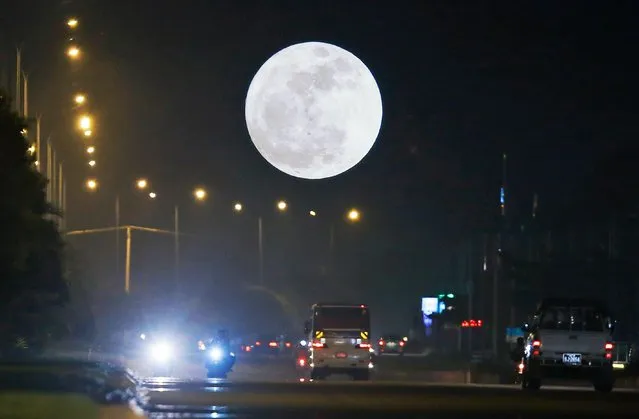
A so-called “Supermoon” dominates the sky while traffic rolls in the streets in Naypyitaw, Myanmar, 03 December 2017. According to the National Aeronautics and Space Administration (NASA) a series of three “Supermoons” – dubbed the “Supermoon trilogy” – will appear in the sky on 03 December 2017, on 01 January 2018 and and 31 January 2018. A 'Supermoon' commonly is a full moon at its closest distance to the earth with the moon appearing larger than usual. (Photo by Hein Htet/EPA/EFE)

A so-called “Supermoon” dominates the sky while traffic rolls in the streets in Naypyitaw, Myanmar, 03 December 2017. According to the National Aeronautics and Space Administration (NASA) a series of three “Supermoons” – dubbed the “Supermoon trilogy” – will appear in the sky on 03 December 2017, on 01 January 2018 and and 31 January 2018. A “Supermoon” commonly is a full moon at its closest distance to the earth with the moon appearing larger than usual. (Photo by Hein Htet/EPA/EFE)
Details
05 Dec 2017 07:45:00
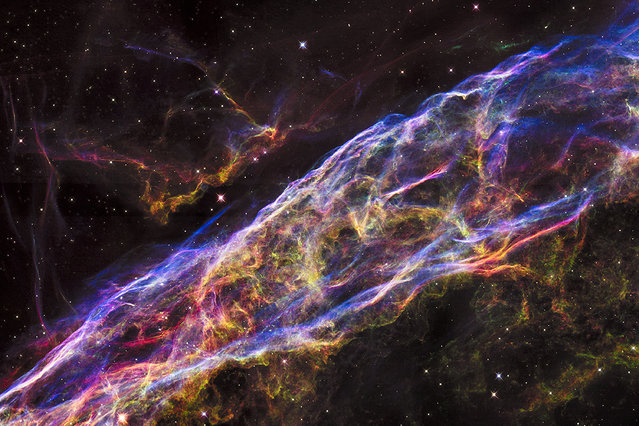
A small section of the expanding remains of the Veil Nebula, a massive star that exploded about 8,000 years ago. The entire nebula is 110 light-years across, covering six full moons on the sky as seen from Earth, and resides about 2,100 light-years away in the constellation Cygnus, the Swan. Image taken by NASA's Hubble Space Telescope. Released September 24, 2015. (Photo by Reuters/NASA/ESA/Hubble Heritage Team)

A small section of the expanding remains of the Veil Nebula, a massive star that exploded about 8,000 years ago. The entire nebula is 110 light-years across, covering six full moons on the sky as seen from Earth, and resides about 2,100 light-years away in the constellation Cygnus, the Swan. Image taken by NASA's Hubble Space Telescope. Released September 24, 2015. (Photo by Reuters/NASA/ESA/Hubble Heritage Team)
Details
10 Dec 2015 08:01:00
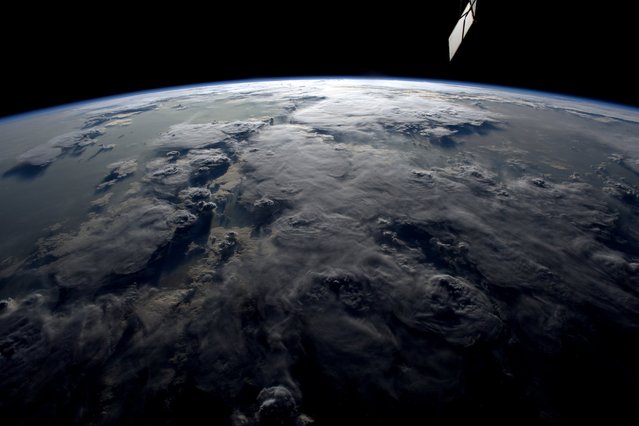
European Space Agency astronaut Tim Peake will return home after a six-month long mission on the International Space Station,on June 18, 2016. Peake was the first British ESA astronaut to visit the ISS and captured hundreds of photographs of the Earth during his mission. Here: “Lots of sun-glint right now during our whole orbit – we haven't seen a sunset for over 3 days”, he wrote. (Photo by Tim Peake/ESA/NASA)

European Space Agency astronaut Tim Peake will return home after a six-month long mission on the International Space Station,on June 18, 2016. Peake was the first British ESA astronaut to visit the ISS and captured hundreds of photographs of the Earth during his mission. Here: “Lots of sun-glint right now during our whole orbit – we haven't seen a sunset for over 3 days”, he wrote. (Photo by Tim Peake/ESA/NASA)
Details
18 Jun 2016 13:08:00
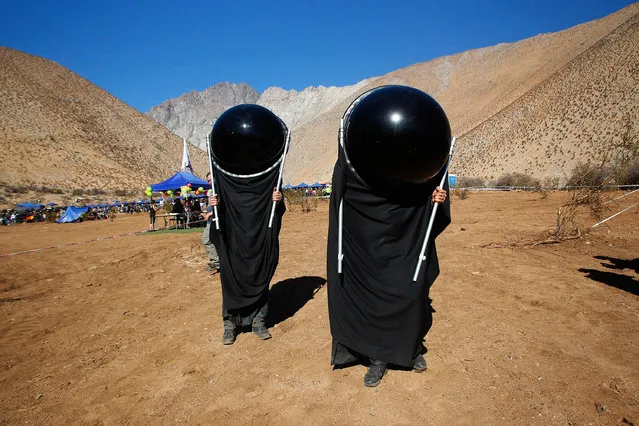
Chileans watch the sky with special suits prior to a total solar eclipse on July 2, 2019 in Paiguano, Chile. Around 25,0000 tourists arrived to Paiguano, a small town of around 1,000 inhabitants in the Elqui Valley, 650 km away Santiago. This is the only Earth's total solar eclipse of 2019 and the first one since 2017. From this point, the sun will fully disappear for around two minutes. It is best visible from a stripe in the South Pacific, Chile and Argentina. (Photo by Marcelo Hernandez/Getty Images)

Chileans watch the sky with special suits prior to a total solar eclipse on July 2, 2019 in Paiguano, Chile. Around 25,0000 tourists arrived to Paiguano, a small town of around 1,000 inhabitants in the Elqui Valley, 650 km away Santiago. This is the only Earth's total solar eclipse of 2019 and the first one since 2017. From this point, the sun will fully disappear for around two minutes. It is best visible from a stripe in the South Pacific, Chile and Argentina. (Photo by Marcelo Hernandez/Getty Images)
Details
04 Jul 2019 00:05:00
An offering of a dried baby llama and fake U.S. burn in honor of Pachamama, or Mother Earth, during a New Year ritual on Turriturrini Mountain on the outskirts of Huarina, Bolivia, Friday, June 21, 2024. Aymara Indigenous communities are celebrating the Andean New Year 5,532 or “Willka Kuti” which translates to “Return of the sun” in Aymara. (Photo by Juan Karita/AP Photo)

An offering of a dried baby llama and fake U.S. burn in honor of Pachamama, or Mother Earth, during a New Year ritual on Turriturrini Mountain on the outskirts of Huarina, Bolivia, Friday, June 21, 2024. Aymara Indigenous communities are celebrating the Andean New Year 5,532 or “Willka Kuti” which translates to “Return of the sun” in Aymara. (Photo by Juan Karita/AP Photo)
Details
31 Jul 2024 06:29:00
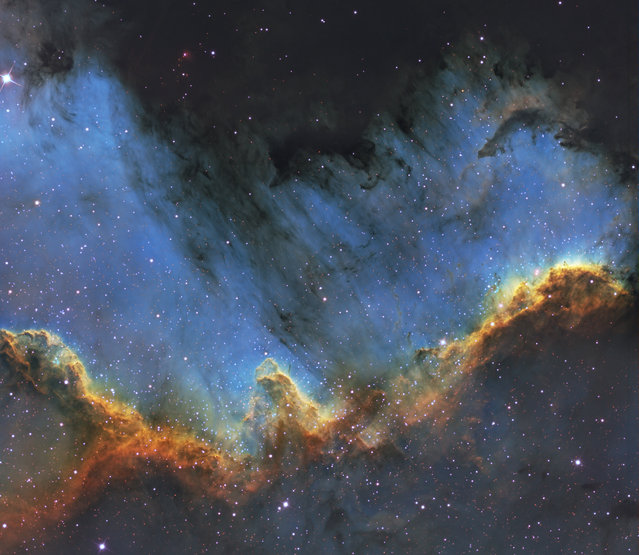
The Cygnus Wall is in the southern  area of NGC7000 also known as the North America Nebula. It is approximately 1800 light years from Earth, and is in the constellation Cygnus. The Wall is an energized shock front and contains the most concentrated star formations in the nebula. The size of the North America Nebula is about 4 full moons. (Bill Snyder)

Amateur astronomer Bill Snyder has been involved with astrophotography since 2007. Photo: The Cygnus Wall is in the southern area of NGC7000 also known as the North America Nebula. It is approximately 1800 light years from Earth, and is in the constellation Cygnus. The Wall is an energized shock front and contains the most concentrated star formations in the nebula. The size of the North America Nebula is about 4 full moons. (Photo and caption by Bill Snyder)
Details
30 Oct 2013 09:15:00
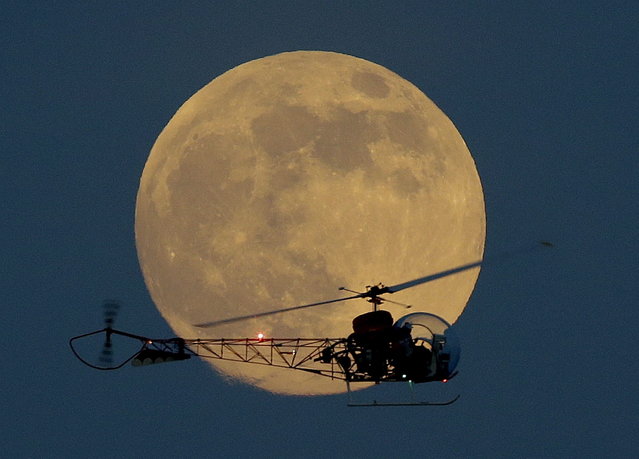
The moon is seen in its waxing gibbous stage as it rises behind the helicopter from the original Batman television show, which people can ride at the New Jersey State Fair, Saturday, June 22, 2013, in East Rutherford, N.J. The moon, which will reach its full stage on Sunday, is expected to be 13.5 percent closer to earth during a phenomenon known as supermoon. (Photo by Julio Cortez/AP Photo)

The moon is seen in its waxing gibbous stage as it rises behind the helicopter from the original Batman television show, which people can ride at the New Jersey State Fair, Saturday, June 22, 2013, in East Rutherford, N.J. The moon, which will reach its full stage on Sunday, is expected to be 13.5 percent closer to earth during a phenomenon known as supermoon. (Photo by Julio Cortez/AP Photo)
Details
24 Jun 2013 12:17:00
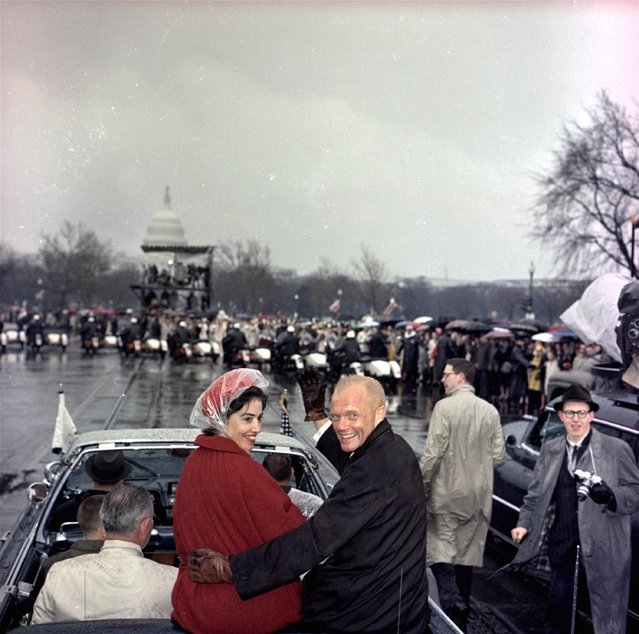
In this February 26, 1962 file photo, Mercury astronaut John Glenn, and his wife, Annie, ride in the back of an open car with Vice-President Johnson during a parade in Glenn's honor in Washington. The Capitol is seen in the background. Glenn, the first American to orbit Earth who later spent 24 years representing Ohio in the Senate, died Thursday, Dec. 8, 2016, at the age of 95. (Photo by AP Photo)

In this February 26, 1962 file photo, Mercury astronaut John Glenn, and his wife, Annie, ride in the back of an open car with Vice-President Johnson during a parade in Glenn's honor in Washington. The Capitol is seen in the background. Glenn, the first American to orbit Earth who later spent 24 years representing Ohio in the Senate, died Thursday, Dec. 8, 2016, at the age of 95. (Photo by AP Photo)
Details
09 Dec 2016 11:35:00