Loading...
Done
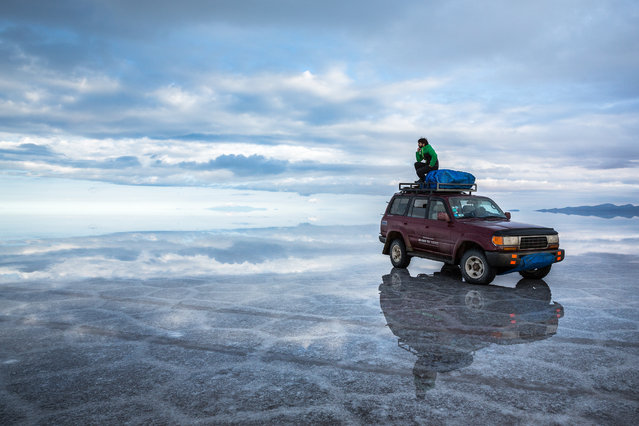
At 10,582 square kilometres, the Bolivian salt flats – otherwise known as Salar de Uyuni – are the largest on the planet and contain between 50 and 70% of the world’s lithium reserves. After exploring Chile and Argentina, photographer Joel Santos decided to travel to Bolivia in January 2017 to check the salt flats off his bucket list. With an electrical storm rolling in, Joel and his two travelling companions were the only souls left on the vast flats and captured the eerie flats without a person in sight. (Photo by Joel Santos/Barcroft Images)

At 10,582 square kilometres, the Bolivian salt flats – otherwise known as Salar de Uyuni – are the largest on the planet and contain between 50 and 70% of the world’s lithium reserves. After exploring Chile and Argentina, photographer Joel Santos decided to travel to Bolivia in January 2017 to check the salt flats off his bucket list. With an electrical storm rolling in, Joel and his two travelling companions were the only souls left on the vast flats and captured the eerie flats without a person in sight. (Photo by Joel Santos/Barcroft Images)
Details
12 Aug 2019 00:03:00
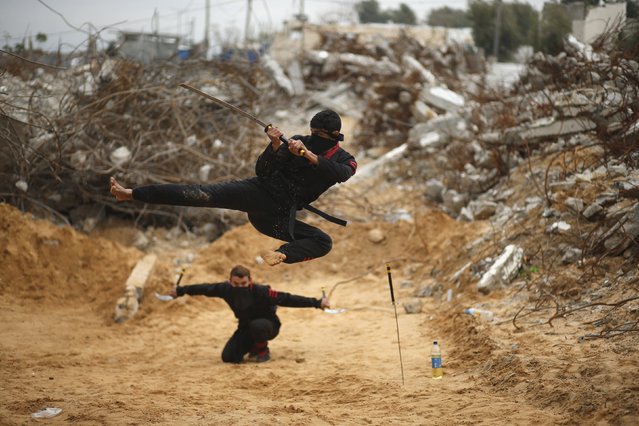
A Palestinian youth jumps with a sword as he demonstrates his ninja-style skills for the photographer in front of the ruins of buildings, that were destroyed in 2014 war, in the northern Gaza Strip January 29, 2016. The youths, who have been receiving martial arts training at local clubs in Gaza for the past two years, decided to form a team to hold regular shows in the hope that the publicity generated will eventually lead to them being invited to participate in international contests. (Photo by Mohammed Salem/Reuters)

A Palestinian youth jumps with a sword as he demonstrates his ninja-style skills for the photographer in front of the ruins of buildings, that were destroyed in 2014 war, in the northern Gaza Strip January 29, 2016. The youths, who have been receiving martial arts training at local clubs in Gaza for the past two years, decided to form a team to hold regular shows in the hope that the publicity generated will eventually lead to them being invited to participate in international contests. (Photo by Mohammed Salem/Reuters)
Details
30 Jan 2016 13:05:00
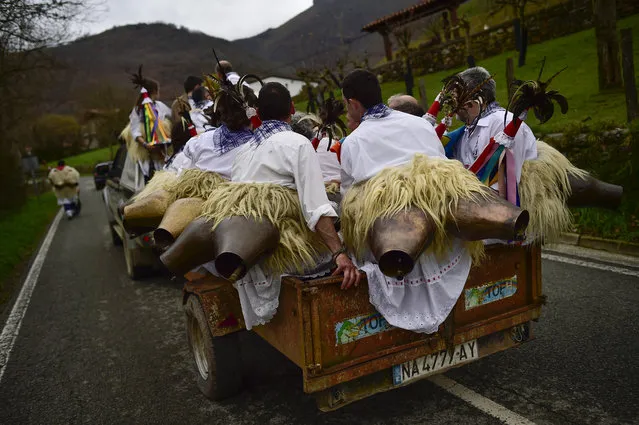
Joaldunaks return in a trailer to their town at the end of Carnival between of the Pyrenees villages of Ituren and Zubieta, northern Spain, Monday, February 1, 2016. In one of the most ancient carnivals in Europe, dating from before the Roman empire, companies of Joaldunak (cowbells) made up of residents of two towns, Ituren and Zubieta, parade the streets costumed in sandals, lace petticoats, sheepskins around the waist and shoulders, coloured neckerchiefs, conical caps with ribbons and a hyssop of horsehair in their right hands and cowbells hung across their lower back. (Photo by Alvaro Barrientos/AP Photo)

Joaldunaks return in a trailer to their town at the end of Carnival between of the Pyrenees villages of Ituren and Zubieta, northern Spain, Monday, February 1, 2016. In one of the most ancient carnivals in Europe, dating from before the Roman empire, companies of Joaldunak (cowbells) made up of residents of two towns, Ituren and Zubieta, parade the streets costumed in sandals, lace petticoats, sheepskins around the waist and shoulders, coloured neckerchiefs, conical caps with ribbons and a hyssop of horsehair in their right hands and cowbells hung across their lower back. (Photo by Alvaro Barrientos/AP Photo)
Details
02 Feb 2016 13:07:00
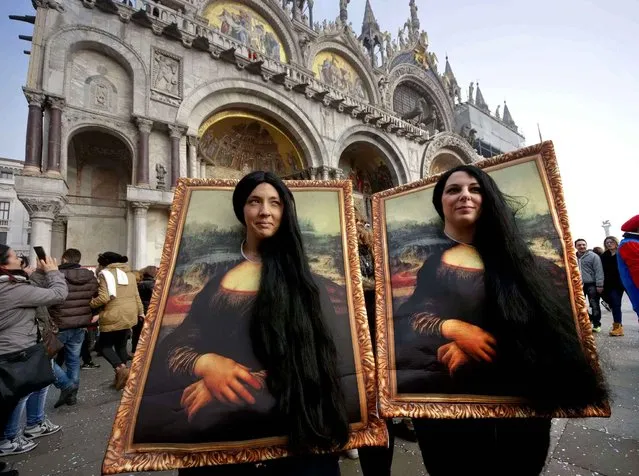
Two carnival revellers masquerade as Leonardo da Vinci's painting “Mona Lisa” pose in St. Mark's Square in Venice, Italy, Sunday, January 31, 2016. Carnival-goers in Venice are being asked by police to momentarily lift their masks as part of new anti-terrorism measures for the annual festivities. (Photo by Domenico Stinellis/AP Photo)

Two carnival revellers masquerade as Leonardo da Vinci's painting “Mona Lisa” pose in St. Mark's Square in Venice, Italy, Sunday, January 31, 2016. Carnival-goers in Venice are being asked by police to momentarily lift their masks as part of new anti-terrorism measures for the annual festivities. (Photo by Domenico Stinellis/AP Photo)
Details
02 Feb 2016 14:02:00
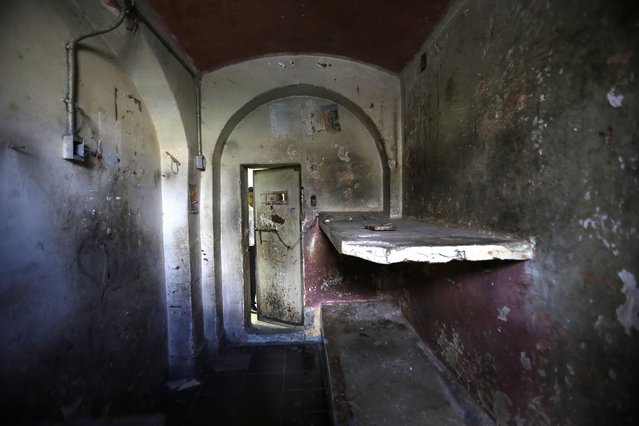
In this April 7, 2015 photo, a tourist peers through the door of a jail cell inside the now empty Garcia Moreno prison during a guided tour for the public in Quito, Ecuador. According to tour guides, this cell was nicknamed “Los Polillas”, or “The Moths”. Here, in a room designed to hold two prisoners, about 15 inmates with drug addictions were locked in overnight by the prison gangs that controlled daily life. The locked-in prisoners were also known to prostitute themselves to get access to drugs. (Photo by Dolores Ochoa/AP Photo)

In this April 7, 2015 photo, a tourist peers through the door of a jail cell inside the now empty Garcia Moreno prison during a guided tour for the public in Quito, Ecuador. According to tour guides, this cell was nicknamed “Los Polillas”, or “The Moths”. Here, in a room designed to hold two prisoners, about 15 inmates with drug addictions were locked in overnight by the prison gangs that controlled daily life. The locked-in prisoners were also known to prostitute themselves to get access to drugs. (Photo by Dolores Ochoa/AP Photo)
Details
03 May 2015 10:34:00
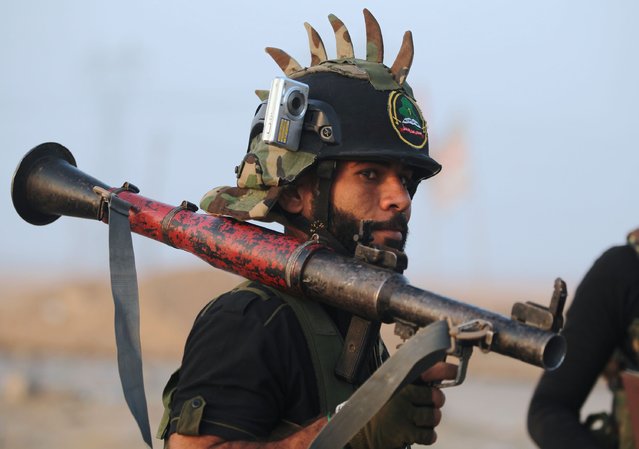
A Shiite fighter from the Hashed al-Shaabi (Popular Mobilisation) patrols in the village of Ayn Nasir, south of Mosul, on October 29, 2016, after recapturing it from Islamic State group jihadists in an ongoing operation to retake the city of Mosul. Iraqi paramilitary forces launched an operation to cut the Islamic State group's supply lines between its Mosul bastion and neighbouring Syria, opening a new front in the nearly two-week-old offensive. (Photo by Ahmad Al-Rubaye/AFP Photo)

A Shiite fighter from the Hashed al-Shaabi (Popular Mobilisation) patrols in the village of Ayn Nasir, south of Mosul, on October 29, 2016, after recapturing it from Islamic State group jihadists in an ongoing operation to retake the city of Mosul. Iraqi paramilitary forces launched an operation to cut the Islamic State group's supply lines between its Mosul bastion and neighbouring Syria, opening a new front in the nearly two-week-old offensive. (Photo by Ahmad Al-Rubaye/AFP Photo)
Details
31 Oct 2016 11:20:00
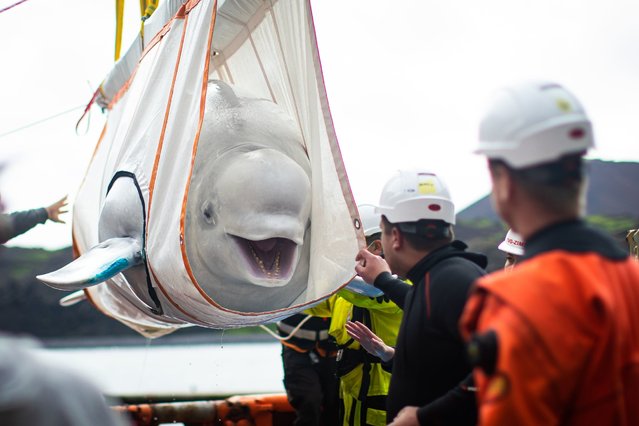
The Sea Life Trust team move Beluga Whale Little Gray from a tugboat during transfer to the bayside care pool where they will be acclimatised to the natural environment of their new home at the open water sanctuary in Klettsvik Bay in Iceland on August 7, 2020. The two Beluga whales, named Little Grey and Little White, are being moved to the world's first open-water whale sanctuary after travelling from an aquarium in China 6,000 miles away in June 2019. (Photo by Aaron Chown/PA Images via Getty Images)

The Sea Life Trust team move Beluga Whale Little Gray from a tugboat during transfer to the bayside care pool where they will be acclimatised to the natural environment of their new home at the open water sanctuary in Klettsvik Bay in Iceland on August 7, 2020. The two Beluga whales, named Little Grey and Little White, are being moved to the world's first open-water whale sanctuary after travelling from an aquarium in China 6,000 miles away in June 2019. (Photo by Aaron Chown/PA Images via Getty Images)
Details
28 Aug 2020 00:03:00
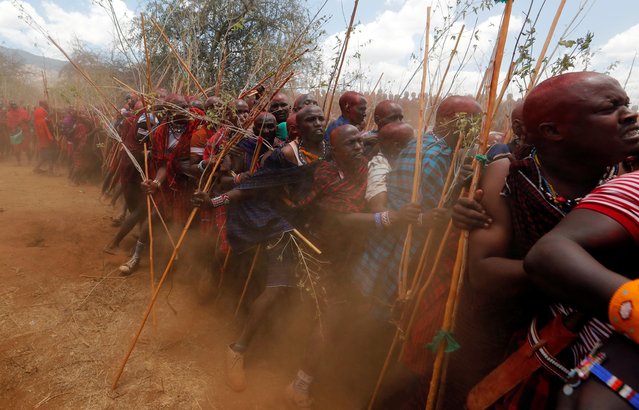
Maasai men of Matapato jostle to parade as they attend the Olng'esherr (meat-eating) passage ceremony to unite two age-sets; the older Ilpaamu and the younger Ilaitete into senior elderhood as the final rite of passage, in Maparasha hills of Kajiado, Kenya on September 23, 2020. Thousands of Maasai men clad in red and purple shawls and with their heads coated in red ochre gathered this week for a ceremony that transforms them from Moran (warriors) to Mzee (elders). (Photo by Thomas Mukoya/Reuters)

Maasai men of Matapato jostle to parade as they attend the Olng'esherr (meat-eating) passage ceremony to unite two age-sets; the older Ilpaamu and the younger Ilaitete into senior elderhood as the final rite of passage, in Maparasha hills of Kajiado, Kenya on September 23, 2020. Thousands of Maasai men clad in red and purple shawls and with their heads coated in red ochre gathered this week for a ceremony that transforms them from Moran (warriors) to Mzee (elders). (Photo by Thomas Mukoya/Reuters)
Details
29 Sep 2020 00:01:00