Loading...
Done


“Body blading (also known as buggy rollin') is an extreme sport that involves descending down a slope while wearing a flexible aerodynamic plastic roller suit that has wheels on the feet, knees, torso, and arms. This suit was created by Jean-Yves Blondeau, and he is one of the premier body bladers. Body blading is similar to roller blading, and in fact a body blader often starts out using the rollers on their feet in the same fashion as roller blades in order to gain initial speed, but then the rider generally assumes a position laying on the stomach facing down the hill. A body blader is capable of reaching very high speeds. Maneuverability is achieved by moving the body into various positions to change direction”. – Wikipedia

Photo: French designer Jean-Yves Blondeau demonstrates his “Buggy Rollin” suit during a performance on August 16, 2007 in Beijing, China. Blondeau is able to roll along in any position and can achieve high speeds wearing the suit. (Photo by China Photos/Getty Images)
Details
29 Jun 2011 11:00:00
In the hours 41-year-old Ralph Savelsberg is not working as a physicist for the Dutch Ministry of Defence, he is recreating classic vehicles in everyones favourite bricks. The Lego mad film buff has lived in the UK for the last few years building every famous car in entertainment you can imagine – And the characters to match! From Del Boys Reliant Regal to Chitty Chitty Bang Bang and the Batmobile, has Ralph handmade the most complete set of popular vehicles ever? Ralph said: Building a LEGO set is fun, but Ive always preferred to build my own models. Here: “Ghostbusters”. (Photo by Ralph Savelsberg/Caters News)

In the hours 41-year-old Ralph Savelsberg is not working as a physicist for the Dutch Ministry of Defence, he is recreating classic vehicles in everyones favourite bricks. Ralph said: Building a LEGO set is fun, but I've always preferred to build my own models. Here: “Ghostbusters”. (Photo by Ralph Savelsberg/Caters News)
Details
29 Nov 2016 13:21:00
In a military base in the Thai province of Chon Buri February 20 U.S. Marines Navy with Thailand began their studies in jungle survival. The event is held in joint military exercises “Cobra Gold 2013”. During a jungle survival program February 20, 2013 taught by Royal Thai Special Forces in Sannapit, Thailand, U.S. Marines learned to catch cobras and drink their fresh blood, not to mention eat forest insects and pull the heads off of chicken. The training was part of Operation Cobra Gold 13, the 32nd edition of international military exercises hosted by the Thai. According to a U.S. Marines press release, Cobra Gold is the largest exercise of its kind in Asia and incorporates troops from five other nations in addition to the U.S. and Thailand. The Daily Mail reports that the Marines were invited to experience the local custom of drinking cobra blood after being taught to catch and kill cobras in the wild. As CNN notes, Cobra blood is believed to be a panacea and aphrodiasic in parts of Southeast Asia. In Jakarta, vendors can earn over $100 a night selling shots of cobra blood mixed with liquor. (Photo by Pornchai Kittiwongsakul/AFP Photo)

During a jungle survival program February 20, 2013 taught by Royal Thai Special Forces in Sannapit, Thailand, U.S. Marines learned to catch cobras and drink their fresh blood, not to mention eat forest insects and pull the heads off of chicken. The training was part of Operation Cobra Gold 13, the 32nd edition of international military exercises hosted by the Thai. According to a U.S. Marines press release, Cobra Gold is the largest exercise of its kind in Asia and incorporates troops from five other nations in addition to the U.S. and Thailand. The Daily Mail reports that the Marines were invited to experience the local custom of drinking cobra blood after being taught to catch and kill cobras in the wild. As CNN notes, Cobra blood is believed to be a panacea and aphrodiasic in parts of Southeast Asia. In Jakarta, vendors can earn over $100 a night selling shots of cobra blood mixed with liquor. (Photo by Pornchai Kittiwongsakul/AFP Photo)
Details
23 Feb 2013 11:52:00


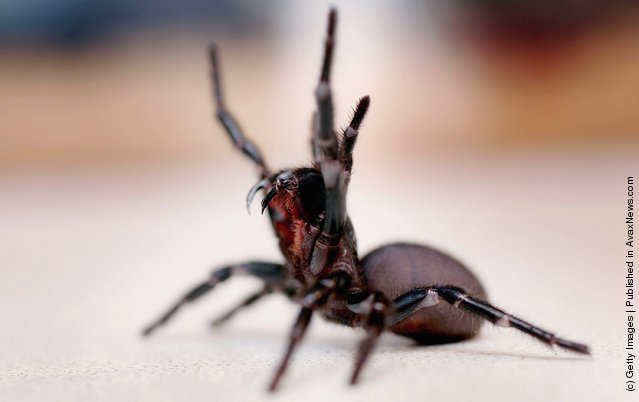
A Funnel Web spider is pictured at the Australian Reptile Park January 23, 2006 in Sydney, Australia. The Funnel Web is one of Australia's deadliest animals, with a venom that is packed with at least 40 different toxic proteins. A bite from a Funnel Web causes massive electrical over-load in the body's nervous system. Finally, fatalities occur from either heart attack or a pulmonary oedema, where the capillaries around the lungs begin to leak fluid and the patient effectively drowns. Death can come as quickly as two hours after a bite if no medical treatment is sought. Due to advances in anti-venom, there has been no death from a Funnel Web bite in Australia since 1980. Australia is home to some of the most deadly and poisonous animals on earth. (Photo by Ian Waldie/Getty Images)
Details
25 Apr 2011 07:49:00
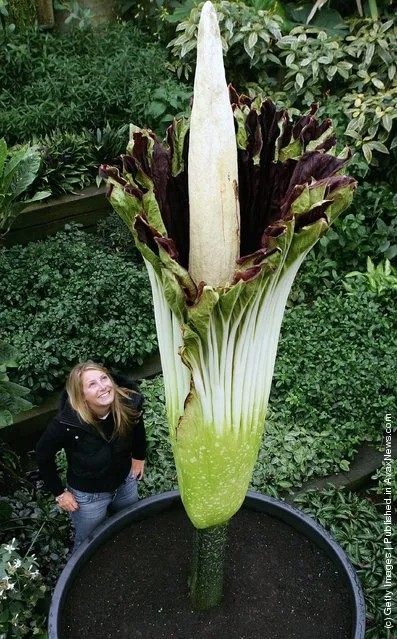
Kew Gardens employee Lauren Bird Royal examines the flowering of the Titan Arum lily at the Botanical Gardens

“The titan arum or Amorphophallus titanum (from Ancient Greek amorphos, “without form, misshapen” + phallos, “phallus”, and titan, “giant”) is a flowering plant with the largest unbranched inflorescence in the world. The titan arum's inflorescence is not as large as that of the Talipot palm, Corypha umbraculifera, but the inflorescence of the Talipot palm is branched rather than unbranched”. – Wikipedia

Photo: Kew Gardens employee Lauren Bird Royal examines the flowering of the Titan Arum lily at the Botanical Gardens at Kew on September 30, 2005 in London, England. For the first time in horticultural history, the Titan Arum lily can be seen at all three active stages in its lifecycle – in flower, fruit and leaf.The flowering corm is nearly three metres tall and weighs 91kg and is very rarely seen outside of the rainforests of Sumatra, Indonesia. (Photo by Scott Barbour/Getty Images)
Details
20 Sep 2011 11:13:00
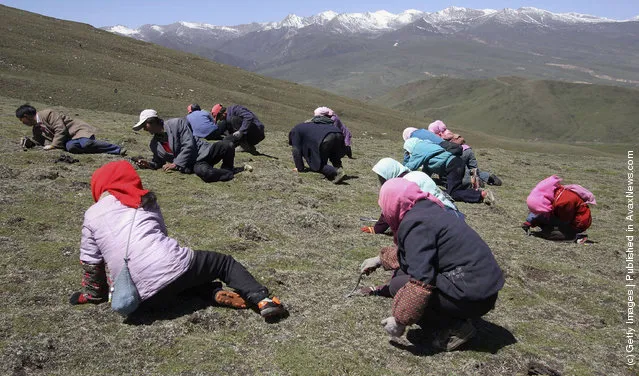
Ophiocordyceps Sinensis A.K.A. Caterpillar Fungus

“There are over 680 documented species of the sac fungus genus Ophiocordyceps, and one of the best known of these is Ophiocordyceps sinensis, colloquially known as caterpillar fungus. The fungus is known in Tibetan as yartsa gunbu or yatsa gunbu. O. sinensis is known in the West as a medicinal mushroom and its use has a long history in Traditional Chinese medicine as well as Traditional Tibetan medicine. The highly valuable fungus-caterpillar combination is hand-collected and is used as an aphrodisiac and as a treatment for a variety of ailments from fatigue to cancer”. – Wikipedia

Photo: Nomads dig for Chinese caterpillar fungus from a mountain May 25, 2007 in Guide County, Hainan Prefecture, Qinghai Province, China. Nomads can earn about 2,000 yuan to 5,000 yuan (about U.S. $260 to $653 ) through their work during the fifty-day Chinese caterpillar fungus gathering season. (Photo by China Photos/Getty Images)
Details
26 Sep 2011 10:47:00
Supporters celebrate as they watch official results from the Union Election Commission on an LED screen in front of the National League for Democracy Party (NLD) head office in Yangon, November 9, 2015. (Photo by Soe Zeya Tun/Reuters)

Supporters celebrate as they watch official results from the Union Election Commission on an LED screen in front of the National League for Democracy Party (NLD) head office in Yangon, November 9, 2015. Myanmar's ruling party conceded defeat in the country's general election on Monday, as the opposition led by democracy figurehead Aung San Suu Kyi appeared on course for a landslide victory that would ensure it can form the next government. "We lost," Union Solidarity and Development Party (USDP) acting chairman Htay Oo told Reuters in an interview a day after the Southeast Asian country's first free nationwide election in a quarter of a century. (Photo by Soe Zeya Tun/Reuters)
Details
11 Nov 2015 08:01:00
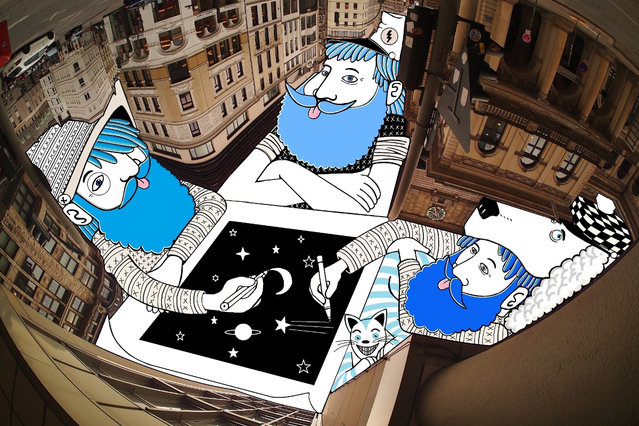
New Illustrations In The Sky Between Buildings By Thomas Lamadieu

French artist Thomas Lamadieu, also know as Roots Art, must really love looking at the sky. Every time he looks up, Thomas sees a potential canvas where the building rooftops frame the sky. He photographs it and uses the odd sky shapes to create whimsical line drawings. “My artistic aim is to show a different perception of urban architecture and the everyday environment around us, what we can construct with a boundless imagination,” says Thomas. (Photo by Thomas Lamadieu)


See Also:Whimsical Sky Art by Thomas Lamadieu
Details
26 Apr 2014 11:43:00