Loading...
Done
James Spears takes his 1964 German built Amphicar for a drive on Lake Mead in Nevada May 6, 2015. A prolonged drought in the Western United States has drastically affected the level of the lakes water. (Photo by Mike Blake/Reuters)

James Spears takes his 1964 German built Amphicar for a drive on Lake Mead in Nevada May 6, 2015. Its a journey many drivers dream of, rather than travelling round a lake simply driving through it. But for James Spears it may be time to make the most of the waters in Lake Mead in Nevada, as water levels are plunging as California struggles to cope with a fourthsuccessive year of droughts. (Photo by Mike Blake/Reuters)
Details
08 May 2015 14:06:00
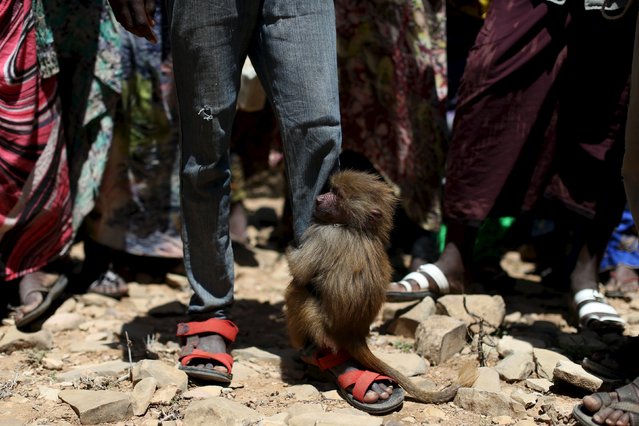
A baboon clings to the leg of an internally displaced boy at a camp on the outskirts of the town of Qol Ujeed, on the border with Ethiopia, Somaliland April 17, 2016. (Photo by Siegfried Modola/Reuters)

A baboon clings to the leg of an internally displaced boy at a camp on the outskirts of the town of Qol Ujeed, on the border with Ethiopia, Somaliland April 17, 2016. Across the Horn of Africa, millions have been hit by the severe El Nino-related drought. In Somaliland and its neighbouring, also semi-autonomous, Puntland region, 1.7 million people are in need of aid, according to the United Nations. In Somaliland itself, the most affected areas include the northwest Awdal region bordering Ethiopia. (Photo by Siegfried Modola/Reuters)
Details
29 Apr 2016 11:19:00
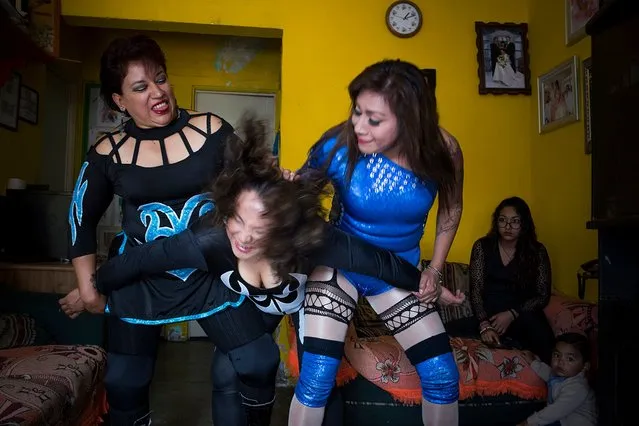
Juliza meets with colleagues at her home. (Photo by Diana Bagnoli/The Washington Post)

Lucha libre is Mexico’s version of what in the United States refer to as pro wrestling. Its dates to 1863, when a Mexican wrestler named Enrique Ugartechea developed a form of “freestyle” wrestling that was based on Greco-Roman wrestling. Lucha libre began to soar in popularity in Mexico after two Italian businessmen started promoting fights in the early 1900s. It has since become popular around the globe. Here: Juliza meets with colleagues at her home. (Photo by Diana Bagnoli/The Washington Post)
Details
15 Jun 2018 00:05:00
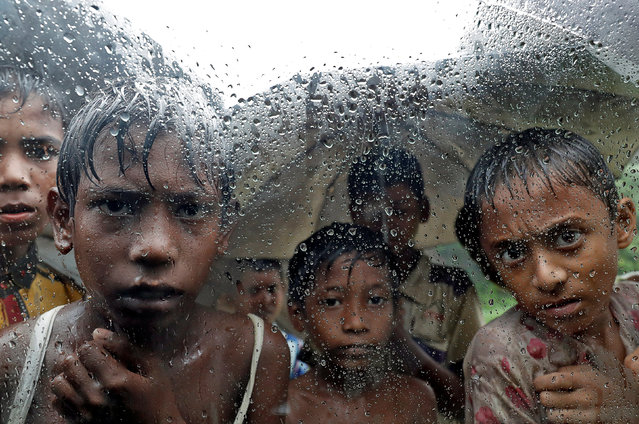
Rohingya refugee children pictured in a camp in Cox's Bazar, Bangladesh, September 19, 2017. (Photo by Cathal McNaughton/Reuters)

Rohingya refugee children pictured in a camp in Cox's Bazar, Bangladesh, September 19, 2017. With a mass exodus of Rohingya Muslims sparking accusations of ethnic cleansing from the United Nations and others, Myanmar leader Aung San Suu Kyi on Tuesday said her country does not fear international scrutiny and invited diplomats to see some areas for themselves. (Photo by Cathal McNaughton/Reuters)
Details
20 Sep 2017 08:36:00
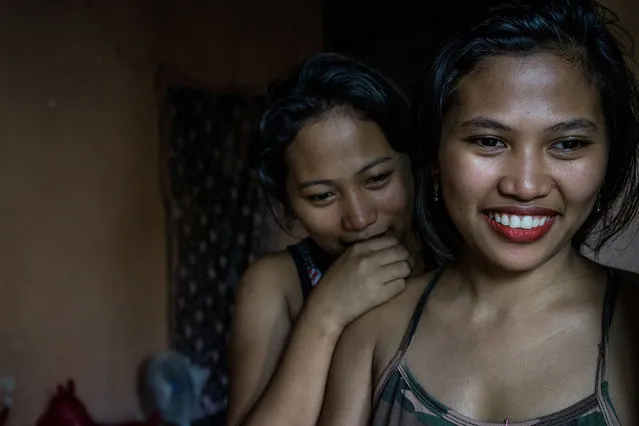
Gemma, right, and Joanne in their home in Angeles City. (Photo by Hannah Reyes Morales/The Washington Post)

Typhoon Yolanda – also known as Haiyan – struck the central part of the country November 8, 2013, leaving at least 6,300 people dead and over four million displaced. A month after Typhoon Haiyan, the United Nations Population Fund estimates that 5,000 women were subjected to sеxual violence. A study by the Health and Human Rights online publication shows the majority of young girls and women in Manila’s sеx industry come from poverty-stricken areas – such as Leyte, Samar, Cebu and southern Mindanao – and enter trafficking through force, deception, economic desperation and psychological manipulation. (Photo by Hannah Reyes Morales/The Washington Post)
Details
01 May 2017 09:59:00
British underwater photographer of the year 2021, British waters wide angle category winner and My Backyard category winner. While You Sleep by Mark Kirkland (UK), common frog taken in Malls Mire, Glasgow, Scotland. (Photo by Mark Kirkland/Underwater Photographer of the Year 2021)

British underwater photographer of the year 2021, British waters wide angle category winner and My Backyard category winner. While You Sleep by Mark Kirkland (United Kingdom), common frog taken in Malls Mire, Glasgow, Scotland. (Photo by Mark Kirkland/Underwater Photographer of the Year 2021)
Details
13 Feb 2021 10:27:00

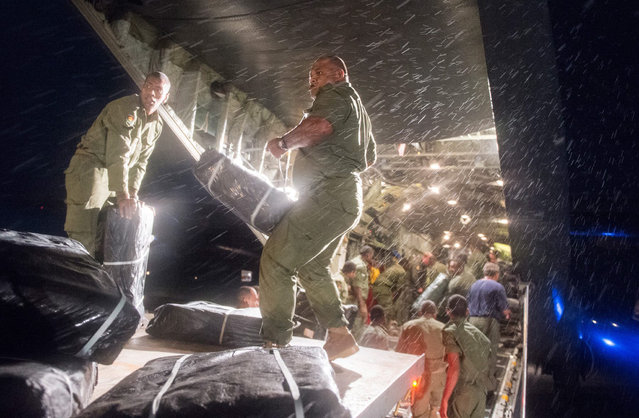
A handout image provided by the New Zealand Defence Force shows aid supplies being unloaded by Fijian soldiers from an Royal New Zealand Airforce C-130 Hercules plane in Suva, Fiji, 23 February 2016. Tool kits, generators, ration packs, water containers and chainsaws make up part of the New Zealand relief following Tropical Cyclone Winston. The death toll from the cyclone that hit Fiji over the weekend climbed to 29, local media reported ON 23 February. (Photo by Sam Shepherd/EPA/NZ Defence Force)

A handout image provided by the New Zealand Defence Force shows aid supplies being unloaded by Fijian soldiers from an Royal New Zealand Airforce C-130 Hercules plane in Suva, Fiji, 23 February 2016. Tool kits, generators, ration packs, water containers and chainsaws make up part of the New Zealand relief following Tropical Cyclone Winston. The death toll from the cyclone that hit Fiji over the weekend climbed to 29, local media reported ON 23 February. Cyclone Winston, the most powerful storm in Fiji's history, battered the country's main island of Viti Levu and other smaller surrounding islands on Saturday, the Fiji Broadcasting Corporation reported. (Photo by Sam Shepherd/EPA/NZ Defence Force)
Details
24 Feb 2016 12:56:00
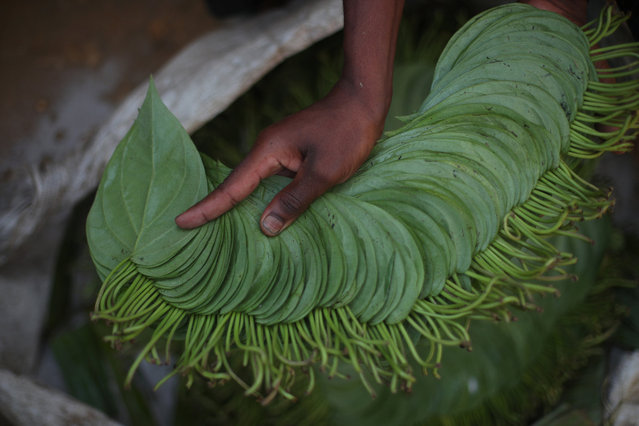
Faruk, 17, a Rohingya refugee trader holds betel leaves which are on sale at a stall in Palong Khali refugee camp near Cox's Bazar, Bangladesh, November 3, 2017. He left his village in Myanmar when the military opened fire towards the Rohingya. “I buy this betel leaf from Palong Khali market, in one bundle there are 160 pieces, I buy it for 80 taka and I sell it for 100 taka. Bangladeshi's and I sell for the same rate in the camp. Outside in the local market it is 80 taka per bundle. My problem is that I don't have money so I can't buy anything to eat, I can't buy fish to eat”, he said. (Photo by Hannah McKay/Reuters)

Faruk, 17, a Rohingya refugee trader holds betel leaves which are on sale at a stall in Palong Khali refugee camp near Cox's Bazar, Bangladesh, November 3, 2017. He left his village in Myanmar when the military opened fire towards the Rohingya. “I buy this betel leaf from Palong Khali market, in one bundle there are 160 pieces, I buy it for 80 taka and I sell it for 100 taka (1 Bangladeshi Taka = 0.012 US Dollar). Bangladeshi's and I sell for the same rate in the camp. Outside in the local market it is 80 taka per bundle. My problem is that I don't have money so I can't buy anything to eat, I can't buy fish to eat”, he said. (Photo by Hannah McKay/Reuters)
Details
27 Nov 2017 08:54:00