Loading...
Done
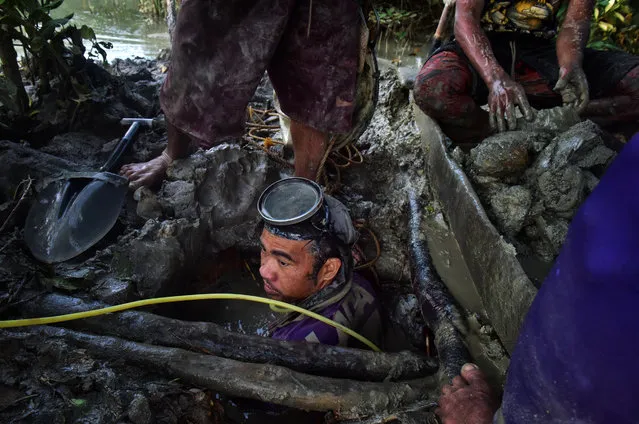
Christian Balderosdasco, 31, is being pulled up a mud pit after diving for 3 hours to look for gold on March 22, 2017 in Paracale, Philippines. (Photo by Jes Aznar/Getty Images)

Christian Balderosdasco, 31, is being pulled up a mud pit after diving for 3 hours to look for gold on March 22, 2017 in Paracale, Philippines. Apart from tunneling and sifting sand, locals dive down murky swamps with the aid of a compressor with air flowing in a small tube for breathing, as they blindly swim under the mud for up to four hours to look for tiny rocks containing gold particles. For decades, local residents at Paracale town work in hazardous conditions scavenging under the earth and diving into tunnels filled with mud using only makeshift tools to mine for gold, often placing their health and lives at risk. (Photo by Jes Aznar/Getty Images)
Details
06 Apr 2017 09:21:00
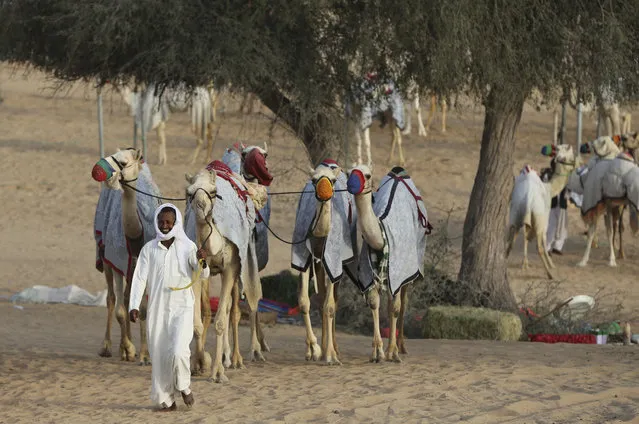
In this Saturday, April 8, 2017 photo, a keeper walks camels to the Al Marmoom Camel Racetrack, in al-Lisaili about 40 km (25  miles) southeast of Dubai, United Arab Emirates. (Photo by Kamran Jebreili/AP Photo)

In this Saturday, April 8, 2017 photo, a keeper walks camels to the Al Marmoom Camel Racetrack, in al-Lisaili about 40 km (25 miles) southeast of Dubai, United Arab Emirates. Camel racing is a big-money sport and fast thoroughbreds can fetch well over a million dollars. As rising temperatures across Gulf Arab countries signal the end of the winter camel racing season, Dubai is wrapping up its races with the annual Al Marmoom Heritage Festival that has drawn thousands of camels from across the oil-rich Gulf. (Photo by Kamran Jebreili/AP Photo)
Details
19 Apr 2017 08:44:00
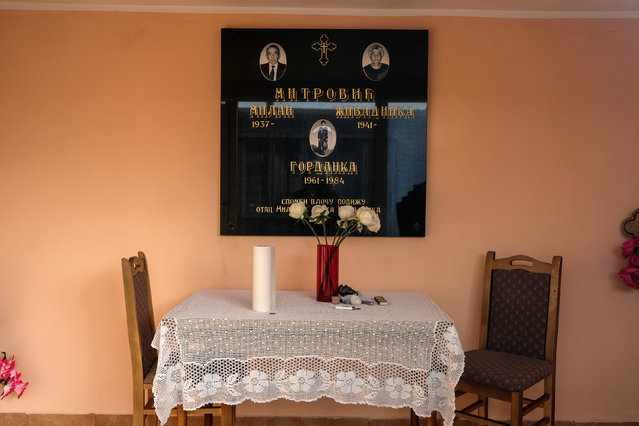
Pictures of deceased people are seen inside a chapel at a cemetery in the village of Smoljinac, Serbia, October 25, 2016. (Photo by Marko Djurica/Reuters)

Pictures of deceased people are seen inside a chapel at a cemetery in the village of Smoljinac, Serbia, October 25, 2016. From a distance, the cemetery in the eastern Serbian village of Smoljinac looks like a residential neighbourhood eerily placed among graves. But once inside the grounds, after passing a section with the usual stone slabs, visitors find rows of small bungalows painted in pastel colours. They have one or two rooms, large windows and ornate plaques – some inside, some outside – memorialising the deceased. These are the burial chapels of Smoljinac, cosy cabins with a furnished room inside, a storage place for wreaths and funeral paraphernalia, and the family crypt below. Some even have electric power inside. (Photo by Marko Djurica/Reuters)
Details
12 Nov 2016 10:37:00
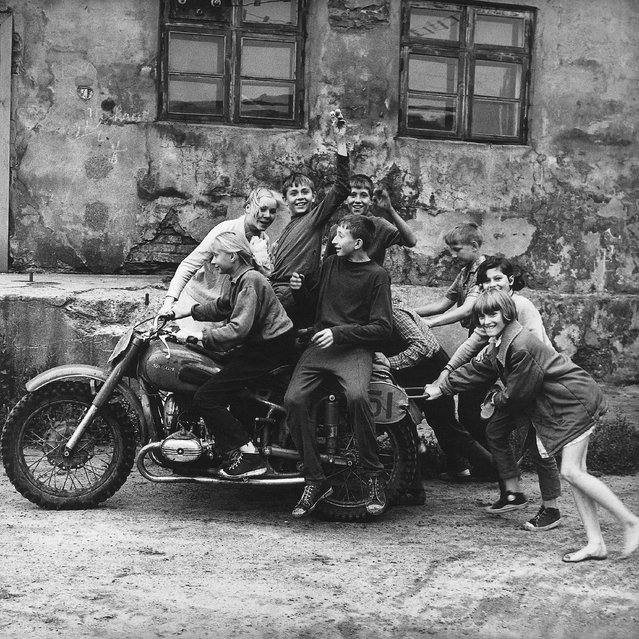
When he started using a camera there were very few documentary photographers working outside the government. Sutkus instead looked to writers and film-makers, and says he drew inspiration from the works of Franz Kafka, Jean-Paul Sartre, Ernest Hemingway and Vladimir Nabokov. Here: The first Lithuanian bikers, 1974. (Photo by Antanas Sutkus)

Rebelling against political propaganda, acclaimed photographer Antanas Sutkus embarked on a life-long journey to capture the everyday scenes around him. Antanas Sutkus, born in 1939, studied journalism at Vilnius University in the late 1950s before becoming disillusioned by the confines of the Soviet-controlled press. He began taking photographs instead, and soon co-founded the Lithuanian Association of Art Photographers. Here: The first Lithuanian bikers, 1974. (Photo by Antanas Sutkus)
Details
11 Apr 2016 10:54:00
A Vietnamese artist acting as a medium, performs the "Hau Dong" ritual at Viet Theatre in Hanoi January 16, 2016. (Photo by Reuters/Kham)

A Vietnamese artist acting as a medium, performs the “Hau Dong” ritual at Viet Theatre in Hanoi January 16, 2016. For the first time, Vietnamese drama director Viet Tu has brought the ritual from religious temples to the theatre partly to draw tourists. The “Hau Dong” is a ritual where a medium puts on special costumes and tells stories of gods and heroes while being accompanied by “Chau Van” music, as part of the act of Dao Mau – the worship of mother goddesses in Vietnam. It is believed that the medium is capable of having a direct contact with spirits during the ritual. (Photo by Reuters/Kham)
Details
18 Jan 2016 08:00:00
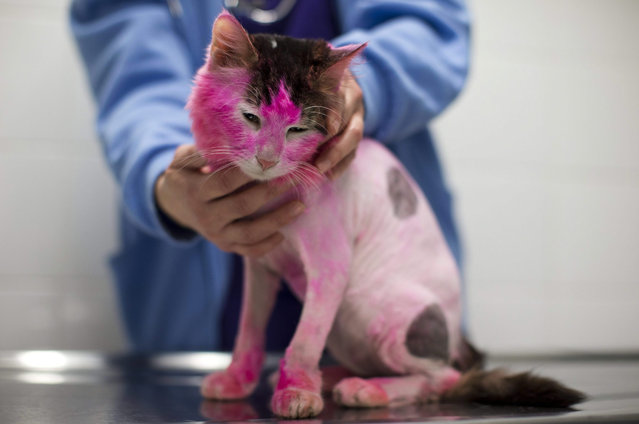
“Bazooka”, a one year old stray cat, is treated at the SPCA (Society for Prevention of Cruelty to Animals) clinic in Tel Aviv, Israel, 06 January 2016. Bazooka arrived at the clinic in critical condition after he went through severe abuse with bruises all over his body and painted with pink oxidation. (Photo by Abir Sultan/EPA)

“Bazooka”, a one year old stray cat, is treated at the SPCA (Society for Prevention of Cruelty to Animals) clinic in Tel Aviv, Israel, 06 January 2016. Bazooka arrived at the clinic in critical condition after he went through severe abuse with bruises all over his body and painted with pink oxidation. The Israeli street cat population is estimated to be about two million. Without enough financial support from the state, animal rights organizations find it difficult to keep the up with the pace when it comes to spaying and neutering feral cats, causing the population to grow. (Photo by Abir Sultan/EPA)
Details
27 Jan 2016 13:17:00
Baby Fennec Fox

“The fennec fox is a small nocturnal fox found in the Sahara of North Africa. Its most distinctive feature is unusually large ears. The name “fennec” comes from the Arabic word for fox, and the species name zerda has a Greek origin that refers to its habitat. The fennec is the smallest species of canid in the world; coat, ears and kidney functions have adapted to a high-temperature, low-water, desert environment. In addition, its hearing is sensitive enough to hear prey moving underground”. – Wikipedia

Photo: A Baby Fennec is seen at Sunshine International Aquarium on June 24, 2009 in Tokyo, Japan. The small nocturnal fox babies were born on May 17 2009. (Photo by Junko Kimura/Getty Images)
Details
16 Sep 2011 12:02:00
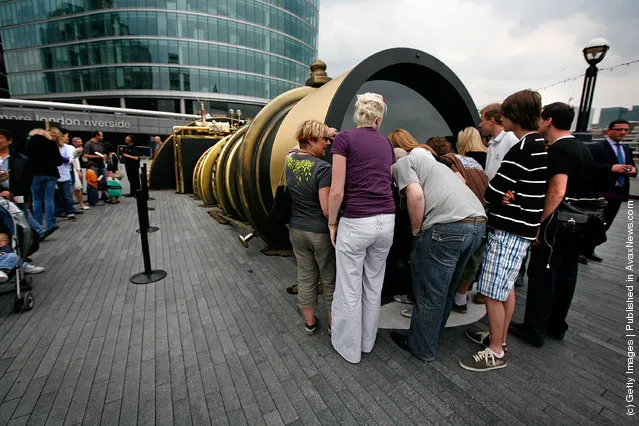
Telectroscope

“The telectroscope (also referred to as “electroscope”) was the first non-working prototype (i.e. conceptual model) of a television or videophone system. The term was used in the 19th century to describe science-based systems of distant seeing. The name and its concept came into being not long after the telephone was patented in 1876, and its original concept evolved from that of remote facsimile reproductions onto paper, into the live viewing of remote images”. – Wikipedia

Photo: Visitors to London wave to people they can see in New York as they peer through the Telectroscope situated by Tower Bridge on May 23, 2008 in London, England. The device named the Telectroscope provides a live visual link up between London and New York, to another Telectroscope by Brooklyn Bridge. (Photo by Cate Gillon/Getty Images)
Details
16 Sep 2011 12:19:00