A patient solves a rubik's cube at a temporary hospital converted from “Wuhan Livingroom” in central China's Hubei Province on February 10, 2020. In face of the outbreak of the novel coronavirus pneumonia epidemic, Wuhan authorities have transformed public venues such as exhibition centers and gymnasiums into temporary hospitals. The hospitals have a large capacity of treating patients with mild symptoms and play an important role in isolating the source of infection and cutting off the routes of infection during epidemic prevention. The first batch of patients was hospitalized on Feb. 5. (Photo by Chine Nouvelle/SIPA Press/Rex Features/Shutterstock)
Contestants of a tattoo competition pose for photographs at the China TATTOO convention in Nanning, Guangxi Zhuang Autonomous Region, China, October 24, 2015. The annual convention was held in Nanning from October 23 to 25 this year. (Photo by Reuters/Stringer)
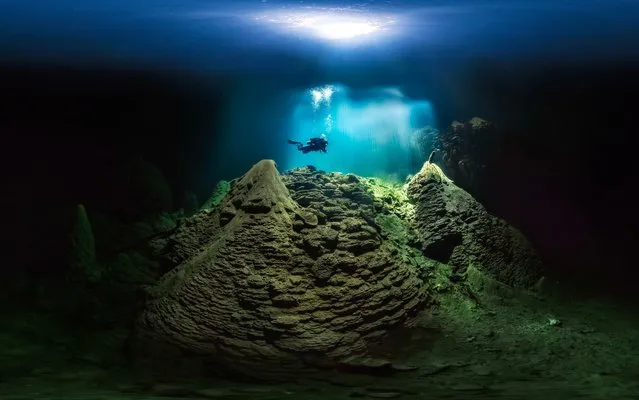
Cave Diver, Anhumas Abyss, Bonito, Brazil: The Anhumas Abyss is an underground cavern with a crystal-clear lake below, more than 260 feet (79 m) deep. A visitor must enter through a narrow opening at the top of the chamber and rappel into the cave. Snorkeling and scuba diving in the lake reveal amazing scenery. Distinctive, conical limestone stalagmites and stalactites occupy the lake and the surrounding area, some reaching 65 feet (20 m) high. (Photo by Marcio Cabral/Nature’s Best Photography Awards 2017)
A tourist catches snowflakes on her tongue during snow fall in Times Square, Midtown, New York, on January 3, 2013. A major snowstorm producing blizzard-like conditions hammered the northeastern United States on Friday, causing more than 1,000 U.S. flight delays and cancellations, paralyzing road travel, and closing schools and government offices. (Photo by Darren Ornitz/Reuters)
Veterans of the Bangladesh war of liberation march past during the celebration of the country’s 45th Victory Day at the national parade ground in Dhaka December 16, 2015. (Photo by Ashikur Rahman/Reuters)
Tip turkey, dumpster chook, rubbish raptor – the Australian white ibis goes by many unflattering names. But it is a true urban success story, scavenging to survive in cities across Australia as wetlands have been lost. Wildlife photographer Rick Stevens captured them in Sydney. Here: Of all the species affected by river regulation in Australia, the ibis is one of the few that has changed its behaviour and moved to coastal cities. (Photo by Rick Stevens/The Guardian)