Loading...
Done
What the World Eats By Peter Menzel And Faith D'Aluisio Part 2

A stunning photographic collection featuring portraits of people from 30 countries and the food they eat in one day. In this fascinating study of people and their diets, 80 profiles are organized by the total number of calories each person puts away in a day. Featuring a Japanese sumo wrestler, a Massai herdswoman, world-renowned Spanish chef Ferran Adria, an American competitive eater, and more, these compulsively readable personal stories also include demographic particulars, including age, activity level, height, and weight. Essays from Harvard primatologist Richard Wrangham, journalist Michael Pollan, and others discuss the implications of our modern diets for our health and for the planet. This compelling blend of photography and investigative reportage expands our understanding of the complex relationships among individuals, culture, and food.
Details
02 May 2014 09:20:00
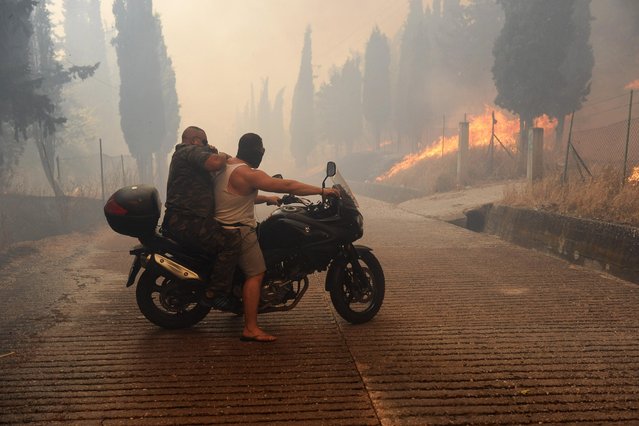
Two men ride a motorcycle away from a fire in Athens on Friday, July 17, 2015. (Photo by Giorgos Bamboukos/InTime News via AP Photo)

Two men ride a motorcycle away from a fire in Athens on Friday, July 17, 2015. Greek firefighters battled large brush and forest fires on the outskirts of Athens and in the country's southern Peloponnese region Friday, where flames forced the evacuation of at least three villages and two summer camps. (Photo by Giorgos Bamboukos/InTime News via AP Photo)
Details
18 Jul 2015 12:19:00
A Thai policeman patrols around a bar area in central Bangkok, Thailand, August 19, 2015. Thai police on Wednesday issued an arrest warrant for an individual they described as a “foreign man”, in connection with a bomb blast in Bangkok that killed 20 people, including many foreigners. (Photo by Kerek Wongsa/Reuters)

A Thai policeman patrols around a bar area in central Bangkok, Thailand, August 19, 2015. Thai police on Wednesday issued an arrest warrant for an individual they described as a “foreign man”, in connection with a bomb blast in Bangkok that killed 20 people, including many foreigners. (Photo by Kerek Wongsa/Reuters)
Details
20 Aug 2015 13:18:00
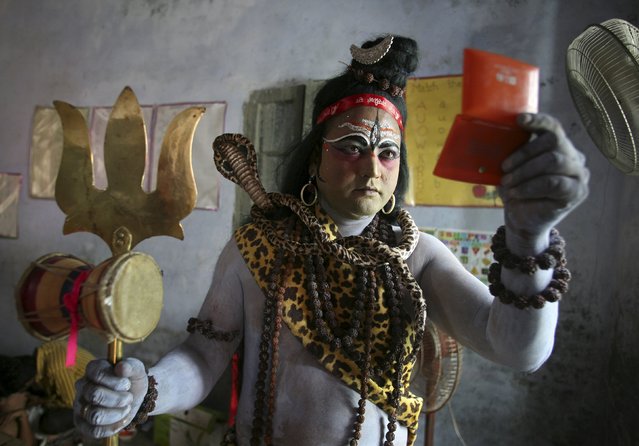
A man dressed as Hindu Lord Shiva looks into the mirror as he gets ready to take part in a religious procession on the eve of Janmashtami festival in Amritsar, India, September 4, 2015. The festival, which marks the birth anniversary of Lord Krishna, will be celebrated across India on Saturday. (Photo by Munish Sharma/Reuters)

A man dressed as Hindu Lord Shiva looks into the mirror as he gets ready to take part in a religious procession on the eve of Janmashtami festival in Amritsar, India, September 4, 2015. The festival, which marks the birth anniversary of Lord Krishna, will be celebrated across India on Saturday. (Photo by Munish Sharma/Reuters)
Details
06 Sep 2015 12:53:00
After their wedding ceremony, groom and bride, Nathan Mauger, Connie Young with family and friends, toast to the solar eclipse from the Rose Garden in Manito Park, Monday, August 21, 2017, in Spokane, Wash. (Photo by Colin Mulvany/The Spokesman-Review via AP Photo)

After their wedding ceremony, groom and bride, Nathan Mauger, Connie Young with family and friends, toast to the solar eclipse from the Rose Garden in Manito Park, Monday, August 21, 2017, in Spokane, Wash. (Photo by Colin Mulvany/The Spokesman-Review via AP Photo)
Details
22 Aug 2017 07:54:00
A model walks the runway during the Vivienne Westwood show as part of the Paris Fashion Week Womenswear Fall/Winter 2018/2019 on March 3, 2018 in Paris, France. (Photo by Patrick Kovarik/WireImage)

A model walks the runway during the Vivienne Westwood show as part of the Paris Fashion Week Womenswear Fall/Winter 2018/2019 on March 3, 2018 in Paris, France. (Photo by Patrick Kovarik/WireImage)
Details
21 Mar 2018 00:03:00
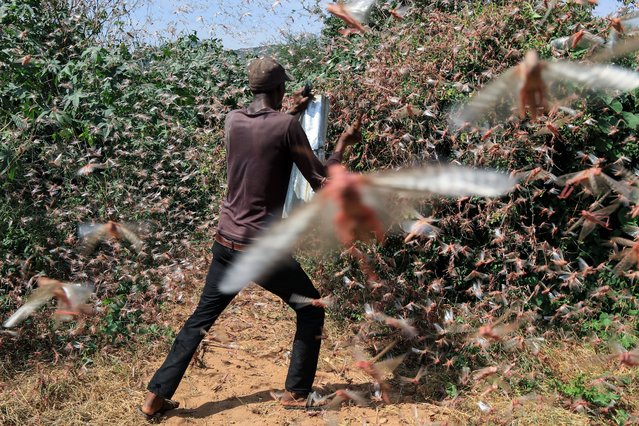
A man uses iron sheet to make noises, as a way of trying to disperse desert locusts that had invaded their farms during the second wave invasion in Kakongo village, in Nuu-Mwingi East, in Kitui, Kenya, 06 February 2021. The second wave invasion of the desert locusts in the country comes at a time where most famers are expecting to harvest their farm produce in the country. According to the United Nations Food and Agriculture Organization (FAO), on 04 February, warned numerous immature desert locust swarms persist in southern Ethiopia and Kenya. Some of the swarms are in community areas and therefore cannot be treated. In Kenya, immature swarms continue to spread westwards across northern and central counties where there are currently about 20 small swarms present, mostly about 50 hectares in size, it said. (Photo by Daniel Irungu/EPA/EFE)

A man uses iron sheet to make noises, as a way of trying to disperse desert locusts that had invaded their farms during the second wave invasion in Kakongo village, in Nuu-Mwingi East, in Kitui, Kenya, 06 February 2021. The second wave invasion of the desert locusts in the country comes at a time where most famers are expecting to harvest their farm produce in the country. (Photo by Daniel Irungu/EPA/EFE)
Details
25 Feb 2021 08:17:00
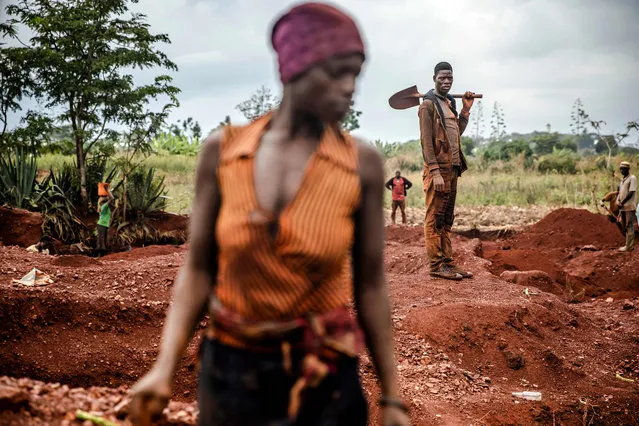
A gold miner observes from the distance how some women miners work at an open-pit gold mine in Nyarugusu, Geita Region, Tanzania on May 27, 2022. Tanzania is a land rich in minerals and one of the main gold producers in Africa, with gold representing more than 90% of the country's mineral exports. Artisanal and small-scale gold mining have culturally and historically relegated women's participation. The extractive sector in Tanzania has historically been a male-dominated industry with high levels of harassment, sеxual abuse, discrimination and misconceptions over women's involvement, and contributions following traditional beliefs. (Photo by Luis Tato/AFP Photo)

A gold miner observes from the distance how some women miners work at an open-pit gold mine in Nyarugusu, Geita Region, Tanzania on May 27, 2022. Tanzania is a land rich in minerals and one of the main gold producers in Africa, with gold representing more than 90% of the country's mineral exports. Artisanal and small-scale gold mining have culturally and historically relegated women's participation. The extractive sector in Tanzania has historically been a male-dominated industry with high levels of harassment, sеxual abuse, discrimination and misconceptions over women's involvement, and contributions following traditional beliefs. (Photo by Luis Tato/AFP Photo)
Details
13 Jun 2022 04:31:00