Loading...
Done
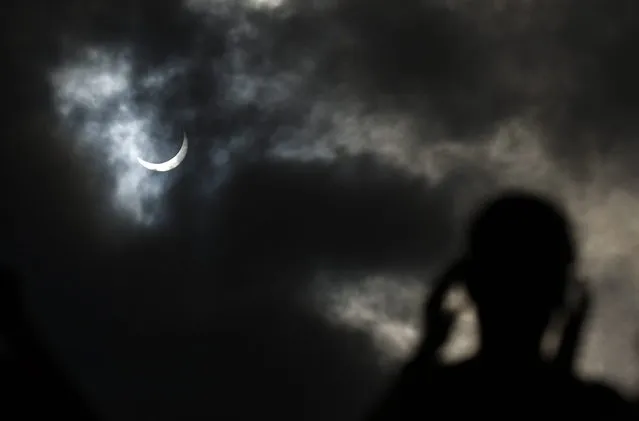
A tourist watches as the moon passing in front of the sun as it approaches a full solar eclipse in the northern Australian city of Cairns November 14, 2012. (Photo by Tim Wimborne/Reuters)

A tourist watches as the moon passing in front of the sun as it approaches a full solar eclipse in the northern Australian city of Cairns November 14, 2012. (Photo by Tim Wimborne/Reuters)
Details
14 Nov 2012 09:38:00
The Lamb National takes place for the racegoers at Ascot Racecourse on April 2, 2017 in Ascot, England. (Photo by Alan Crowhurst/Getty Images)

The Lamb National takes place for the racegoers at Ascot Racecourse on April 2, 2017 in Ascot, England. (Photo by Alan Crowhurst/Getty Images)
Details
23 Dec 2017 07:25:00
Cats gather in front of a house damaged by shelling in the town of Dokuchayevsk, south of Donetsk, February 12, 2015. (Photo by Maxim Shemetov/Reuters)

Cats gather in front of a house damaged by shelling in the town of Dokuchayevsk, south of Donetsk, February 12, 2015. (Photo by Maxim Shemetov/Reuters)
Details
19 Feb 2015 14:17:00
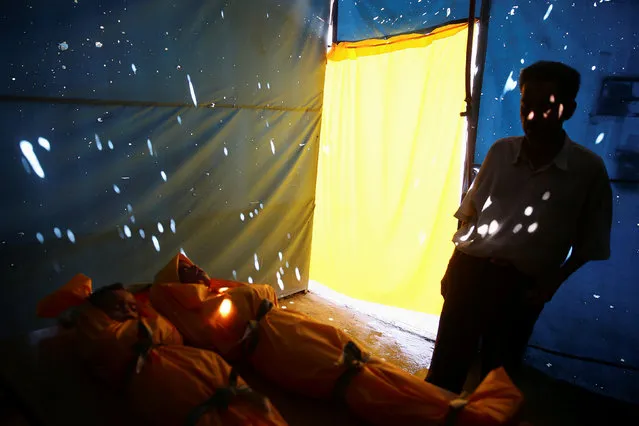
A man stands near bodies of his young relatives after an airstrike in the rebel held Douma neighbourhood of Damascus, Syria August 22, 2016. (Photo by Bassam Khabieh/Reuters)

A man stands near bodies of his young relatives after an airstrike in the rebel held Douma neighbourhood of Damascus, Syria August 22, 2016. (Photo by Bassam Khabieh/Reuters)
Details
26 Aug 2016 10:52:00
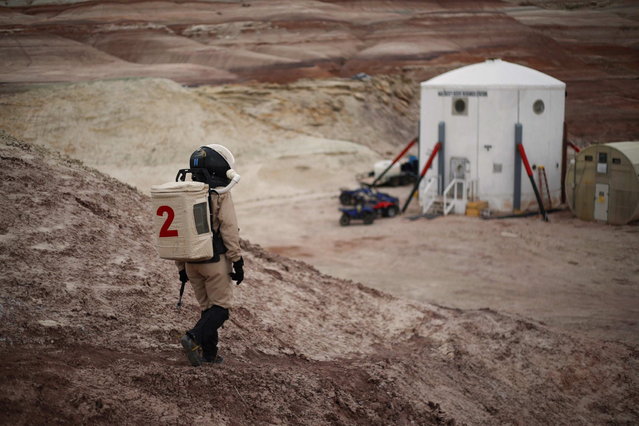
Csilla Orgel, a geologist of Crew 125 EuroMoonMars B mission, makes her way back to the Mars Desert Research Station (MDRS) in the Utah desert March 3, 2013. (Photo by Jim Urquhart/Reuters)

NASA says it could be another 20 years before humans touch down on Mars, but in a sense, the Mars Society has been exploring the red planet for more than a decade – in Utah. Photo: Csilla Orgel, a geologist of Crew 125 EuroMoonMars B mission, makes her way back to the Mars Desert Research Station (MDRS) in the Utah desert March 3, 2013. The MDRS aims to investigate the feasibility of a human exploration of Mars and uses the Utah desert's Mars-like terrain to simulate working conditions on the red planet. Scientists, students and enthusiasts work together developing field tactics and studying the terrain. All outdoor exploration is done wearing simulated spacesuits and carrying air supply packs and crews live together in a small communication base with limited amounts of electricity, food, oxygen and water. Everything needed to survive must be produced, fixed and replaced on site. (Photo by Jim Urquhart/Reuters)
Details
14 Mar 2013 12:11:00
A mahout rides an elephant at Tad Sae Waterfall outside Luang Prabang, Laos July 31, 2016. (Photo by Jorge Silva/Reuters)

A mahout rides an elephant at Tad Sae Waterfall outside Luang Prabang, Laos July 31, 2016. Protected by the United Nations cultural heritage agency UNESCO, Luang Prabang is one of the most alluring places in the region – a city that evokes old-world romance that has gained a reputation as a travellers' Shangri La. (Photo by Jorge Silva/Reuters)
Details
04 Sep 2016 09:05:00
A man wears a costume during a parade to celebrate the Chinese Lunar New Year, which welcomes the Year of the Monkey, in Madrid, Spain, February 13, 2016. (Photo by Andrea Comas/Reuters)

A man wears a costume during a parade to celebrate the Chinese Lunar New Year, which welcomes the Year of the Monkey, in Madrid, Spain, February 13, 2016. (Photo by Andrea Comas/Reuters)
Details
14 Feb 2016 11:26:00
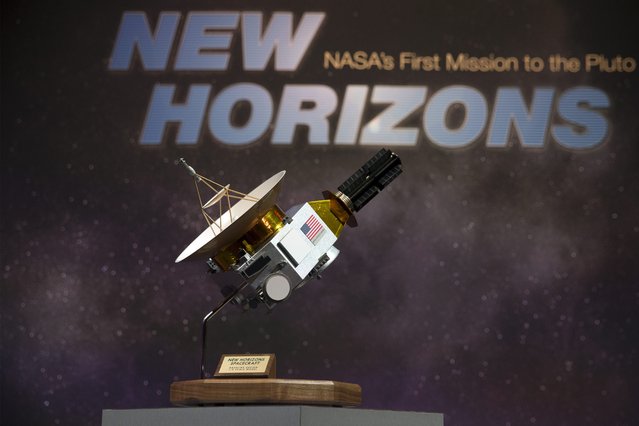
A model of the New Horizons spacecraft is seen at a live television program on NASA television celebrating the spacecraft's closest proximity to Pluto, at Johns Hopkins University Applied Physics Laboratory, site of the mission operations center, in Laurel, Maryland, USA, 14 July 2015. (Photo by Michael Reynolds/EPA)

A model of the New Horizons spacecraft is seen at a live television program on NASA television celebrating the spacecraft's closest proximity to Pluto, at Johns Hopkins University Applied Physics Laboratory, site of the mission operations center, in Laurel, Maryland, USA, 14 July 2015. At approximately 7:49 am ET (11:49 am GMT), 14 July, New Horizons was scheduled to be as close to Pluto as the spacecraft will get; about 7,800 miles (12,500 kilometers) above the surface, following a journey of more than nine years and three billion miles. This is the first mission to the Pluto System and the Kuiper Belt. (Photo by Michael Reynolds/EPA)
Details
15 Jul 2015 10:08:00