Loading...
Done
Reenactors playing the roll of Kentucky volunteers, fighting for the United States, fire muskets during a reenactment of the Battle of New Orleans in the War of 1812, marking its bicentennial in Chalmette, Louisiana, January 10, 2015. (Photo by Lee Celano/Reuters)

Reenactors playing the roll of Kentucky volunteers, fighting for the United States, fire muskets during a reenactment of the Battle of New Orleans in the War of 1812, marking its bicentennial in Chalmette, Louisiana, January 10, 2015. The participants, some of whom have travelled thousands of miles to join in the event, recreated the five clashes that comprise the battle, which some historians say was key in making the British honor the terms of a peace treaty signed in late 1814. (Photo by Lee Celano/Reuters)
Details
12 Jan 2015 14:56:00
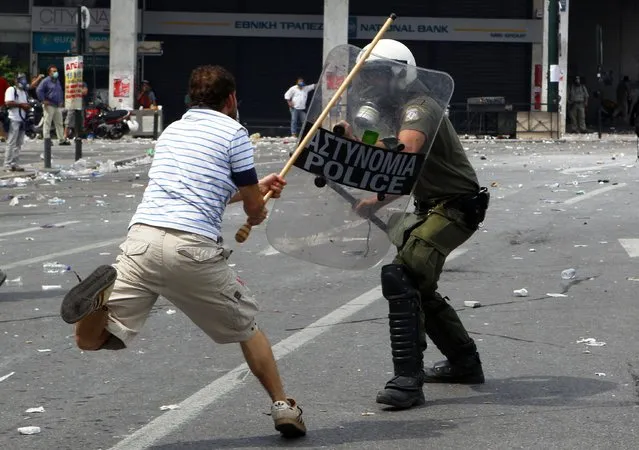
A protester clashes with a police officer in Athens' central Syntagma (Constitution) Square in this June 15, 2011 file photo. Greece triggered the regional financial crisis in 2009 when a far higher budget deficit than previously calculated emerged. (Photo by Yannis Behrakis/Reuters)

A protester clashes with a police officer in Athens' central Syntagma (Constitution) Square in this June 15, 2011 file photo. Greece triggered the regional financial crisis in 2009 when a far higher budget deficit than previously calculated emerged. The collapse of talks with creditors in Paris last November set off a month-long sequence of events leading to elections this week and proving Greece is still the region's weak link. The vote is expected to be won by Syriza, a far-left party opposed to the bailout, worrying investors and creditors alike. (Photo by Yannis Behrakis/Reuters)
Details
22 Jan 2015 13:44:00
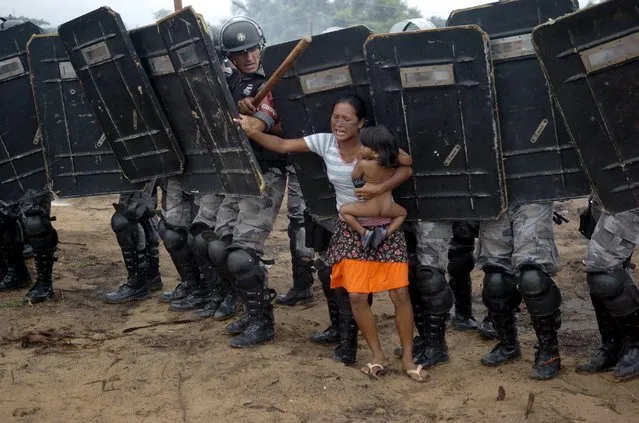
An indigenous woman holds her child while trying to resist the advance of Amazonas state policemen who were expelling the woman and some 200 other members of the Landless Movement from a privately-owned tract of land on the outskirts of Manaus, in the heart of the Brazilian Amazon, in this March 11, 2008 file photo. (Photo by Luiz Vasconcelos-A Critica/Reuters/AE)

An indigenous woman holds her child while trying to resist the advance of Amazonas state policemen who were expelling the woman and some 200 other members of the Landless Movement from a privately-owned tract of land on the outskirts of Manaus, in the heart of the Brazilian Amazon, in this March 11, 2008 file photo. (Photo by Luiz Vasconcelos-A Critica/Reuters/AE)
Details
19 Apr 2015 09:09:00
Hook, an indigenous Moken man, holds a three-pronged throwing spear and searches for fish in the waters of Ko Surin National Park. March 1, 2013 – Ko Surin, Thailand. (Photo by Taylor Weidman/zReportage via ZUMA Press)

“For centuries, the Moken sea nomads have traveled the islands between Thailand and Myanmar fishing and foraging for food on the sea floor. Throughout the Mergui Archipelago, Moken migrate in flotillas of Kabangs (traditional boat of the Moken people), stopping at different islands and beaches. Expert freedivers, the Moken have adapted physically to an aquatic life, developing unique characteristics that let them see better and hold their breath longer while underwater”. – Taylor Weidman. Photo: Hook, an indigenous Moken man, holds a three-pronged throwing spear and searches for fish in the waters of Ko Surin National Park. March 1, 2013 – Ko Surin, Thailand. (Photo by Taylor Weidman/zReportage via ZUMA Press)
Details
24 Mar 2014 06:45:00
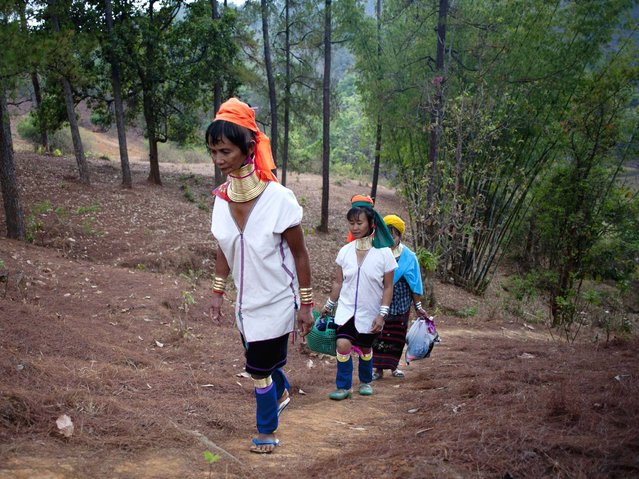
One of the theories says that the coils originate from the desire to look more attractive by exaggerating sexual dimorphism, as women have more slender necks than men. (Photo by Ye Aung Thu/AFP Photo)

This photo taken on April 16, 2014 shows ethnic Kayan women wearing traditional clothes and bronze rings around tbeir neck in Panpet village, Demoso township in Kayah state, eastern Myanmar. Some ethnic Kayan women, also known as Padaung, begin wearing the bronze rings on their neck and legs from a young age. Usually they start wearing six to ten rings when they are five to ten-years-old and then they put on one more ring a year for years after then. (Photo by Ye Aung Thu/AFP Photo)
Details
23 Apr 2014 08:56:00
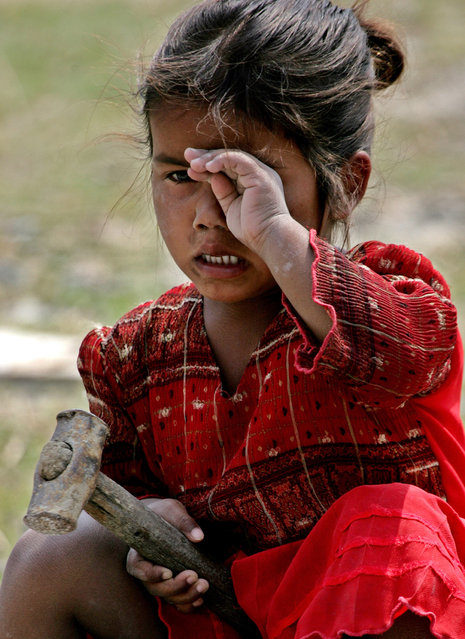
5-year-old Rina Kumari rubs her eye while cracking stones on the banks of Mahananda river in Siliguri, northeast India, March 5, 2005. Over 400 million people in India live below the internationally agreed poverty line (living on less than US $1 per day). According to estimates, several hundred thousand children work as labourers and beg on the streets in India. Photo taken on March 5, 2005. (Photo by Desmond Boylan/Reuters)

5-year-old Rina Kumari rubs her eye while cracking stones on the banks of Mahananda river in Siliguri, northeast India, March 5, 2005. Over 400 million people in India live below the internationally agreed poverty line (living on less than US $1 per day). According to estimates, several hundred thousand children work as labourers and beg on the streets in India. (Photo by Desmond Boylan/Reuters)
Details
13 Jun 2014 12:07:00
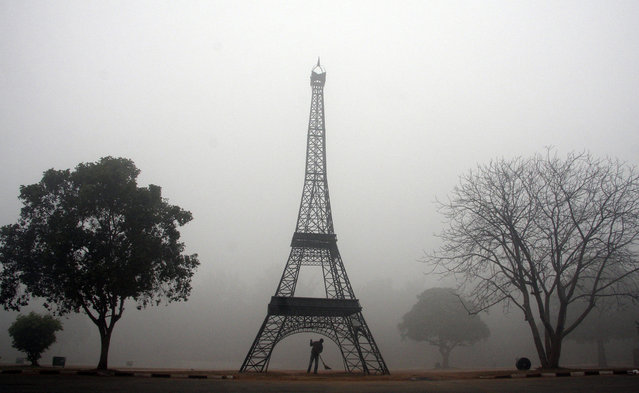
India: A sweeper cleans the side of a road near a replica of the Eiffel Tower amid heavy fog in the early morning in the northern Indian city of Chandigarh January 18, 2010. (Photo by Ajay Verma/Reuters)

India: A sweeper cleans the side of a road near a replica of the Eiffel Tower amid heavy fog in the early morning in the northern Indian city of Chandigarh January 18, 2010. (Photo by Ajay Verma/Reuters)
Details
27 Jun 2014 10:21:00
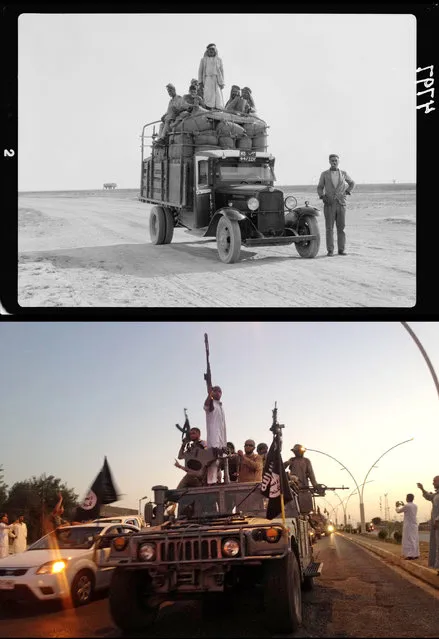
This combination of two photographs shows a 1932 image of men on a lorry on the road to Mosul, northern Iraq, from the Library of Congress, top, and fighters from the Islamic State group parading in a commandeered Iraqi security forces armored vehicle down a main road in Mosul on Monday, June 23, 2014. (Photo by AP Photo)


Iraq's second largest city, Mosul, is locked under the rule of extremists from the Islamic State group trying to purge it of everything they see as contradicting their stark vision of Islam. A trove of photographs now housed at the Library of Congress offers a glimpse of a different Mosul – before wars, insurgency, sectarian strife and now radicals' rule. The scenes were taken in the autumn of 1932 by staff from the American Colony Photo Department during a visit to Iraq at the end of the British mandate. (Photo by AP Photo)
Details
21 Sep 2014 11:13:00