Five-year-old Julia cuddles a free teddy bear at a toy adoption station in a branch of Dobbies in Wallington, UK on December 4, 2023. Research shows almost half of parents (46%) in Britain plan to spend less on their children’s Christmas presents this year, and 47% believe their child would not mind receiving a preloved toy as a gift. (Photo by Michael Leckie/PA Wire Press Association)
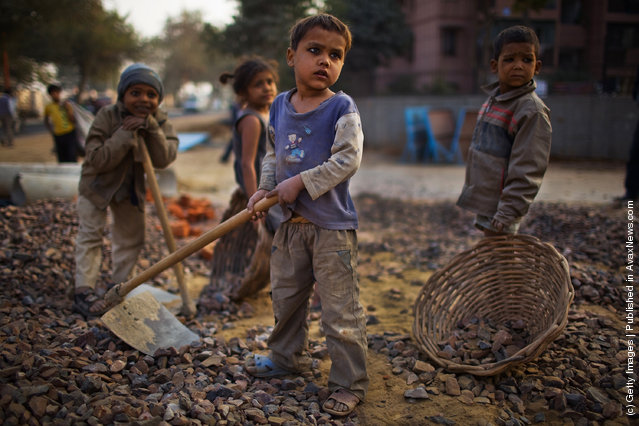
Indian children work nearby to their parents at a construction project in front of the Jawaharlal Nehru Stadium on January 30, 2010 in New Delhi, India. The children accompany their parents to the work site, where if they are prepared to work, they will receive money for bread an milk and be provided with dinner by the contractor. The sheer scale of the project has drawn an enormous population of migrant workers from all over India.
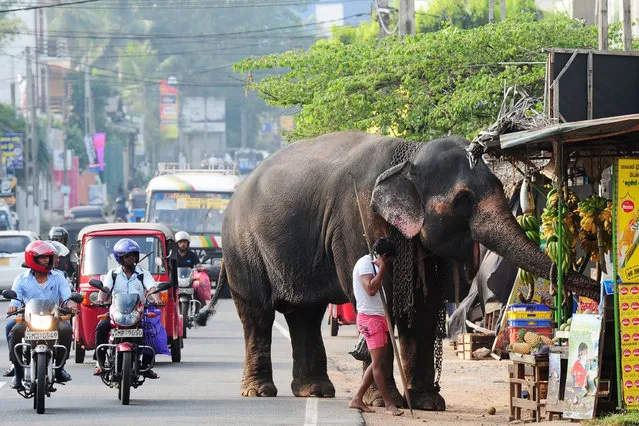
A Sri Lankan elephant, accompanied by his mahout, browse through a roadside fruit stall in Colombo on January 19, 2015. The Sri Lankan elephant is listed as endangered by the International Union for Conservation of Nature (IUCN) as the population has declined by at least 50 percent over the last three generations, with the species threatened by habitat loss, degradation and fragmentation. (Photo by Lakruwan Wanniarachchi/AFP Photo)
Julian, left, is photographed by his mother with friend Gianluca, right, under water at a public pool in Gelsenkirchen, Germany, on a hot Friday, July 3, 2015. Germany faces a heat wave with temperatures up to 38 degrees Celsius (100 degrees Fahrenheit) at the weekend. (Photo by Martin Meissner/AP Photo)
A girl laughs while unloading her boat of produce at a market in Ganvie on January 6, 2012 in Cotonou, Benin. Often called the Venice of Africa, Ganvie is a stilted fishing village on Lake Nokoue, near Cotonou in Benin, the largest such village in Africa, and home to approximately 20,000 residents. (Photo by Dan Kitwood/Getty Images)
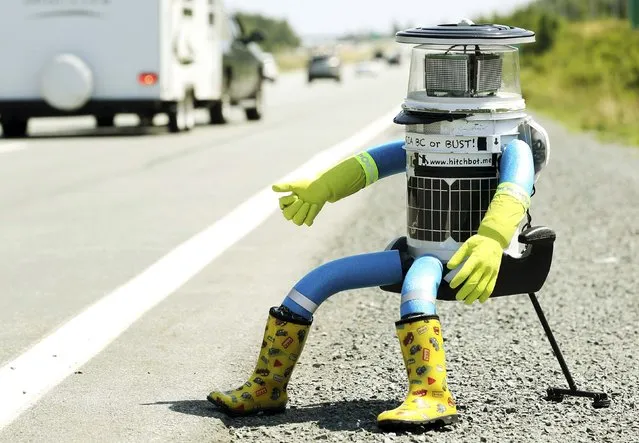
The anthropomorphic robot named hitchBOT sits on the shoulder of Highway 102 to begin its 6000 kilometer cross country journey outside of Halifax, Nova Scotia, July 27, 2014. The hitch hiking robot is part of a social experiment to see if drivers will pick up and drop off the robot in one piece to an art gallery in Victoria, British Columbia. (Photo by Paul Darrow/Reuters)
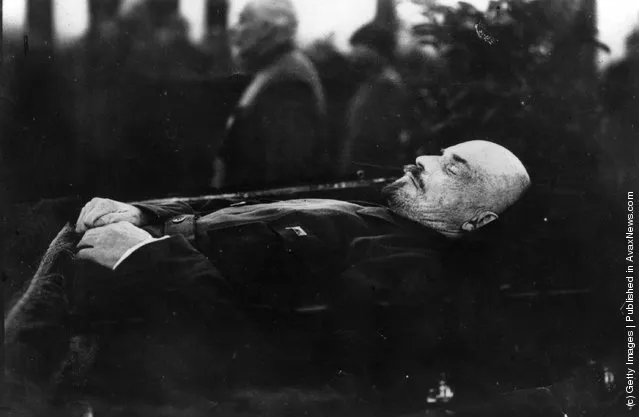
Photo: Vladimir Ilyich Lenin (1870 – 1924) lying in state in the Kremlin. (Photo by Hulton Archive/Getty Images). 1924
Important! For the same article in Russian language click here.
Something quite intriguing is happening within Russian-speaking internet during the last few – should you type a fully academic inquiry (at least, according to Russian academic requirements) in national search engines for "Lenin's mausoleum" – the first thing you get (even in top 10 searches) is website pages talking about black magic and occult. Website authors view this construction differently, but unconditionally agree on one thing: the mausoleum of the "leader of the world proletariat” – the essence of a magical artifact, a sort of “energy vampire”. It was built with a certain purpose: to drain the energy out of miserable Soviet citizens on one hand; and to poison the anthroposphere of one-sixth part of the earth with its vibes (the exact territory that was occupied by the former Soviet Union), depriving the Russian people of will to resist on the other hand. Complete nonsense? No doubt. Nevertheless, an intriguing one. Well, probably because some oddities do exist in mausoleum's history. These oddities are the thing we are going to discuss this time. First, let me refresh you memory on the subject.