Loading...
Done
A sun bear reacts to triple-digit temperatures at the Henry Doorly Zoo in Omaha, Nebraska, where the temperature reached 103 degrees Fahrenheit

A sun bear reacts to triple-digit temperatures at the Henry Doorly Zoo in Omaha, Nebraska, where the temperature reached 103 degrees Fahrenheit on July 6, 2012. (Photo by Nati Harnik/Associated Press)
Details
15 Jul 2012 07:15:00
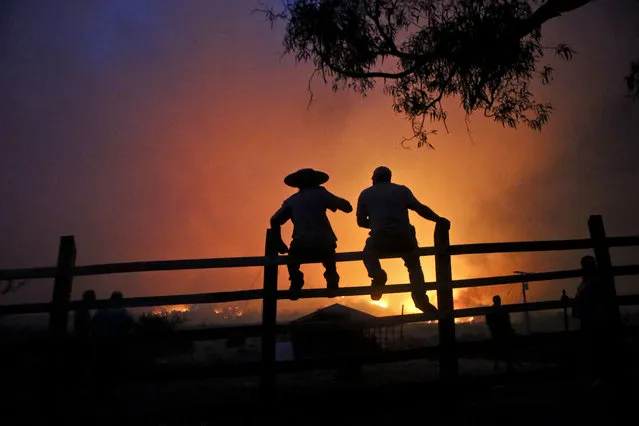
Residents watch the forest burn in Portezuelo, Chile, Sunday, January 29, 2017. Chilean President Michelle Bachelet has announced that the country will continue with its various measures to deal with wild fires, one of the biggest natural disasters in the country for decades, according to a government report released on Sunday. (Photo by Esteban Felix/AP Photo)

Residents watch the forest burn in Portezuelo, Chile, Sunday, January 29, 2017. Chilean President Michelle Bachelet has announced that the country will continue with its various measures to deal with wild fires, one of the biggest natural disasters in the country for decades, according to a government report released on Sunday. (Photo by Esteban Felix/AP Photo)
Details
31 Jan 2017 10:25:00
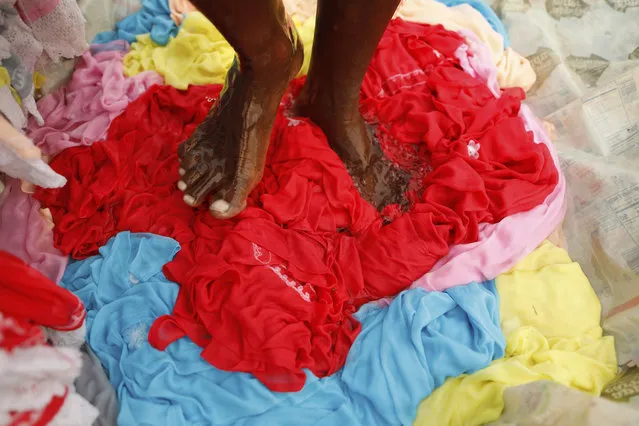
A dhobi, or a washerman washes cloths on the banks of the River Gomti in Lucknow, India, Saturday, September 12, 2020. Dhobis are traditional laundry workers who wash clothes by hand and dry them in the sun, an occupation which has been in existence for generations. Most cities in India have a Dhobi Ghat, or washermen's area, where the city's pile of clothes is laundered. This practice is still popular in India, despite of modern technology. Around 1,000 families work in Lucknow's Dhobi Ghat. However, in light of the novel coronavirus, their wages have decreased drastically. With each family earning around US$100-200 per month. (Photo by Rajesh Kumar Singh/AP Photo)


A dhobi, or a washerman washes cloths on the banks of the River Gomti in Lucknow, India, Saturday, September 12, 2020. Dhobis are traditional laundry workers who wash clothes by hand and dry them in the sun, an occupation which has been in existence for generations. Most cities in India have a Dhobi Ghat, or washermen's area, where the city's pile of clothes is laundered. This practice is still popular in India, despite of modern technology. Around 1,000 families work in Lucknow's Dhobi Ghat. However, in light of the novel coronavirus, their wages have decreased drastically. With each family earning around US$100-200 per month. (Photo by Rajesh Kumar Singh/AP Photo)
Details
25 Sep 2020 00:03:00
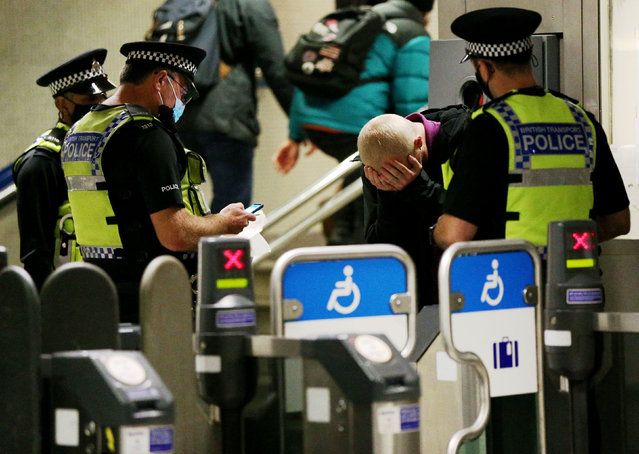
A man reacts to being warned by a British Transport Police officer for not wearing a face mask at King's Cross underground station, London, England on October 8, 2020. (Photo by Jonathan Brady/PA Images via Getty Images)

A man reacts to being warned by a British Transport Police officer for not wearing a face mask at King's Cross underground station, London, England on October 8, 2020. (Photo by Jonathan Brady/PA Images via Getty Images)
Details
10 Oct 2020 00:07:00
(L-R)  Pieter Van Lankveld, Jay Schippers, Ynze Oegema, Justin Kimmann, Teun Kivit and Twan Van Gendt compete during the Dutch National BMX Championships at Olympic Training Centre Papendal on October 11, 2020 in Arnhem, Netherlands. (Photo by Dean Mouhtaropoulos/Getty Images)

(L-R) Pieter Van Lankveld, Jay Schippers, Ynze Oegema, Justin Kimmann, Teun Kivit and Twan Van Gendt compete during the Dutch National BMX Championships at Olympic Training Centre Papendal on October 11, 2020 in Arnhem, Netherlands. (Photo by Dean Mouhtaropoulos/Getty Images)
Details
19 Oct 2020 00:03:00
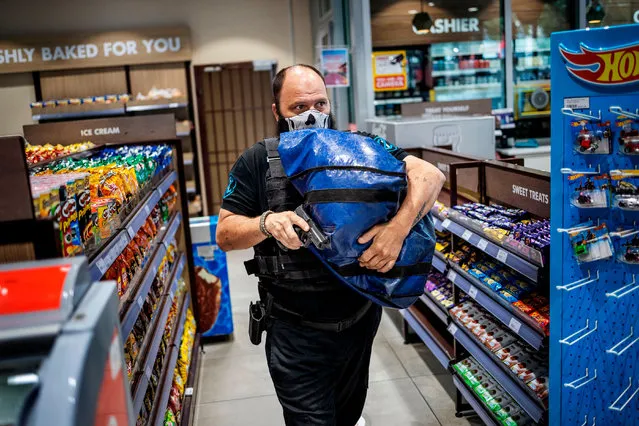
A CIT guard carries his gun handgun while bringing a bag containing cash inside an armoured vehicle during a money collection in Johannesburg's CBD, on December 8, 2020. As the Christmas festive season approaches, cash-in-transit (CIT) companies are gearing up as they continue to be target of crime, with about 3000 money vans traveling daily nationwide. Despite the COVID-19 lockdown, there have been 260 cash-in-transit heist incidents in South Africa this year, with 19 CIT crew members killed. Cash-in-transit heists in the country are often military-style planned operations with criminals recurring to bomb making and assault rifles attacks. (Photo by Michele Spatari/AFP Photo)

A CIT guard carries his gun handgun while bringing a bag containing cash inside an armoured vehicle during a money collection in Johannesburg's CBD, on December 8, 2020. As the Christmas festive season approaches, cash-in-transit (CIT) companies are gearing up as they continue to be target of crime, with about 3000 money vans traveling daily nationwide. Despite the COVID-19 lockdown, there have been 260 cash-in-transit heist incidents in South Africa this year, with 19 CIT crew members killed. Cash-in-transit heists in the country are often military-style planned operations with criminals recurring to bomb making and assault rifles attacks. (Photo by Michele Spatari/AFP Photo)
Details
18 Dec 2020 00:01:00
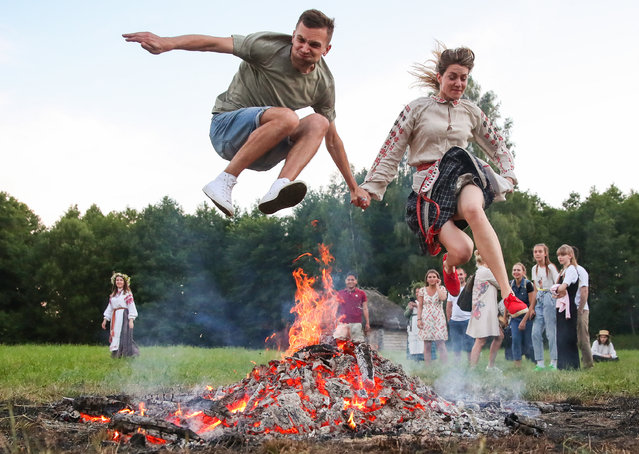
A man and a woman jump over a bonfire during Ivan Kupala Day celebrations held by the Belarusian State Museum of Folk Architecture and Rural Lifestyle in the village of Ozertso near Minsk, Belarus on July 4, 2020. Ivan Kupala Day, also known as Ivana-Kupala or Kupala Night, is a traditional pagan holiday celebrated in eastern Slavic cultures. Various rituals are traditionally performed on Kupala Night, including making flower wreaths, fortune-telling, jumping over bonfires, and burning a wheel-like effigy symbolizing the sun. (Photo by Natalia Fedosenko/TASS)

A man and a woman jump over a bonfire during Ivan Kupala Day celebrations held by the Belarusian State Museum of Folk Architecture and Rural Lifestyle in the village of Ozertso near Minsk, Belarus on July 4, 2020. Ivan Kupala Day, also known as Ivana-Kupala or Kupala Night, is a traditional pagan holiday celebrated in eastern Slavic cultures. Various rituals are traditionally performed on Kupala Night, including making flower wreaths, fortune-telling, jumping over bonfires, and burning a wheel-like effigy symbolizing the sun. (Photo by Natalia Fedosenko/TASS)
Details
23 Jan 2021 09:53:00
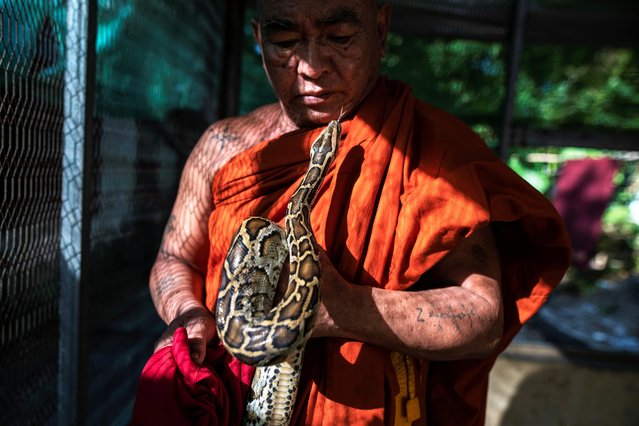
Buddhist monk Wilatha holds a rescued Burmese python at his monastery that has turned into a snake sanctuary on the outskirts of Yangon, Myanmar, November 26, 2020. Wilatha is trying to play a part in saving scores of snakes that might otherwise be killed or destined for the black market. (Photo by Shwe Paw Mya Tin/Reuters)

Buddhist monk Wilatha holds a rescued Burmese python at his monastery that has turned into a snake sanctuary on the outskirts of Yangon, Myanmar, November 26, 2020. Wilatha is trying to play a part in saving scores of snakes that might otherwise be killed or destined for the black market. (Photo by Shwe Paw Mya Tin/Reuters)
Details
03 Feb 2021 09:09:00