A man presents a self-made robot that local media reported is able to carry a person, in Heihe, Heilongjiang province, China, April 5, 2017. (Photo by Reuters/China Daily)
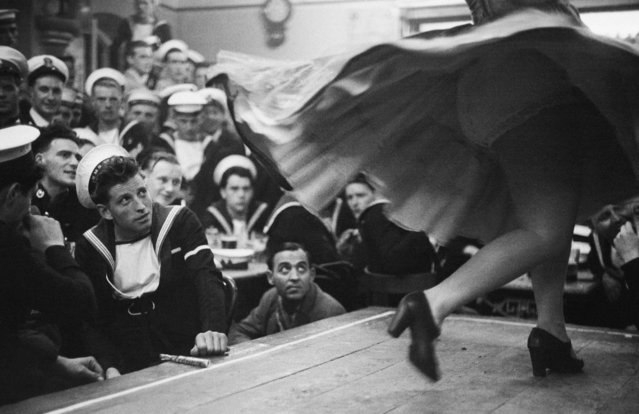
British sailors taking shore leave on the British dependency of Gibraltar visit the Suiza Bar to watch a Spanish dancer perform on August 05, 1954. These Spanish entertainers are under contract and must return over the border by 11 o'clock. (Photo by Bert Hardy/Getty Images)
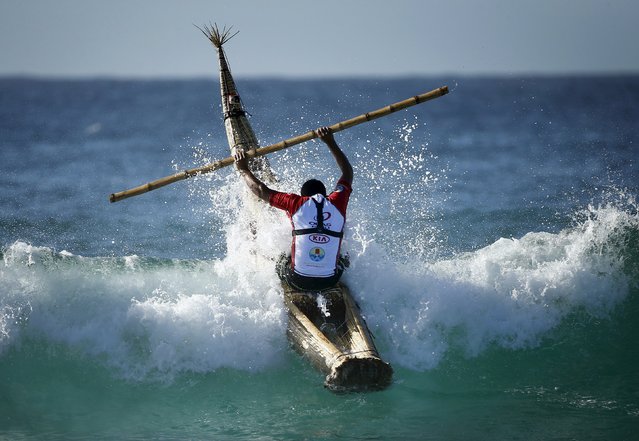
Peruvian surfer Carlos “Huevito” Areola rides a reed board, or “caballito” (little horse), into a wave at Sydney's Bondi Beach, February 24, 2016. Areola is part of a group of Peruvian surfers touring Australia’s east coast to promote the use of the “caballito”. The “caballito” is thought to have been invented around 3,000 BC in northern Peru. (Photo by Jason Reed/Reuters)
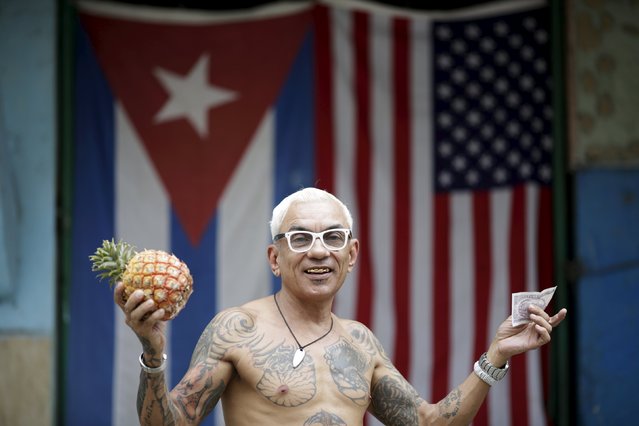
Zamora, 55, self-employed, poses for a photograph in front of the Cuban and U.S. flags after buying a pineapple in Havana, March 25, 2016. Regarding Obama's historic visit to the island, Zamora said “It's good for the Cubans that he came and re-established relationships between the two countries”. (Photo by Ueslei Marcelino/Reuters)
Members of the Albert Battery perform a gun salute during the Anzac Day dawn service held by the Currumbin RSL on the Gold Coast in Currumbin, Australia, 25 April 2016. The Anzac day marks the landing of the Australian and New Zealand Army Corps (Anzac) troops at Gallipoli in what is today Turkey during WWI. World War One, also called the Great War, according to official statistics cost more than 37 million military and civilian casualties between 1914 and 1918. (Photo by Glenn Hunt/EPA)
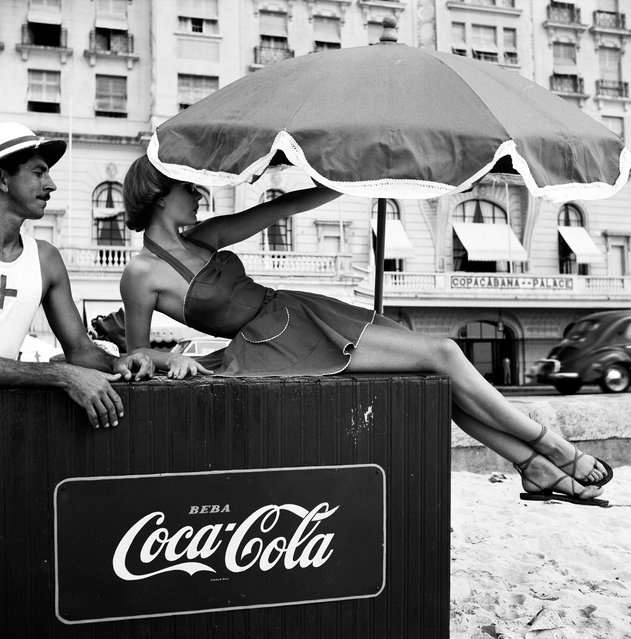
“Grit and Glamour”, a retrospective of the late British photographer Elsbeth Juda, who fled Nazi occupation and came to England in 1933, is at the Jewish Museum, in London, until July 1, 2018. Here: Shelagh Wilson, Copacabana beach, Rio de Janeiro, 1951. (Photo by Elsbeth Juda Archive/Victoria and Albert Museum)
Women wearing traditional hats, known as a non la, sell fruits in Hoi An, Vietnam April 4, 2016. The non la hats are made of readily available materials such as palm leaves, tree bark and bamboo and are visible everywhere in the city, a UNESCO World Heritage site. Hoi An's history as a busy trading port is evident throughout its architecture, a mix of eras and styles, with traditional wooden Vietnamese houses, Chinese temples and French colonial buildings. (Photo by Jorge Silva/Reuters)