Loading...
Done
A woman poses for a souvenir photo with a cat statue on display at the Shenzhen Bay commercial district, in Shenzhen, China's Guangdong province, Monday, September 15, 2025. (Photo by Andy Wong/AP Photo)

A woman poses for a souvenir photo with a cat statue on display at the Shenzhen Bay commercial district, in Shenzhen, China's Guangdong province, Monday, September 15, 2025. (Photo by Andy Wong/AP Photo)
Details
03 Oct 2025 02:35:00
People play ice hockey in front of the Olympic Tower near the National Stadium at Olympic Park on January 13, 2022 in Beijing, China. Playing host to the 2022 Winter Olympics has boosted the popularity of winter sports and outdoor activities in many parts of China, with the government pouring billions of dollars into developing programs, athletes, and fans. With more outdoor skating rinks, ski resorts, and other activities luring people outside, the ice and snow sports boom has created nearly 350 million winter sport enthusiasts since Beijing"u2019s successful Games bid in 2015, according to officials. China is seeking to become a winter sports destination as the global snow sports industry eyes growth in the world second largest economy. (Photo by Kevin Frayer/Getty Images)

People play ice hockey in front of the Olympic Tower near the National Stadium at Olympic Park on January 13, 2022 in Beijing, China. Playing host to the 2022 Winter Olympics has boosted the popularity of winter sports and outdoor activities in many parts of China, with the government pouring billions of dollars into developing programs, athletes, and fans. With more outdoor skating rinks, ski resorts, and other activities luring people outside, the ice and snow sports boom has created nearly 350 million winter sport enthusiasts since Beijing"u2019s successful Games bid in 2015, according to officials. China is seeking to become a winter sports destination as the global snow sports industry eyes growth in the world second largest economy. (Photo by Kevin Frayer/Getty Images)
Details
02 Feb 2022 07:51:00
A woman wears a mask while carrying a dog in the street on January 22, 2020 in Wuhan, Hubei province, China. A new infectious coronavirus known as “2019-nCoV” was discovered in Wuhan as the number of cases rose to over 400 in mainland China. Health officials stepped up efforts to contain the spread of the pneumonia-like disease which medicals experts confirmed can be passed from human to human. The death toll has reached 17 people as the Wuhan government issued regulations today that residents must wear masks in public places. Cases have been reported in other countries including the United States, Thailand, Japan, Taiwan, and South Korea. (Photo by Getty Images/China Stringer Network)

A woman wears a mask while carrying a dog in the street on January 22, 2020 in Wuhan, Hubei province, China. A new infectious coronavirus known as “2019-nCoV” was discovered in Wuhan as the number of cases rose to over 400 in mainland China. Health officials stepped up efforts to contain the spread of the pneumonia-like disease which medicals experts confirmed can be passed from human to human. The death toll has reached 17 people as the Wuhan government issued regulations today that residents must wear masks in public places. Cases have been reported in other countries including the United States, Thailand, Japan, Taiwan, and South Korea. (Photo by Getty Images/China Stringer Network)
Details
31 Dec 2020 00:01:00
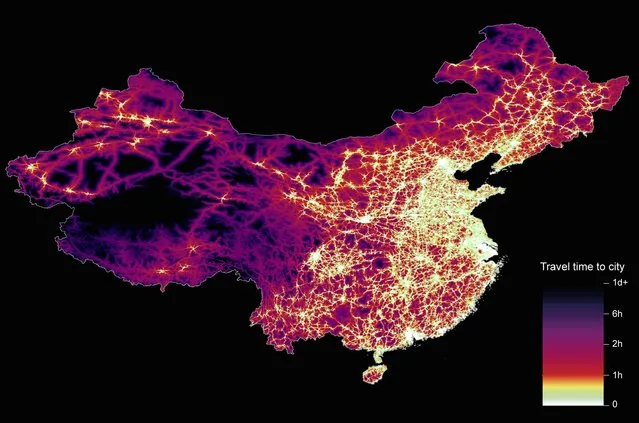
From Britain to China to Mali, new maps showing travel times to the nearest urban centre reveal huge differences between countries. Using Open Street Map and Google, a University of Oxford team have created a visual breakdown that suggests major inequalities when it comes to commuting. Here: China. The dataset used for China was unique as it relied solely on Open Street Map, due to restrictions on accessing Google data. The population is densely concentrated in the east and accessibility is increased, whereas rural provinces in the west remain remote. (Photo by Daniel Weiss/Jennifer Rozier/Malaria Atlas Project/University of Oxford )

From Britain to China to Mali, new maps showing travel times to the nearest urban centre reveal huge differences between countries. Using Open Street Map and Google, a University of Oxford team have created a visual breakdown that suggests major inequalities when it comes to commuting. Here: China. The dataset used for China was unique as it relied solely on Open Street Map, due to restrictions on accessing Google data. The population is densely concentrated in the east and accessibility is increased, whereas rural provinces in the west remain remote. (Photo by Daniel Weiss/Jennifer Rozier/Malaria Atlas Project/University of Oxford)
Details
12 Jan 2018 06:43:00
A woman takes her souvenir picture with a white fox in front of ice sculptures illuminated by coloured lights during the opening day of the 31st Harbin International Ice and Snow Festival in the northern city of Harbin, Heilongjiang province, January 5, 2015. The annual Ice and Snow Festival, organized by China National Tourism Administration and local governments, kicked off on Monday in Harbin. (Photo by Kim Kyung-Hoon/Reuters)

A woman takes her souvenir picture with a white fox in front of ice sculptures illuminated by coloured lights during the opening day of the 31st Harbin International Ice and Snow Festival in the northern city of Harbin, Heilongjiang province, January 5, 2015. The annual Ice and Snow Festival, organized by China National Tourism Administration and local governments, kicked off on Monday in Harbin, one of the coldest cities in China. (Photo by Kim Kyung-Hoon/Reuters)
Details
10 Jan 2015 13:07:00
This picture taken on February 1, 2015 shows participants competing in a tofu (beancurd) wrestling competition in Fogang county, south China's Guangdong province. Participants, mostly women, fight it out in an inflatable pool which is filled with nearly two tons of fresh milk and tofu, in a promotion to attract tourists for the upcoming Chinese Lunar New Year holiday. (Photo by AFP Photo/Stringer)

This picture taken on February 1, 2015 shows participants competing in a tofu (beancurd) wrestling competition in Fogang county, south China's Guangdong province. Participants, mostly women, fight it out in an inflatable pool which is filled with nearly two tons of fresh milk and tofu, in a promotion to attract tourists for the upcoming Chinese Lunar New Year holiday. The upcoming Chinese lunar new year of the sheep, which will fall on February 19 this year, marks the biggest festival of the year in China as hundreds of millions of people journey across the country to celebrate the season with their families. (Photo by AFP Photo/Stringer)
Details
07 Feb 2015 14:44:00
Devotees bow to a passingTibetan Buddhist monk on his way to take part in a special prayer during Monlam or the Great Prayer rituals on March 5, 2015 at the Labrang Monastery, Xiahe County, Amdo, Tibetan Autonomous Prefecture, Gansu Province, China. (Photo by Kevin Frayer/Getty Images)

Devotees bow to a passingTibetan Buddhist monk on his way to take part in a special prayer during Monlam or the Great Prayer rituals on March 5, 2015 at the Labrang Monastery, Xiahe County, Amdo, Tibetan Autonomous Prefecture, Gansu Province, China. Labrang Monastery is one of the six great monasteries of the Gelug school of Tibetan Buddhism and one of the largest outside of the Tibetan Autonomous Region. Monlam, the most important prayer event for many Tibetans was banned during the Cultural Revolution in China but once again in recent years it is celebrated in many areas. (Photo by Kevin Frayer/Getty Images)
Details
14 Mar 2015 14:37:00
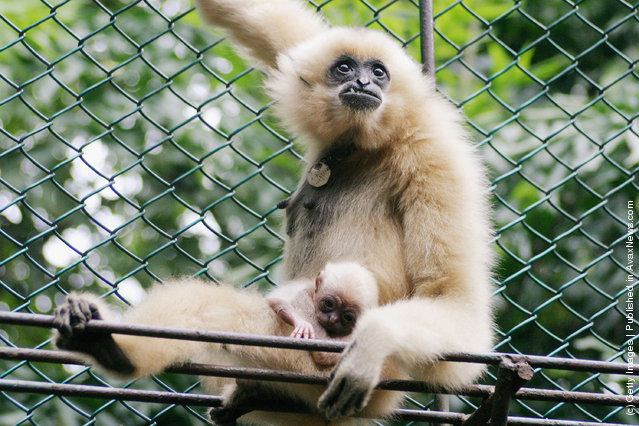
Newborn White-Cheeked Gibbon Nomascus

“Nomascus is the second most speciose genus of gibbons (family Hylobatidae). Originally this genus was a subgenus of Hylobates, and all individuals were considered one species, Hylobates concolor. Species within Nomascus are characterized by 52 chromosomes. Some species are all black, some light with a distinct black tuft of crown fur, and some by distinct, light-colored cheek patches. Nomascus is found from southern China (Yunnan) to southern Vietnam, and also on Hainan Island. One of the genus' species, Nomascus nasutus, has been deemed “the most critically endangered ape species in the world”. All of the species in this genus are endangered or critically endangered”. – Wikipedia

Photo: A newborn White-Cheeked Gibbon clings to its mother in the Nanning Zoo on April 12, 2004 in Nanning, Guangxi province, China. The White-Cheeked Gibbon's natural habitat is Southern China as well as Vietnam and Laos. They are classified as highly endangered and are on the brink of extinction due to poaching and reduction of natural rainforests. (Photo by Getty Images)

Details
12 Aug 2011 11:51:00