Loading...
Done
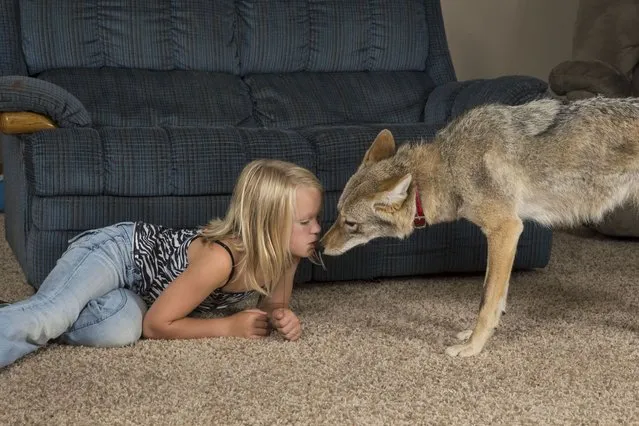
Coyote Wiley sniffs Hailey, 8, at their home. (Photo by Barcroft Media)

Hailey Hanestad thinks nothing about nuzzling up to the animal, called Wiley, and even dozes off with him on her bed. Wiley has been a treasured member of the family since being rescued by Hailey's dad, Rick, three years ago. Today he's thought to be just one of two coyotes in the US that have become domesticated after being born in the wild. Photo: Coyote Wiley sniffs Hailey, 8, at their home. (Photo by Barcroft Media)
Details
15 Jan 2014 11:00:00
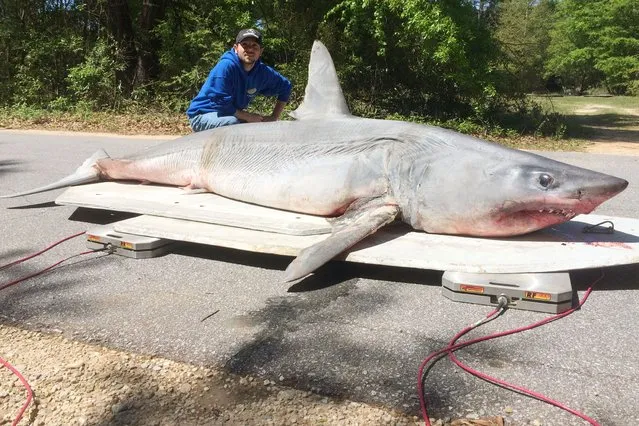
The giant fish helped to feed over 200 members of the local community. (Photo by Joey Polk/Barcroft Media)

A fisherman caught a record-breaking 805lb Mako shark – and then barbecued and ate it with his friends. Joey Polk, 29, and his two cousins Earnie Polk, 43, and Kenny Peterson, 21, battled the 11ft predator for more than an hour before finally hauling it onto the beach. They normally tag and release their catches for conservation but were unable to resuscitate this one and instead made it the main course at a jumbo-sized family barbecue. (Photo by Joey Polk/Barcroft Media)
Details
23 Apr 2014 09:34:00
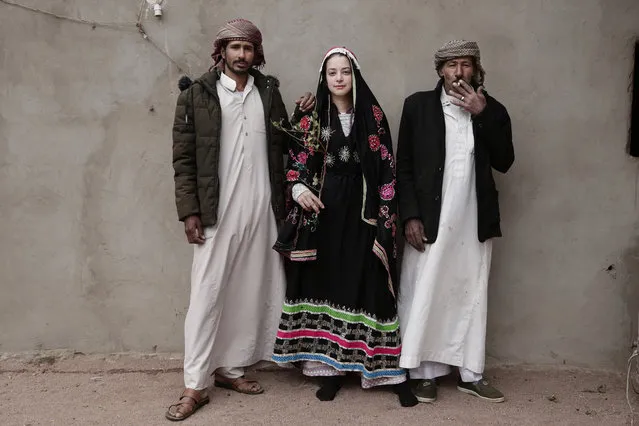
In this March 31, 2019 photo, an Egyptian student borrows a Bedouin wedding dress to pose for a photograph with Bedouin men from the Hamada tribe, in Wadi Sahw, Abu Zenima, in South Sinai, Egypt. Four Bedouin women are for the first time leading tours in Egypt’s Sinai Peninsula, breaking new ground in their deeply conservative community, where women almost never work outside the home or interact with outsiders.  The tourists can only be women, and the tours can’t go overnight. Each day before the sun sets, the group returns to the Hamada’s home village in Wadi Sahu, a narrow desert valley. (Photo by Nariman El-Mofty/AP Photo)

In this March 31, 2019 photo, an Egyptian student borrows a Bedouin wedding dress to pose for a photograph with Bedouin men from the Hamada tribe, in Wadi Sahw, Abu Zenima, in South Sinai, Egypt. Four Bedouin women are for the first time leading tours in Egypt’s Sinai Peninsula, breaking new ground in their deeply conservative community, where women almost never work outside the home or interact with outsiders. The tourists can only be women, and the tours can’t go overnight. Each day before the sun sets, the group returns to the Hamada’s home village in Wadi Sahu, a narrow desert valley. (Photo by Nariman El-Mofty/AP Photo)
Details
11 Apr 2019 00:01:00
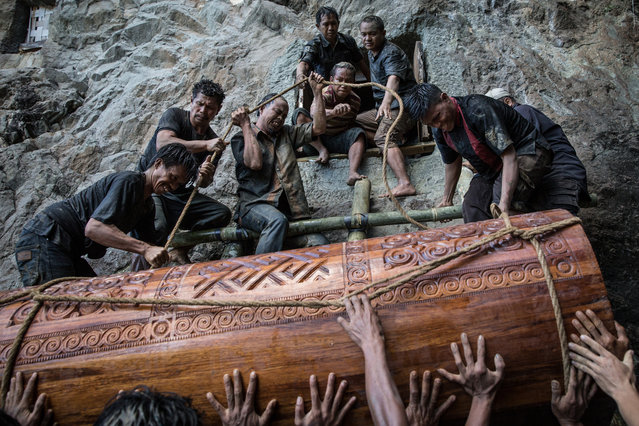
It is said that Torajans are people who “live to die”. For this Indonesian ethnic group, funerals are such extravagant events that they sometimes attract tourists. Families can postpone burials years (and the deceased are considered sick and hosted at home until the funeral) until the family can raise enough money and gather as many relatives as possible. And then it’s a jubilant multiday social event with a parade, dances and animal sacrifices. Agung Parameswara photographed these funerary practices when he traveled to South Sulawesi province, where the Torajans live. But often, their funeral isn’t the last time the dead are seen. In August, crypts are opened, coffins are slid back out and bodies delicately unsheathed. This tender ritual is known as Ma’Nene, which is customarily performed every few years. (Photo by Agung Parameswara/The Washington Post)

It is said that Torajans are people who “live to die”. For this Indonesian ethnic group, funerals are such extravagant events that they sometimes attract tourists. Families can postpone burials years (and the deceased are considered sick and hosted at home until the funeral) until the family can raise enough money and gather as many relatives as possible. And then it’s a jubilant multiday social event with a parade, dances and animal sacrifices. Agung Parameswara photographed these funerary practices when he traveled to South Sulawesi province, where the Torajans live. (Photo by Agung Parameswara/The Washington Post)
Details
06 Oct 2016 09:15:00


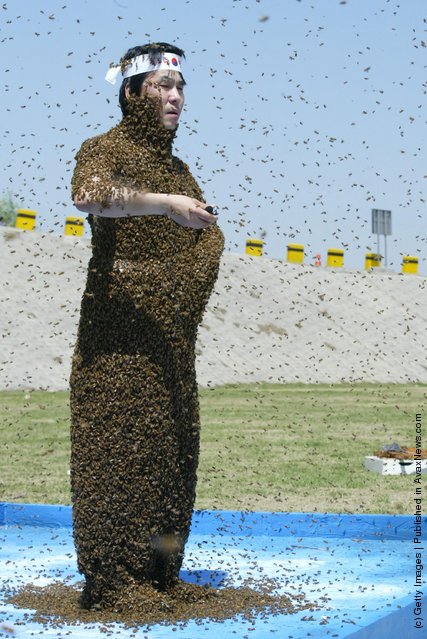
South Korean bee farmer Ahn Sang-Kyu protests Japan's claim of sovereignty over disputed islets May 2, 2006 in Seoul, South Korea. Ahn, a local bee farmer, released over 140,000 bees and attracted them to his body to protest Japan's sovereignty claims over a tiny group of islands located off the east coast of South Korea, called the Dokdo islets by the Koreans and Takeshima by the Japanese. The volcanic islets located about 90 kilometres east of South Korea's Ullung Island, have been a source of diplomatic friction between South Korea and Japan for years. (Photo by Chung Sung-Jun/Getty Images)
Details
05 May 2011 10:32:00
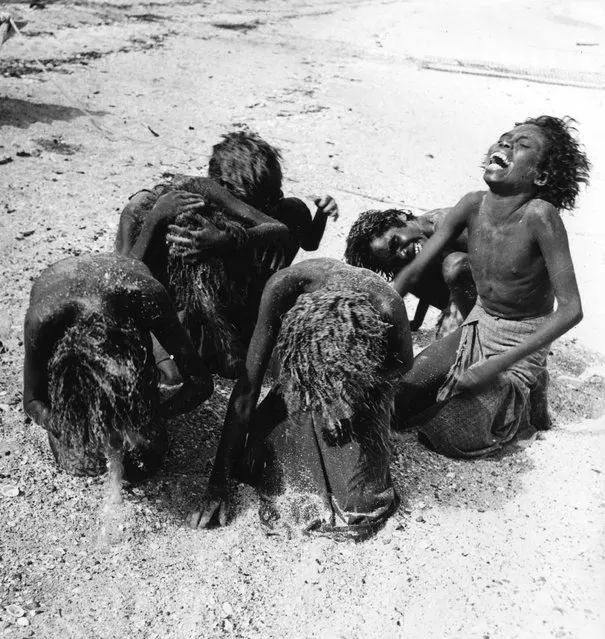
1st January 1950:  Aboriginal women washing their hair with sand at Arnhem land in the Northern Territory of Australia.  (Photo by Three Lions/Getty Images)

“Australian Aborigines are those people regarded as indigenous to the Australian continent. In the High Court of Australia, Australian Aborigines have been specifically identified as a group of people who share, in common, biological ancestry back to the original occupants of the continent”. – Wikipedia

Photo: Aboriginal women washing their hair with sand at Arnhem land in the Northern Territory of Australia. 1st January 1950. (Photo by Three Lions)
Details
02 Feb 2014 07:29:00
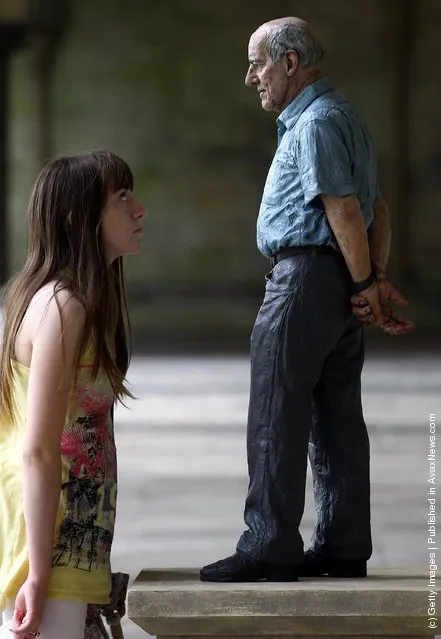
Visitors to Salisbury Cathedral stop to look at Sean Henry's sculpture Standing Man

Visitors to Salisbury Cathedral stop to look at Sean Henry's sculpture Standing Man (2007) currently being exhibited in the Cloisters on August 2, 2011 in Salisbury, United Kingdom. The exhibition, “Conflux: A Union of the Sacred and the Anonymous”, features over 20 contemporary sculptures of dramatically different scales occupying vacant plinths and open spaces on both the inside and exterior of the iconic 13th century building. This exhibition brings to the Cathedral the biggest single group of polychrome sculpture since the Reformation and runs until the end of October. (Photo by Matt Cardy/Getty Images)
Details
03 Aug 2011 11:28:00
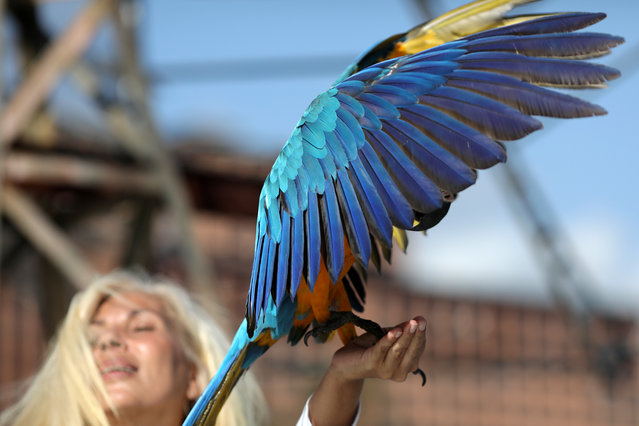
A macaw lands in Carmen Borges' hand while she stays at a rooftop of a building in Caracas, Venezuela, June 12, 2019. (Photo by Manaure Quintero/Reuters)

Looking for an escape from the daily realities of crisis-ridden Venezuela, Carmen Gomez finds solace receiving visitors on the roof of her Caracas apartment building every morning: groups of blue and gold macaws that arrive at daybreak. Here: A macaw lands in Carmen Borges' hand while she stays at a rooftop of a building in Caracas, Venezuela, June 12, 2019. (Photo by Manaure Quintero/Reuters)
Details
24 Jul 2019 00:03:00