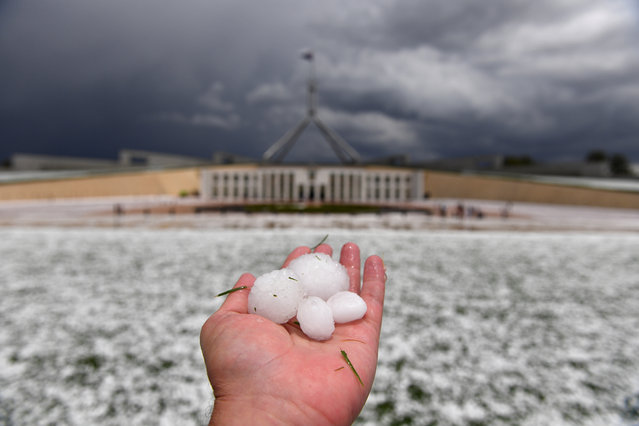
A man shows golf ball-size hail outside Parliament House after a severe hail storm hit Canberra, Australia, 20 January 2020. (Photo by Mick Tsikas/EPA/EFE)
Jonny Simpson-Lee captures the moment these adorable pooches dove head first into a pool. Here: A Golden Labrador jumps for a tennis ball baring his teeth. (Photo by Jonny Simpson-Lee/Caters News Agency)
Moroccan-born pole dancer Karima El Mahroug, nicknamed “Ruby the Heart Stealer” attends the traditional Vienna Opera Ball at the state opera on March 3, 2011 in Vienna, Austria. (Photo by Andreas Rentz/Getty Images)
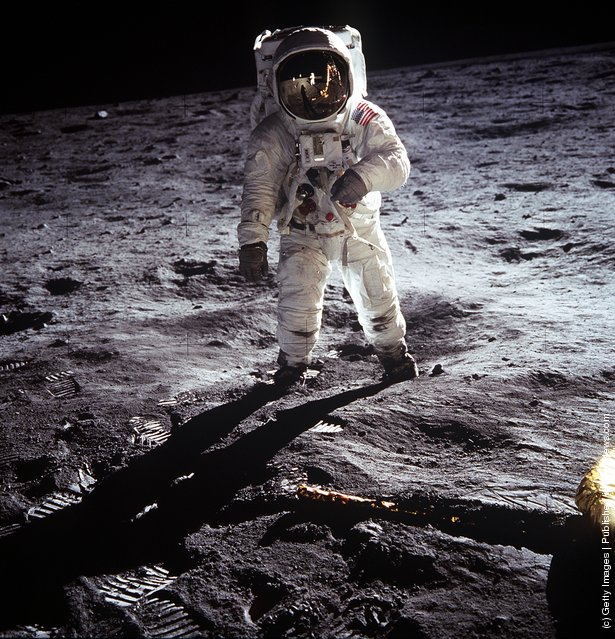
Astronaut Edwin E. Aldrin Jr. walks near the Lunar Module during the Apollo 11 extravehicular activity July 20, 1969 on the Moon. (Photo by NASA/Newsmakers)
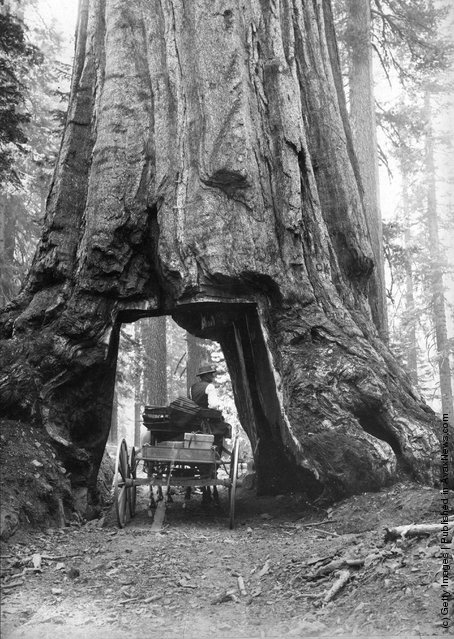
A horse-drawn cart passing through a section cut out of the base of a giant sequoia tree in the Mariposa groves of Yosemite Park, California. (Photo by Carleton E Watkins/Getty Images). 1870
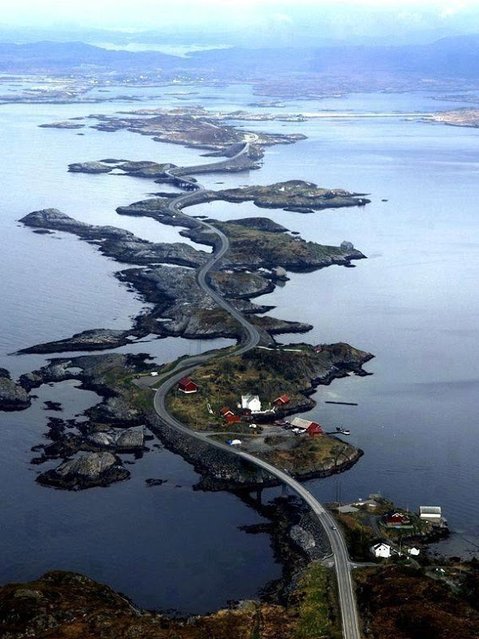
The Atlantic Ocean Road or the Atlantic Road (Norwegian: Atlanterhavsveien) is a 8.3-kilometer (5.2 mi) long section of County Road 64 that runs through an archipelago in Eide and Averøy in Møre og Romsdal, Norway. It passes by Hustadvika, an unsheltered part of the Norwegian Sea, connecting the island of Averøy with the mainland and Romsdalshalvoya peninsula. It runs between the villages of Karvag on Averoy and Vevang in Eida. It is built on several small islands and skerries, which are connected by several causeways, viaducts and eight bridges – the most prominent being Storseisundet Bridge.
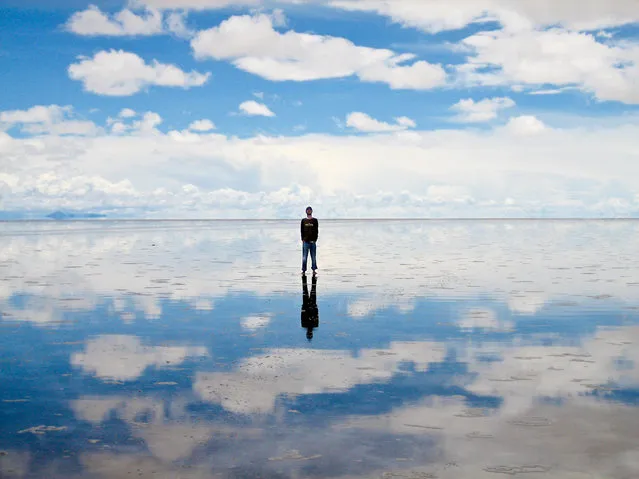
Salar de Uyuni (or Salar de Tunupa) is the world's largest salt flat at 10,582 square kilometers (4,086 sq mi). It is located in the Potosí and Oruro departments in southwest Bolivia, near the crest of the Andes, and is elevated 3,656 meters (11,995 ft) above mean sea level. The Salar was formed as a result of transformations between several prehistoric lakes. It is covered by a few meters of salt crust, which has an extraordinary flatness with the average altitude variations within one meter over the entire area of the Salar.
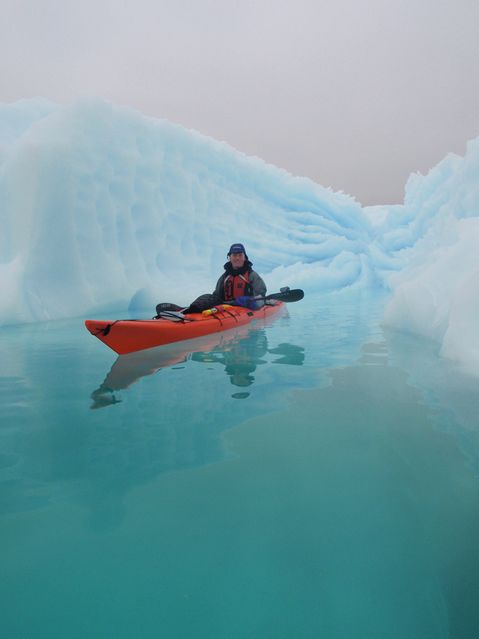
The Greenland ice sheet is a vast body of ice covering 660,235 sq miles, roughly 80% of the surface of Greenland. It is the second largest ice body in the world, after the Antarctic Ice Sheet. Some scientists predict that climate change may be near a "tipping point" where the entire ice sheet will melt in about 2000 years. If the entire 2,850,000 cubic kilometres (683,751 cu mi) of ice were to melt, it would lead to a global sea level rise of 7.2 m (23.6 ft).