Loading...
Done
People wade through a flooded path near Sangam, the confluence of the Ganges, Yamuna and mythical Saraswati rivers after the water level of river Ganges and river Yamuna rose, in Allahabad on October 14, 2022. (Photo by Sanjay Kanojia/AFP Photo)

People wade through a flooded path near Sangam, the confluence of the Ganges, Yamuna and mythical Saraswati rivers after the water level of river Ganges and river Yamuna rose, in Allahabad on October 14, 2022. (Photo by Sanjay Kanojia/AFP Photo)
Details
19 Oct 2022 04:34:00
An Afghan boy mourns next to the grave of his little brother who died due to an earthquake, in Zenda Jan district in Herat province, western of Afghanistan, Monday, October 9, 2023. Saturday's deadly earthquake killed and injured thousands when it leveled an untold number of homes in Herat province. (Photo by Ebrahim Noroozi/AP Photo)

An Afghan boy mourns next to the grave of his little brother who died due to an earthquake, in Zenda Jan district in Herat province, western of Afghanistan, Monday, October 9, 2023. Saturday's deadly earthquake killed and injured thousands when it leveled an untold number of homes in Herat province. (Photo by Ebrahim Noroozi/AP Photo)
Details
14 Oct 2023 01:29:00
A guard secures gates of a catfish farm visited by a group of foreign reporters in Pyongyang, North Korea April 17, 2017. (Photo by Damir Sagolj/Reuters)

A guard secures gates of a catfish farm visited by a group of foreign reporters in Pyongyang, North Korea April 17, 2017. (Photo by Damir Sagolj/Reuters)
Details
16 May 2017 07:23:00
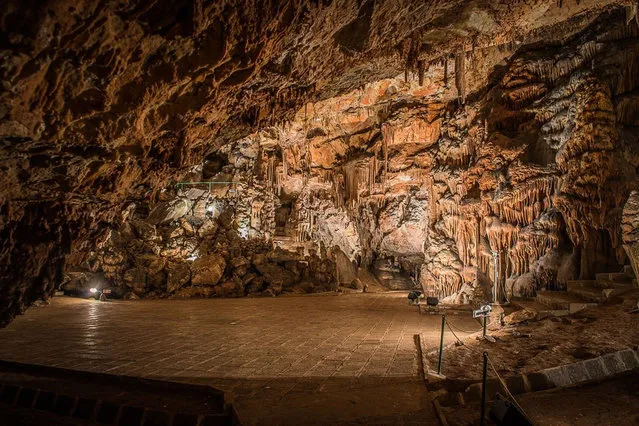
Saeva Dupka Cave

Saeva dupka (Bulgarian: Съева дупка) is a cave in Northern Bulgaria near the village of Brestnitsa, Lovech Province (43°2′N 24°11′E). Its five halls and 400 metres of corridors offer some of the most beautiful cave formations in the country. Besides that the cave has hosted many Choral music performances, thanks to the excellent acoustic conditions. Saeva dupka was named after two brothers Seyu and Sae who used it as a hiding place during the Ottoman occupation of Bulgaria. Recent excavations have showed the cave was inhabited since Roman times. Currently Saeva dupka is one of the 100 Tourist Sites of Bulgaria.
Details
20 Feb 2013 11:30:00
Foam party: Marck captured this moment in time from the shore on July, 30, 2015, in Durban, South Africa. (Photo by Marck Botha/Barcroft Media)

Beautiful seascapes capture the “raw power” of waves rising and crashing in the Indian Ocean. The stunning photos were taken off the coast of Durban in South Africa, and show formations from above and below the surface. Surfer and photographer Marck Botha took the images between April and July, and has always had a passion for the ocean. Here: Marck captured this moment in time from the shore on July, 30, 2015, in Durban, South Africa. (Photo by Marck Botha/Barcroft Media)
Details
30 Jan 2016 13:46:00
RT-2PM2 Topol-M TEL with presumably Yars system transport-launch container

“March 19, 2012 was the first rehearsal for the Victory Day Parade at the training ground in Alabino (near Moscow, Moscow Military District). Since the end of February troops and vehicles from various units and formations of the Armed Forces began arriving to Alabino training ground. The first rehearsal included only military vehicles. During the ride the average speed of vehicles is 12 km/h, the distance depending on the type of vehicle from 12 to 15 meters”. – Vitaly Kuzmin
Details
15 Apr 2012 12:50:00
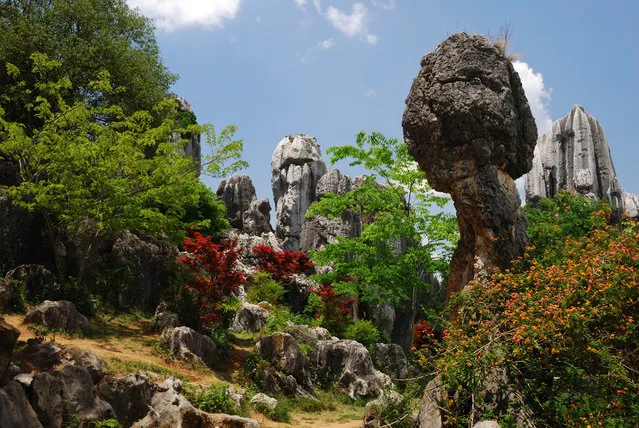
Shilin Stone Forest

The Stone Forest or Shilin is a notable set of limestone formations located in Shilin Yi Autonomous County, Yunnan Province, People's Republic of China, near Shilin approximately 120 km (75 mi) from the provincial capital Kunming. The tall rocks seem to emanate from the ground in the manner of stalagmites, with many looking like petrified trees thereby creating the illusion of a forest made of stone. Since 2007, two parts of the site, the Naigu Stone Forest (乃古石林) and Suogeyi Village (所各邑村), have been UNESCO World Heritage Sites as part of the South China Karst.
Details
27 Sep 2013 10:03:00
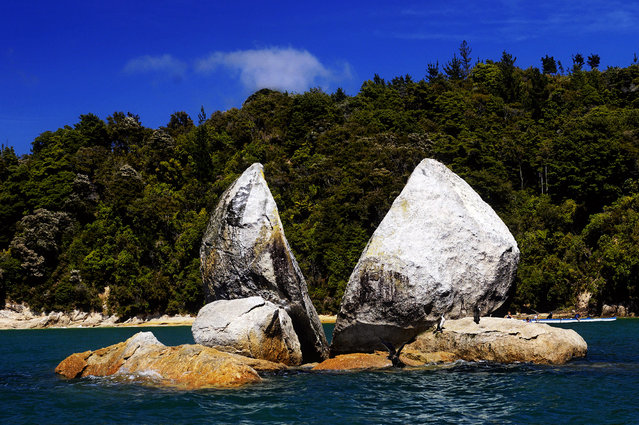
Split Apple Rock

Split Apple Rock is a geological rock formation in The Tasman Bay off the northern coast of the South Island of New Zealand. Made of granite, it is in the shape of an apple which has been cut in half. It is a popular tourist attraction in the waters of the Tasman Sea approximately 50 metres off the coast between Kaiteriteri and Marahau. The rock sits in shallow water at low tide and is accessible by wading. It is also a point of interest for the many tourist boats and pleasure craft which operate along the shores of the Abel Tasman National Park. The cleft to produce two sides of the 'apple' was a natural occurrence. It is unknown when this happened and therefore the cleaving of the rock has attracted mythological explanations.
Details
19 Oct 2013 10:58:00