Loading...
Done
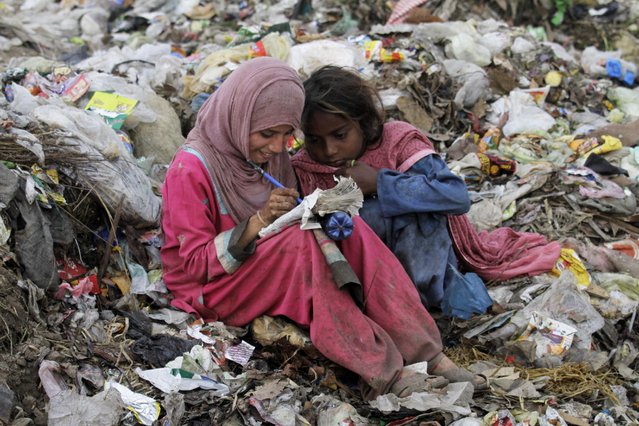
A Pakistani scavenger girl writes on a notebook she collected from a garbage, while another girl sits next to her in Lahore, Pakistan, Wednesday, April 1, 2015. Thousands of children pick recyclable items from waste dumping points to earn living for their poor families. (Photo by K. M. Chaudary/AP Photo)

A Pakistani scavenger girl writes on a notebook she collected from a garbage, while another girl sits next to her in Lahore, Pakistan, Wednesday, April 1, 2015. Thousands of children pick recyclable items from waste dumping points to earn living for their poor families. (Photo by K. M. Chaudary/AP Photo)
Details
05 Apr 2015 11:38:00
A Pakistani Hindu woman lights candles during Diwali celebrations at a local temple in Lahore, Pakistan, Wednesday, November 11, 2015. Diwali, the festival of lights, is one of Hinduism's most important festivals dedicated to the worship of Lakshmi, the Hindu goddess of wealth. (Photo by K. M. Chaudary/AP Photo)

A Pakistani Hindu woman lights candles during Diwali celebrations at a local temple in Lahore, Pakistan, Wednesday, November 11, 2015. Diwali, the festival of lights, is one of Hinduism's most important festivals dedicated to the worship of Lakshmi, the Hindu goddess of wealth. (Photo by K. M. Chaudary/AP Photo)
Details
15 Nov 2015 08:05:00
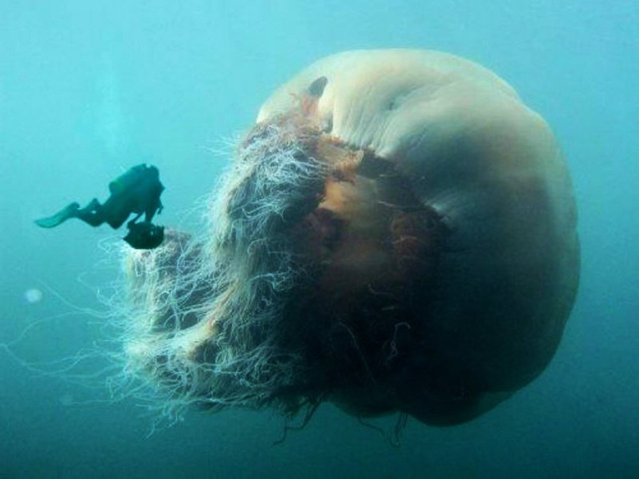
Giant Jellyfish Cyanea capillata

Cyanea capillata is the largest known species of jellyfish. Its range is confined to cold, boreal waters of the Arctic, northern Atlantic, and northern Pacific Oceans, seldom found farther south than 42°N latitude. Similar jellyfish, which may be the same species, are known to inhabit seas near Australia and New Zealand. The largest recorded specimen found, washed up on the shore of Massachusetts Bay in 1870, had a bell (body) with a diameter of 7 feet 6 inches (2.29 m) and tentacles 120 feet (37 m) long.Lion's mane jellyfish have been observed below 42°N latitude for some time—specifically in the larger bays of the east coast of the United States.
Details
24 Jul 2012 12:00:00
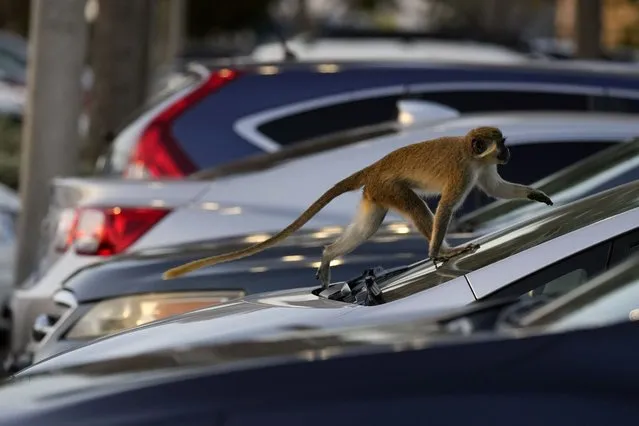
A vervet monkey walks over a parked car in the Park 'N Fly airport lot which lies adjacent to the mangrove preserve where the monkey colony lives, Tuesday, March 1, 2022, in Dania Beach, Fla. For 70 years, a group of non-native monkeys has made their home next to a South Florida airport, delighting visitors and becoming local celebrities. (Photo by Rebecca Blackwell/AP Photo)

A vervet monkey walks over a parked car in the Park 'N Fly airport lot which lies adjacent to the mangrove preserve where the monkey colony lives, Tuesday, March 1, 2022, in Dania Beach, Fla. For 70 years, a group of non-native monkeys has made their home next to a South Florida airport, delighting visitors and becoming local celebrities. (Photo by Rebecca Blackwell/AP Photo)
Details
07 Apr 2022 05:26:00
Alejandra Guajardo, Miss Universe El Salvador 2022 poses on stage in an outfit inspired by the country's use of Bitcoin, and previously the colón and cocoa beans as a currency, during the 71st Miss Universe National Costume Show at the Ernst N. Morial Convention Center in New Orleans, Louisiana, U.S. January 11, 2023. (Photo by Benjamin Askinas/©IMG Universe LLC/Handout via Reuters)

Alejandra Guajardo, Miss Universe El Salvador 2022 poses on stage in an outfit inspired by the country's use of Bitcoin, and previously the colón and cocoa beans as a currency, during the 71st Miss Universe National Costume Show at the Ernst N. Morial Convention Center in New Orleans, Louisiana, U.S. January 11, 2023. (Photo by Benjamin Askinas/©IMG Universe LLC/Handout via Reuters)
Details
11 Mar 2024 10:02:00
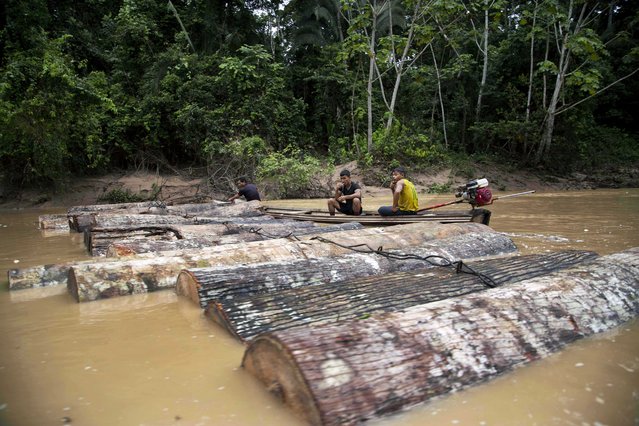
In this March 17, 2015 photo, Ashaninka Indian men, identified by locals as illegal loggers, tie tree trunks together to move them along the Putaya River near the hamlet of Saweto, Peru. Illegal logging persists unabated in this remote Amazon community where four indigenous leaders who resisted it were slain in September. The Putaya River is the waterway that transports felled trees, cut both legally and illegally, to the city of Pucallpa. (Photo by Martin Mejia/AP Photo)

In this March 17, 2015 photo, Ashaninka Indian men, identified by locals as illegal loggers, tie tree trunks together to move them along the Putaya River near the hamlet of Saweto, Peru. Illegal logging persists unabated in this remote Amazon community where four indigenous leaders who resisted it were slain in September. The Putaya River is the waterway that transports felled trees, cut both legally and illegally, to the city of Pucallpa. (Photo by Martin Mejia/AP Photo)
Details
27 Mar 2015 12:40:00
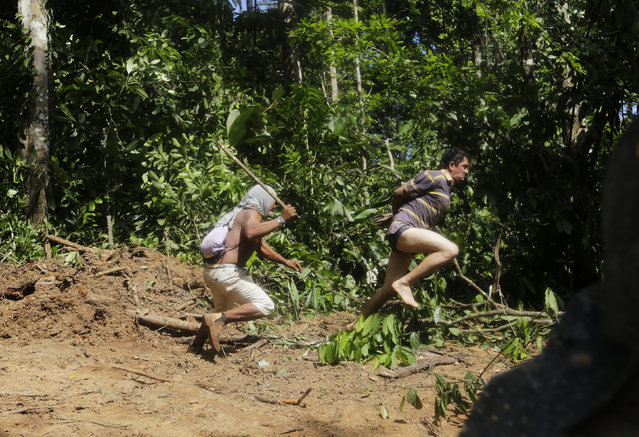
A Ka'apor Indian warrior (L) chases a logger who tried to escape after they captured him during a jungle expedition to search for and expel loggers from the Alto Turiacu Indian territory, near the Centro do Guilherme municipality in the northeast of Maranhao state in the Amazon basin, August 7, 2014. (Photo by Lunae Parracho/Reuters)

A Ka'apor Indian warrior (L) chases a logger who tried to escape after they captured him during a jungle expedition to search for and expel loggers from the Alto Turiacu Indian territory, near the Centro do Guilherme municipality in the northeast of Maranhao state in the Amazon basin, August 7, 2014. Tired of what they say is a lack of sufficient government assistance in keeping loggers off their land, the Ka'apor Indians, who along with four other tribes are the legal inhabitants and caretakers of the territory, have sent their warriors out to expel all loggers they find and set up monitoring camps in the areas that are being illegally exploited. (Photo by Lunae Parracho/Reuters)
Details
05 Sep 2014 11:41:00
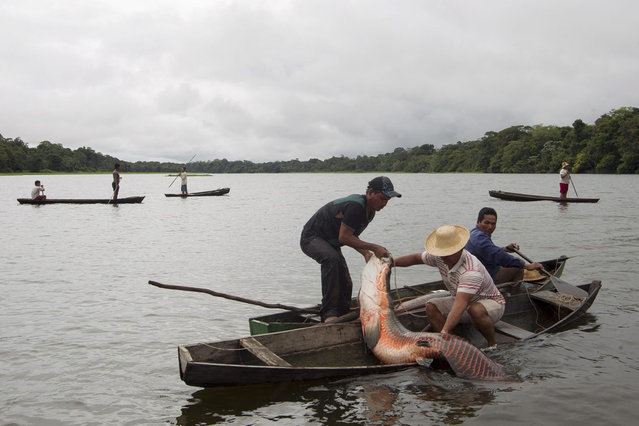
Villagers from the Porto Novo community load into their canoes arapaima or pirarucu, the largest freshwater fish species in South America and one of the largest in the world, while fishing in Poco Fundo lake along a branch of the Solimoes river, one of the main tributaries of the Amazon, in the Mamiraua nature reserve near Fonte Boa about 600 km (373 miles) west of Manaus, November 26, 2013. (Photo by Bruno Kelly/Reuters)

Villagers from the Porto Novo community load into their canoes arapaima or pirarucu, the largest freshwater fish species in South America and one of the largest in the world, while fishing in Poco Fundo lake along a branch of the Solimoes river, one of the main tributaries of the Amazon, in the Mamiraua nature reserve near Fonte Boa about 600 km (373 miles) west of Manaus, November 26, 2013. Catching the arapaima, a fish that is sought after for its meat and is considered by biologists to be a living fossil, is only allowed once a year by Brazil's environmental protection agency. The minimum size allowed for a fisherman to keep an arapaima is 1.5 meters (4.9 feet). (Photo by Bruno Kelly/Reuters)

Details
17 Dec 2013 08:03:00