Loading...
Done
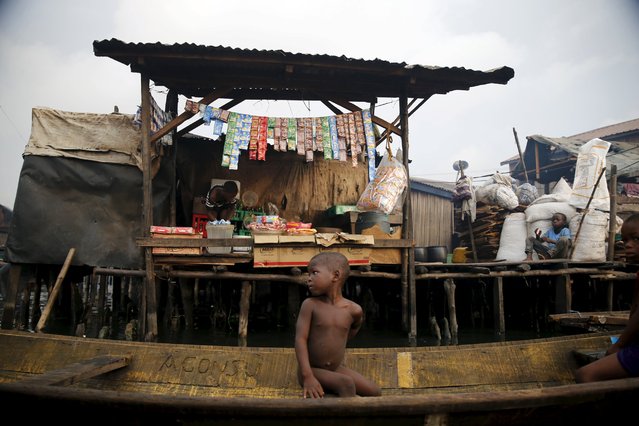
A boy sits in a canoe in front of a shed built on a raft in the Makoko fishing community on the Lagos Lagoon, Nigeria February 29, 2016. Makoko, a vast slum of houses on stilts in a Lagos lagoon, now boasts a new school – pyramid-shaped, floating and capable of withstanding the waterways' extreme weather, it is a beacon of hope for the nearly 100,000 Nigerians who live there.  (Photo by Akintunde Akinleye/Reuters)

A boy sits in a canoe in front of a shed built on a raft in the Makoko fishing community on the Lagos Lagoon, Nigeria February 29, 2016. In Makoko, a sprawling slum of Nigeria's megacity Lagos, a floating school capable of holding up to a hundred pupils has since November brought free education to the waterways known as the Venice of Lagos. It offers the chance of social mobility for youngsters who, like most of the city's 21 million inhabitants, lack a reliable electricity and water supply and whose water-based way of life is threatened by climate change as well as rapid urbanisation. (Photo by Akintunde Akinleye/Reuters)
Details
05 Mar 2016 12:01:00
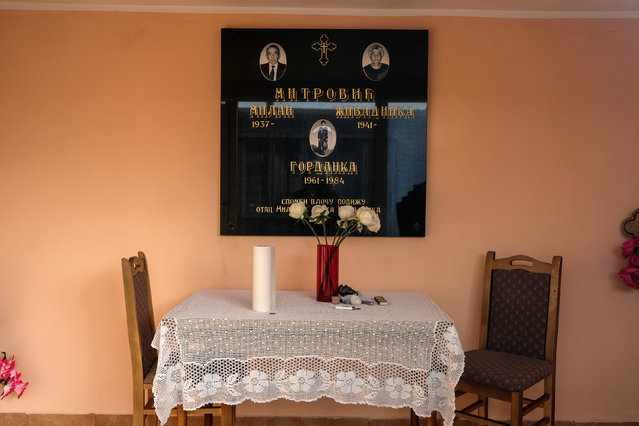
Pictures of deceased people are seen inside a chapel at a cemetery in the village of Smoljinac, Serbia, October 25, 2016. (Photo by Marko Djurica/Reuters)

Pictures of deceased people are seen inside a chapel at a cemetery in the village of Smoljinac, Serbia, October 25, 2016. From a distance, the cemetery in the eastern Serbian village of Smoljinac looks like a residential neighbourhood eerily placed among graves. But once inside the grounds, after passing a section with the usual stone slabs, visitors find rows of small bungalows painted in pastel colours. They have one or two rooms, large windows and ornate plaques – some inside, some outside – memorialising the deceased. These are the burial chapels of Smoljinac, cosy cabins with a furnished room inside, a storage place for wreaths and funeral paraphernalia, and the family crypt below. Some even have electric power inside. (Photo by Marko Djurica/Reuters)
Details
12 Nov 2016 10:37:00
Britain's Mo Farah reacts as he wins the men's 5000m final at the London 2012 Olympic Games at the Olympic Stadium in Britain August 11, 2012. Lucy Nicholson: “When Mo Farah was rounding the final corner for the 5000m the huge stadium was electric, everybody was on their feet and he knew he was going to win as he came into that final stretch. All the photographers were excited because we knew he was going to react in a very dramatic way so it was a lovely sequence of photos as he crossed the finish line – he put his hands over his head, he wrapped himself in the British flag, it was a very long celebration sequence, which is all you can really wish for as a photographer”. (Photo by Lucy Nicholson/Reuters)

The Rio de Janeiro Olympics kick off on August 5 for some two weeks of competitive games drawing athletes as well as audiences from around the world. As they prepare to cover the event, Reuters photographers look back on their favourite pictures from past Olympics where they captured the action on the ground as well as the participants' tears and joy that followed. (Photo by Lucy Nicholson/Reuters)
Details
03 Aug 2016 11:19:00


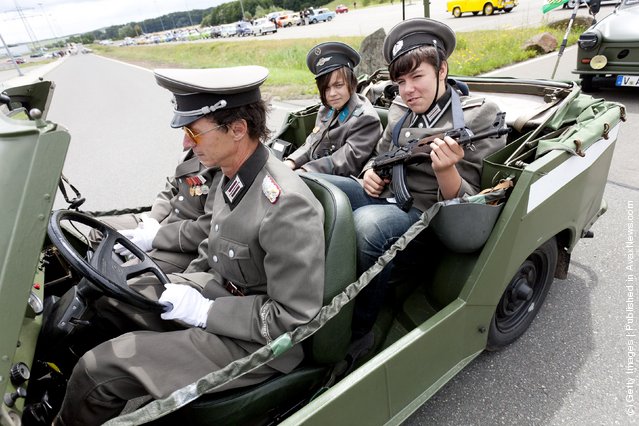
“The Trabant is a car that was produced by former East German auto maker VEB Sachsenring Automobilwerke Zwickau in Zwickau, Sachsen. It was the most common vehicle in East Germany, and was also exported to countries both inside and outside the communist bloc. The main selling points was that it had room for four adults and luggage in a compact, light and durable shell and that it was fast (when introduced) and durable. With its mediocre performance, smoky two-stroke engine, and production shortages, the Trabant is often cited as an example of the disadvantages of centralized planning; on the other hand, it is regarded with derisive affection as a symbol of the failed former East Germany and of the fall of communism (in former West Germany, as many East Germans streamed into West Berlin and West Germany in their Trabants after the opening of the Berlin Wall in 1989). It was in production without any significant changes for nearly 30 years with 3,096,099 Trabants produced in total”. – Wikipedia

Photo: Enthusiasts weared in uniforms of the former eastern german army trive in a military Trabant car as fans and owners of East German-era Trabant cars gather at the 2011 International Trabantfahrer Treffen (International Trabant Drivers Meeting) on June 26, 2011 in Zwickau, Germany. The Trabant, also known as the Trabi, was among the main cars produced in communist East Germany and built by VEB Sachsenring Automobilwerke in Zwickau for 30 years until 1989. Today the car has cult status for many followers and one company, IndiKar, is even seeking to revive the brand in a modern, electric version. (Photo by Carsten Koall/Getty Images)

Details
27 Jun 2011 12:21:00
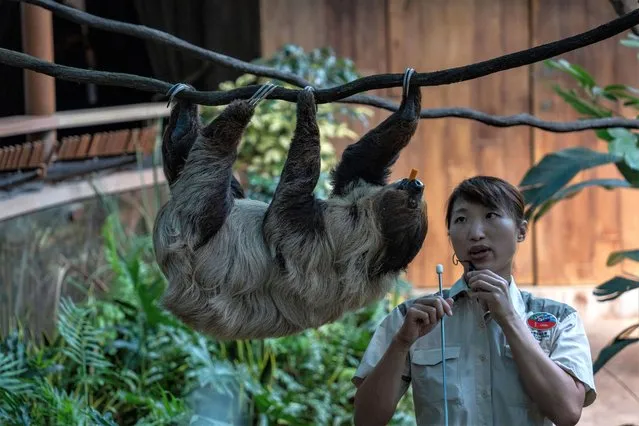
A worker stands next to a Southern Two-toed Sloth at the Sloth and Friends Studio inside Hong Kong Ocean Park on August 3, 2023 in Hong Kong, China. (Photo by Vernon Yuen/Rex Features/Shutterstock)

A worker stands next to a Southern Two-toed Sloth at the Sloth and Friends Studio inside Hong Kong Ocean Park on August 3, 2023 in Hong Kong, China. (Photo by Vernon Yuen/Rex Features/Shutterstock)
Details
15 Aug 2023 03:15:00
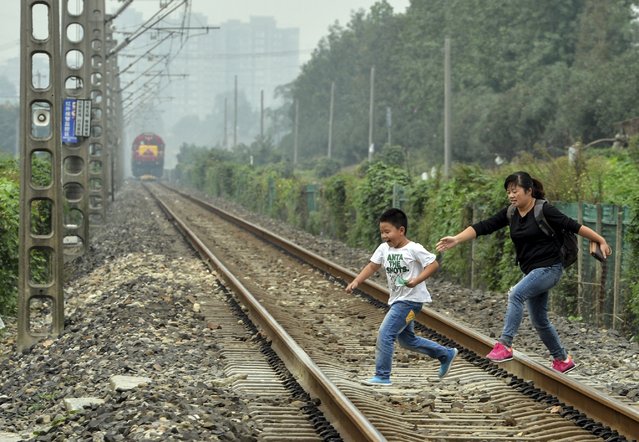
A boy and a woman run across a railway track as a train approaches in Chengdu, Sichuan province, China, October 8, 2015. Many residents disregard sign prohibiting this kind of illegal crossing and choose to do so to save time, local media reported. (Photo by Hao Fei/Reuters/Western China Metropolis Daily)

A boy and a woman run across a railway track as a train approaches in Chengdu, Sichuan province, China, October 8, 2015. Many residents disregard sign prohibiting this kind of illegal crossing and choose to do so to save time, local media reported. (Photo by Hao Fei/Reuters/Western China Metropolis Daily)
Details
18 Oct 2015 08:04:00
People use large water guns to spray each other as they celebrate the annual Songkran festival in Bangkok, Thailand on April 14, 2025. Thailand celebrated the Thai traditional New Year, called Songkran in Thai and also known as ëthe water festivalí, on 13 April, with festivities going on on throughout the weekend. During Songkran, people celebrate the New Year by splashing water to each other as a sign of washing away sins and bad luck from the previous year. People across Thailand celebrate the New Year with parties and water related activities throughout the weekend. (Photo by Diego Azubel/Matrix Images)

People use large water guns to spray each other as they celebrate the annual Songkran festival in Bangkok, Thailand on April 14, 2025. Thailand celebrated the Thai traditional New Year, called Songkran in Thai and also known as ëthe water festivalí, on 13 April, with festivities going on on throughout the weekend. During Songkran, people celebrate the New Year by splashing water to each other as a sign of washing away sins and bad luck from the previous year. People across Thailand celebrate the New Year with parties and water related activities throughout the weekend. (Photo by Diego Azubel/Matrix Images)
Details
19 Jul 2025 02:24:00
Space Invaders, 2011 by Mickey McCooper

Mickey McCooper, born 1972 as Michel Valentino in Stuttgart-Germany, is a photo-artist, filmmaker, painter, and media-entrepreneur. He is well known for the broad range of subject matter he is able to interpret, he is widely recognized for his unusual people portraiture, his editorial photography, his photo illustrations, photographic design and his extraordinary repertoire of art photography, painings and drawings.

Photo: Space Invaders, 2011. (Photo by Mickey McCooper)
Details
26 Apr 2012 14:03:00