Loading...
Done
Professor Xie Yong works on an art installation of a beaver, which is made out of plastic and around 300,000 needles, in Shenyang, Liaoning province, July 23, 2013. The needles, according to Xie, represent the pain felt by animals when their fur is taken off to produce clothing. (Photo by Reuters/Stringer)

Professor Xie Yong works on an art installation of a beaver, which is made out of plastic and around 300,000 needles, in Shenyang, Liaoning province, July 23, 2013. The needles, according to Xie, represent the pain felt by animals when their fur is taken off to produce clothing. (Photo by Reuters/Stringer)
Details
27 Jul 2013 09:15:00
South Vietnamese-born designer Quasar drives the six-foot long square-shaped plastic car he built and which is scheduled to be a hit with the young driving set, in Paris, June 23, 1967. The car can be driven at speeds of up to 60 mph  (Photo by Michel Laurent/AP Photo)

South Vietnamese-born designer Quasar drives the six-foot long square-shaped plastic car he built and which is scheduled to be a hit with the young driving set, in Paris, June 23, 1967. The car can be driven at speeds of up to 60 mph (Photo by Michel Laurent/AP Photo)
Details
07 Oct 2017 07:37:00
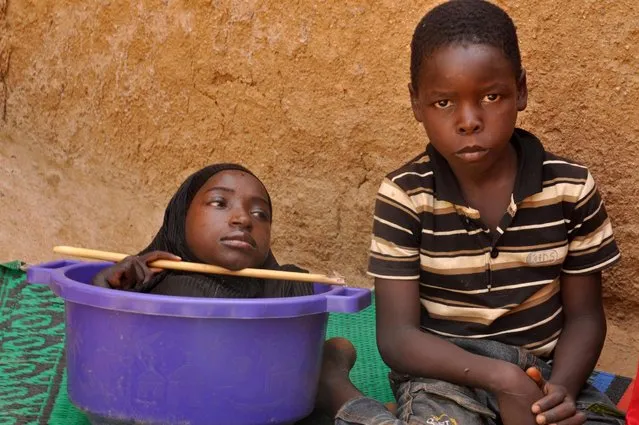
Rahma, 19, pictured with her 10-year old brother Fahad on June 21, 2016 in Kano, Nigeria. A teenage girl born without limbs lives her life in a plastic bowl. Rahma Haruna is a bright, happy girl, despite suffering from a mystery condition that stopped her arms and legs developing properly – leaving her practically limbless and in constant pain. The 19-year- old, from Kano, Nigeria, was born a healthy baby but when she turned six months old her growth came to a sudden halt and she stopped hitting key development milestones. Rahma’s family do their best to provide her with a fulfilling life and transport her around the village in a plastic bowl. Rahma said: “They help me a lot. How do they? They give me anything I need”. Rahma died on 25 December 2016. (Photo by Sani Maikatanga/Barcroft Images)

Rahma, 19 (L), pictured with her 10-year old brother Fahad on June 21, 2016 in Kano, Nigeria. A teenage girl born without limbs lives her life in a plastic bowl. Rahma Haruna is a bright, happy girl, despite suffering from a mystery condition that stopped her arms and legs developing properly – leaving her practically limbless and in constant pain. The 19-year- old, from Kano, Nigeria, was born a healthy baby but when she turned six months old her growth came to a sudden halt and she stopped hitting key development milestones. Rahma’s family do their best to provide her with a fulfilling life and transport her around the village in a plastic bowl. Rahma said: “They help me a lot. How do they? They give me anything I need”. Rahma died on 25 December 2016. (Photo by Sani Maikatanga/Barcroft Images)
Details
30 Dec 2016 10:52:00
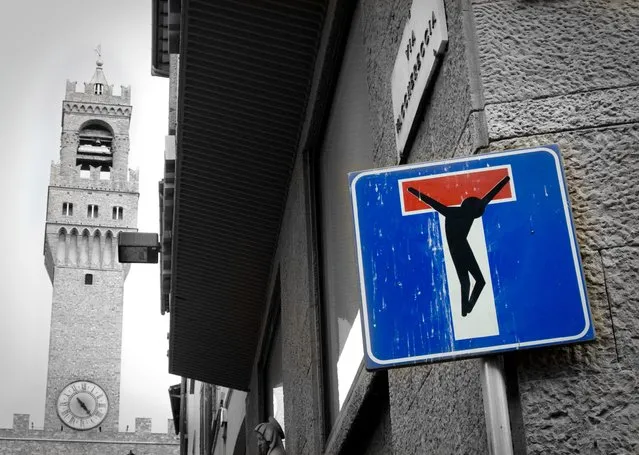
Street Art by Clet Abraham

Clet Abraham, 46 years old, is a plastic artistic that is transforming the traffic signs in something with an intelligent lecture, with a political, religious and philosophic understanding.
Details
12 Jun 2012 10:12:00
Art by Kris Kuksi

A post-industrial Rococo master, Kris Kuksi obsessively arranges characters and architecture in asymmetric compositions with an exquisite sense of drama. Instead of stones and shells he uses screaming plastic soldiers, miniature engine blocks, towering spires and assorted debris to form his landscapes.
Details
06 Sep 2012 11:32:00
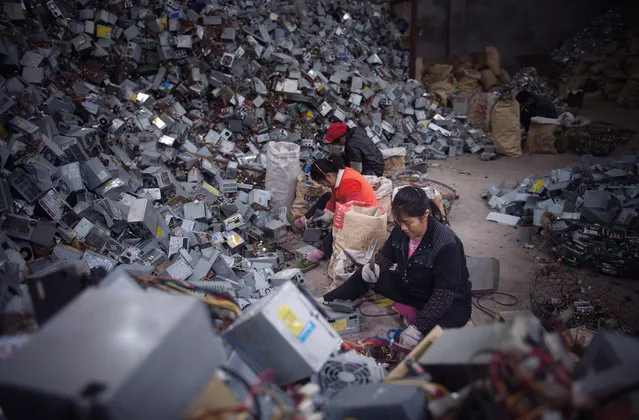
“The sustainable development goals cannot be met unless waste management is addressed as a priority”, says UK waste management charity Waste Aid. “E-waste is one of the fastest growing categories of the 7-10bn tonnes of waste produced globally every year”, adds director Mike Webster. “In our view, decent waste management is a basic right and we want governments around the world take this issue much more seriously – in 2012 only 0.2% of international aid went on improving solid waste management – it’s just not enough”. (Photo by Kai Loeffelbein/laif Agentur)

Sustainable development goal target 12.5 is to reduce waste. But with a planet increasingly dependent on technology, is that even possible? As of today, over 30m tonnes of electronic waste has been thrown out so far this year, according to the World Counts. Most e-waste is sent to landfills in Asia and Africa where it is recycled by hand, exposing the people who do it to environmental hazards. Kai Loeffelbein’s photographs of e-waste recycling in Guiyu, southern China show what happens to discarded computers. (Photo by Kai Loeffelbein/laif Agentur)
Details
19 Oct 2016 12:14:00
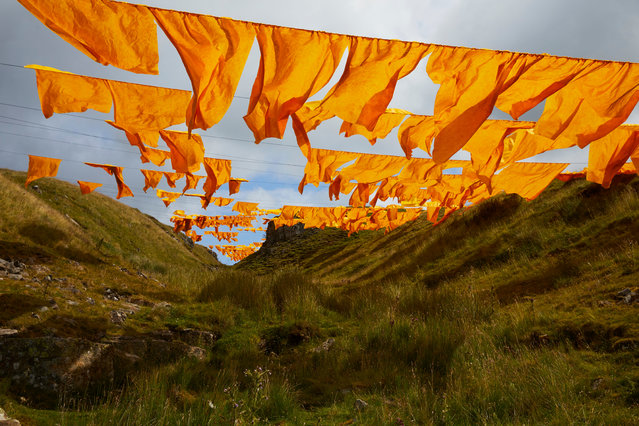
Monumental landscape artwork “Hush” by installation artist Steve Messam hangs in the moors of Teesdale on July 18, 2019 in Barnard Castle, England. The outdoor installation is inspired by the geology, mining history and landscape of the area. It hangs over Bales Hush, a deep gauge in the terrain created when miners flushed the area with water to reveal the geological riches below. Hundreds of metres of recyclable saffron yellow fabric blow in the wind. (Photo by Christopher Thomond/The Guardian)

Monumental landscape artwork “Hush” by installation artist Steve Messam hangs in the moors of Teesdale on July 18, 2019 in Barnard Castle, England. The outdoor installation is inspired by the geology, mining history and landscape of the area. It hangs over Bales Hush, a deep gauge in the terrain created when miners flushed the area with water to reveal the geological riches below. Hundreds of metres of recyclable saffron yellow fabric blow in the wind. (Photo by Christopher Thomond/The Guardian)
Details
20 Jul 2019 00:03:00
A dead green sea turtle is collected from the beach at the Khor Kalba Conservation Reserve, in the city of Kalba, on the east coast of the United Arab Emirates, Tuesday, February 1, 2022.  A staggering 75% of all dead green turtles and 57% of all loggerhead turtles in Sharjah had eaten marine debris, including plastic bags, bottle caps, rope and fishing nets, a new study published in the Marine Pollution Bulletin. The study seeks to document the damage and danger of the throwaway plastic that has surged in use around the world and in the UAE, along with other marine debris. (Photo by Kamran Jebreili/AP Photo)

A dead green sea turtle is collected from the beach at the Khor Kalba Conservation Reserve, in the city of Kalba, on the east coast of the United Arab Emirates, Tuesday, February 1, 2022. A staggering 75% of all dead green turtles and 57% of all loggerhead turtles in Sharjah had eaten marine debris, including plastic bags, bottle caps, rope and fishing nets, a new study published in the Marine Pollution Bulletin. The study seeks to document the damage and danger of the throwaway plastic that has surged in use around the world and in the UAE, along with other marine debris. (Photo by Kamran Jebreili/AP Photo)
Details
26 Feb 2022 04:58:00