Loading...
Done
A Northern Romance Series By David Renshaw

Lovely is the correct work to describe this beautiful paintings series by David Renshaw from “Ted n’ Doris – A Northern Romance”. “Deep down I always knew what I wanted to do for a living and in my school years I remember my father teaching me some basic elements of drawing and I dreamed of one day becoming an artist. Being only really interested in art I left school and studied Graphic Design, after which I started work at a local art gallery as a picture framer. I continued to paint alongside my job, mainly developing techniques and ideas and in 2005 decided it was time to follow my dreams and dedicate myself to painting full time. I always try to make my work feel atmospheric, and I like to pay particular attention to sky and cloud formations as I consider this element of my work to be extremely important to the mood of the finished painting, whether it be a dramatic sunset or a misty moonlit night.”
Details
19 Oct 2013 11:48:00
Pineapple

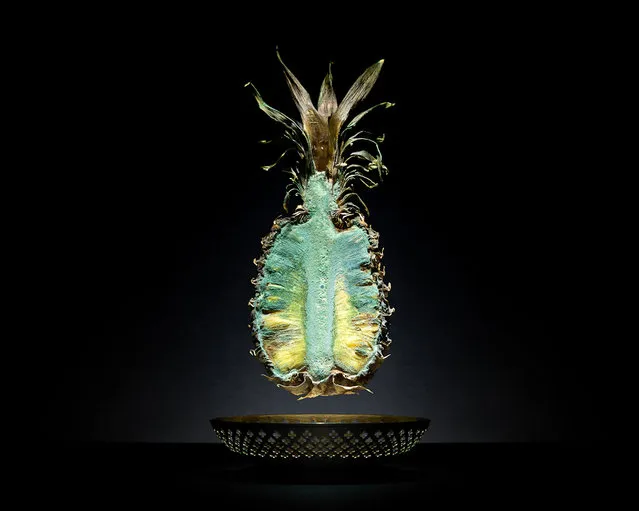
“One Third” – a project on food waste by an Austrian photography Klaus Pichler. According to a UN study one third of the world's food goes to waste – the largest part thereof in the industrialized nations of the global north. Equally, 925 million people around the world are threatened by starvation. The series “One Third” describes the connection between individual wastage of food and globalized food production.

Photo: Pineapple. Place of production: Guayaquil, Ecuador. Cultivation method: Outdoor plantation • Time of harvest: All- season. Transporting distance: 10.666 km (linear distance) • Means of transportation: Aircraft, truck. Carbon footprint (total) per kg: 11,94 kg • Water requirement (total) per kg: 360 l. Price: 2,10 € / kg. (Photo by Klaus Picher)
Details
02 May 2012 11:01:00
When he started using a camera there were very few documentary photographers working outside the government. Sutkus instead looked to writers and film-makers, and says he drew inspiration from the works of Franz Kafka, Jean-Paul Sartre, Ernest Hemingway and Vladimir Nabokov. Here: The first Lithuanian bikers, 1974. (Photo by Antanas Sutkus)

Rebelling against political propaganda, acclaimed photographer Antanas Sutkus embarked on a life-long journey to capture the everyday scenes around him. Antanas Sutkus, born in 1939, studied journalism at Vilnius University in the late 1950s before becoming disillusioned by the confines of the Soviet-controlled press. He began taking photographs instead, and soon co-founded the Lithuanian Association of Art Photographers. Here: The first Lithuanian bikers, 1974. (Photo by Antanas Sutkus)
Details
11 Apr 2016 10:54:00


“Rudolf Khametovich Nureyev was a Russian Tatar dancer from the former Soviet Union, primarily known for his work in ballet. Nureyev's artistic skills explored expressive areas of the dance, providing a new role to the male ballet dancer who once served only as support to the women. He defected to the West, despite KGB efforts to stop him. According to KGB archives studied by Peter Watson, Nikita Khrushchev personally signed an order to have Nureyev killed”.

Photo: British ballerina Margot Fonteyn (Margaret Hookham) (1919 – 1991) and her professional partner during his tenure with the Royal Ballet Rudolf Nureyev. (Photo by Potter/Express/Getty Images). 12th December 1965. (Photo by Central Press/Getty Images)
Details
16 Mar 2011 09:10:00
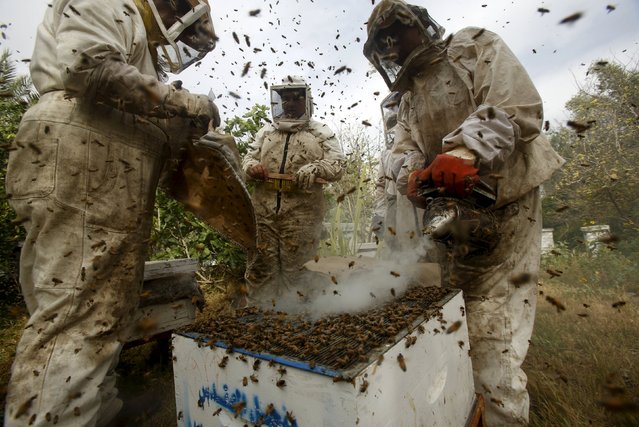
A Palestinian beekeeper uses smoke to calm bees in the process of collecting honey at a farm in Rafah, in the southern Gaza Strip April 11, 2016. (Photo by Suhaib Salem/Reuters)

A Palestinian beekeeper uses smoke to calm bees in the process of collecting honey at a farm in Rafah, in the southern Gaza Strip April 11, 2016. Rateb Samour sees 250 patients a day, whose complaints range from hair loss to cerebral palsy and cancer. He is not a doctor and has never worked in a hospital. Samour inherited the skill of bee-sting therapy from his father. From 2003 the agricultural engineer dedicated all his time to study and develop the alternative-medicine treatment of apitherapy, which uses bee-related products from honey, propolis – or bee glue used to build hives – to venom. (Photo by Suhaib Salem/Reuters)
Details
13 Apr 2016 09:14:00
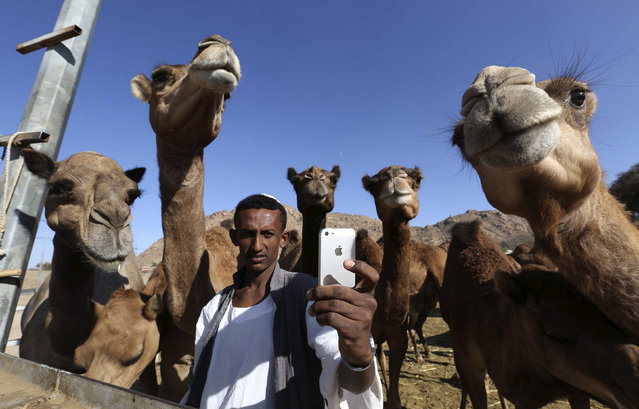
A man takes a “selfie” with camels at a farm in Taif November 1, 2014. Saudi Arabia said late on Wednesday it had detected six new cases of the deadly Middle East Respiratory Syndrome (MERS) in 24 hours, the biggest daily jump for months with officials blaming lax hospital procedures. (Photo by Mohamed Alhwaity/Reuters)

A man takes a “selfie” with camels at a farm in Taif November 1, 2014. Saudi Arabia said late on Wednesday it had detected six new cases of the deadly Middle East Respiratory Syndrome (MERS) in 24 hours, the biggest daily jump for months with officials blaming lax hospital procedures. Scientists are not sure of the origin of the virus, but several studies have linked it to camels and some experts think it is being passed to humans through close physical contact or through the consumption of camel meat or camel milk. (Photo by Mohamed Alhwaity/Reuters)
Details
08 Nov 2014 12:33:00
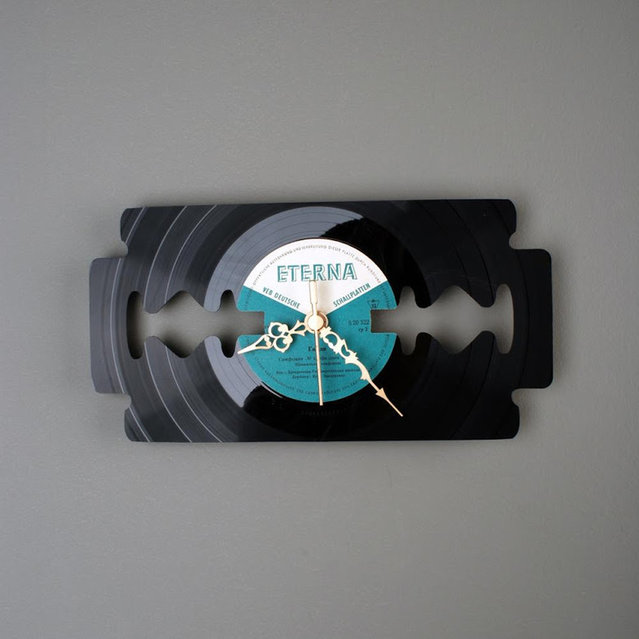
Vinyl Clock By Pavel Sidorenko Part 1

Pavel Sidorenko is an award winning Estonian designer who was born in 1980 in Tallinn and studied product design at Estonian Academy of Arts and Graduated in 2006. Not only does he incorporate pragmatic necessity, but also transmits an emotional qualities within the everyday environment. His fantastic collection of Re Vinyl designs are a result of upcycling a product fashioned from old vinyl records. Beautifully crafted and working with a range of themes from scenography to animal creatures, there is sure to be something for everyone with these stylish selection of recycled vinyl clocks!


See also:Part 2
Details
28 Feb 2014 08:55:00
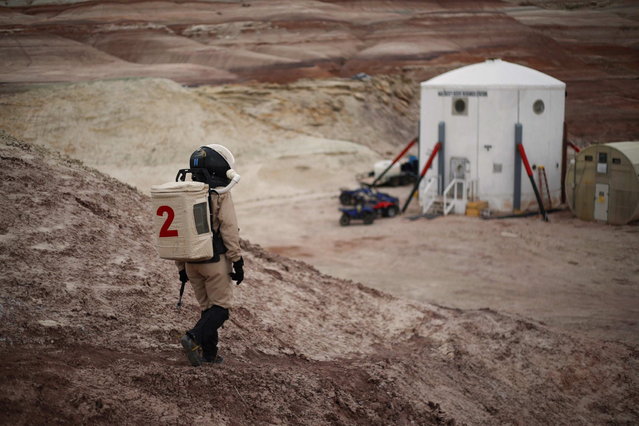
Csilla Orgel, a geologist of Crew 125 EuroMoonMars B mission, makes her way back to the Mars Desert Research Station (MDRS) in the Utah desert March 3, 2013. (Photo by Jim Urquhart/Reuters)

NASA says it could be another 20 years before humans touch down on Mars, but in a sense, the Mars Society has been exploring the red planet for more than a decade – in Utah. Photo: Csilla Orgel, a geologist of Crew 125 EuroMoonMars B mission, makes her way back to the Mars Desert Research Station (MDRS) in the Utah desert March 3, 2013. The MDRS aims to investigate the feasibility of a human exploration of Mars and uses the Utah desert's Mars-like terrain to simulate working conditions on the red planet. Scientists, students and enthusiasts work together developing field tactics and studying the terrain. All outdoor exploration is done wearing simulated spacesuits and carrying air supply packs and crews live together in a small communication base with limited amounts of electricity, food, oxygen and water. Everything needed to survive must be produced, fixed and replaced on site. (Photo by Jim Urquhart/Reuters)
Details
14 Mar 2013 12:11:00