Loading...
Done
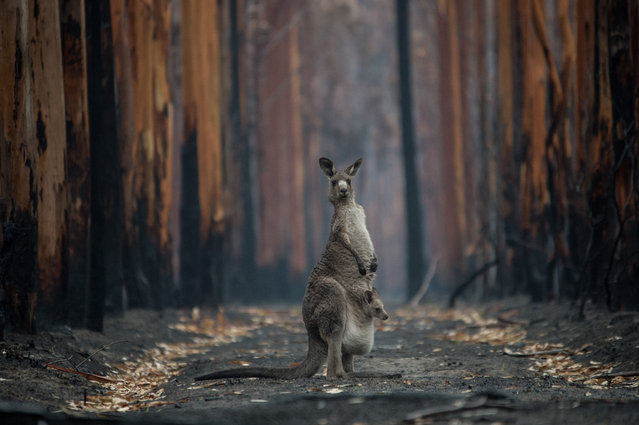
A kangaroo and joey are seen in a burnt forest on Kangaroo Island, south west of Adelaide on January 16, 2020. Australia’s continuing bushfire crisis has taken an enormous toll on wildlife, with huge numbers of mammals, birds, reptiles, insects and other species killed. (Photo by Jo-Anne McArthur/Weanimals)

A kangaroo and joey are seen in a burnt forest on Kangaroo Island, south west of Adelaide on January 16, 2020. Australia’s continuing bushfire crisis has taken an enormous toll on wildlife, with huge numbers of mammals, birds, reptiles, insects and other species killed. (Photo by Jo-Anne McArthur/Weanimals)
Details
26 Jan 2020 00:03:00
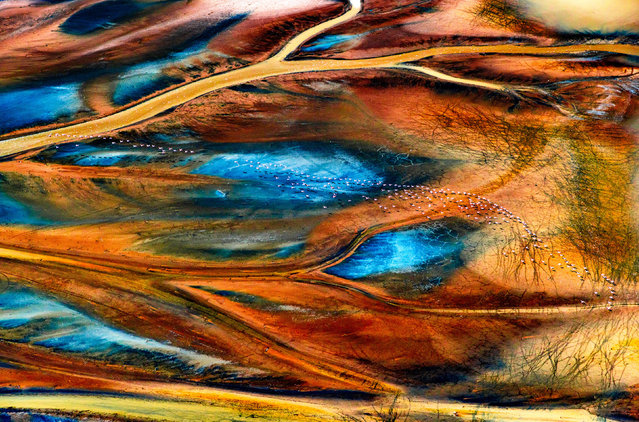
Hundreds of flamingos take flight in the Rift Valley in East Africa early September 2024. The birds gather in the region’s saline lakes to eat the blue-green algae that grows in abundance. The red-orange pigment in the algae is what gives them their distinctive pink plumage. They also use the site to breed. (Photo by Alexandre and Chloe Bes/Naturagency/Solent News)

Hundreds of flamingos take flight in the Rift Valley in East Africa early September 2024. The birds gather in the region’s saline lakes to eat the blue-green algae that grows in abundance. The red-orange pigment in the algae is what gives them their distinctive pink plumage. They also use the site to breed. (Photo by Alexandre and Chloe Bes/Naturagency/Solent News)
Details
23 Sep 2024 02:54:00
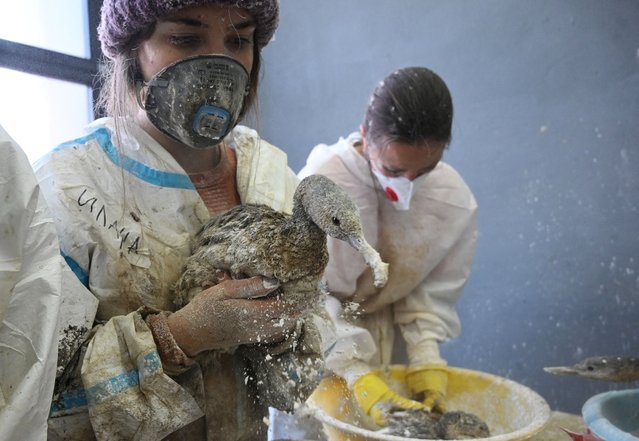
Volunteers use flour to clean birds following an oil spill caused by an incident involving two tankers damaged in a storm in the Kerch Strait, in the village of Vityazevo near the Black Sea resort of Anapa, Russia on December 20, 2024. (Photo by Sergey Pivovarov/Reuters)

Volunteers use flour to clean birds following an oil spill caused by an incident involving two tankers damaged in a storm in the Kerch Strait, in the village of Vityazevo near the Black Sea resort of Anapa, Russia on December 20, 2024. (Photo by Sergey Pivovarov/Reuters)
Details
24 Dec 2024 04:11:00
Vets of Animals Asia Foundation's Vietnam Bear Rescue Center hold a paw of a sun bear as they check its health while it is rescued from a Vietnamese family in Nam Dinh province, south of Hanoi, Vietnam August 18, 2016. (Photo by Reuters/Kham)

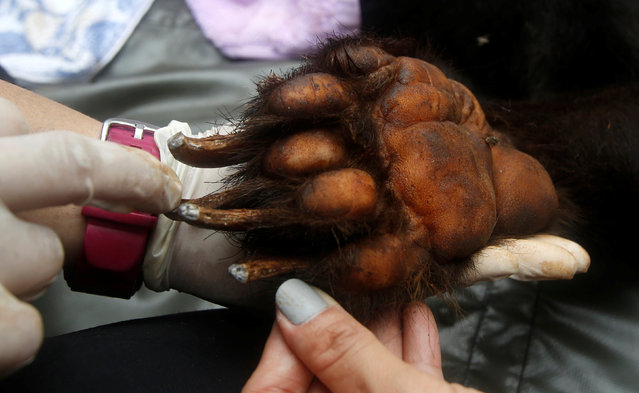
Vets of Animals Asia Foundation's Vietnam Bear Rescue Center hold a paw of a sun bear as they check its health while it is rescued from a Vietnamese family in Nam Dinh province, south of Hanoi, Vietnam August 18, 2016. A man in northern Vietnam has voluntarily handed over a bear his family had caged for seven years to an animal rights organization, which will take it to a nearby sanctuary. (Photo by Reuters/Kham)
Details
19 Aug 2016 12:07:00
Macaque monkeys crowd together in their cage at a monkey farm on February 3, 2016 in Xinye county, Henan province, China. The area boasts a centuries-long and lucrative history of raising and training monkeys for performance. In Xinye, villagers are seeing an increase in business with the lunar calendar's “Year of the Monkey”. Farmers say most of the monkeys are bred and raised for domestic zoos, circuses, and performing groups, but add that some are also sold for medical research in China and the United States. Despite the popularity of the tradition, critics contend the training methods and conditions constitute animal cruelty. (Photo by Kevin Frayer/Getty Images)

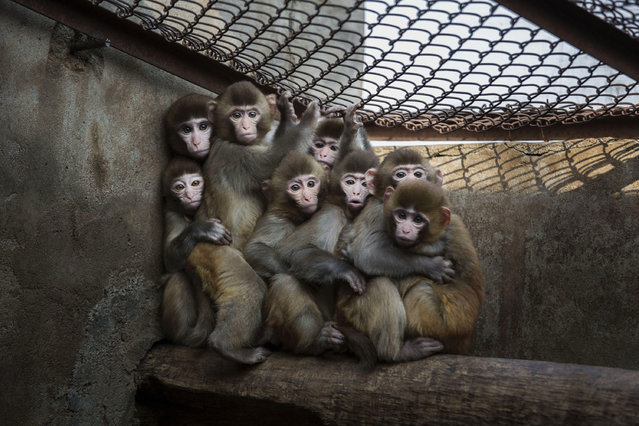
Macaque monkeys crowd together in their cage at a monkey farm on February 3, 2016 in Xinye county, Henan province, China. The area boasts a centuries-long and lucrative history of raising and training monkeys for performance. In Xinye, villagers are seeing an increase in business with the lunar calendar's “Year of the Monkey”. Farmers say most of the monkeys are bred and raised for domestic zoos, circuses, and performing groups, but add that some are also sold for medical research in China and the United States. Despite the popularity of the tradition, critics contend the training methods and conditions constitute animal cruelty. (Photo by Kevin Frayer/Getty Images)
Details
31 Dec 2016 09:56:00
Awesome Zodiac Monsters By Damon Hellandbrand

Have you ever found something mesmerizing in the beautifully and intricately drawn visages of beasts? Damon Hellandbrand finds it to be true, which is the reason why he depicted each of the zodiac signs in a completely new light. Only their main characteristics remain, such as Cancer`s pincers and Scorpio`s stinger, while everything else was completely altered. Other zodiac signs are recognized by their prominent features, such as Gemini`s two heads, Libra`s symbol of balance that looks like two connected cages, and Sagittarius`s bow. Every picture, when looked at separately, resembles a concept art, taken from a video game. However, their combination forms a horrific, yet mystifying puzzle of Zodiac signs. (Photo by Damon Hellandbrand)

Details
15 Jan 2015 13:56:00
“Cassowaries are large, flightless birds related to emus and (more distantly) to ostriches, rheas, and kiwis”, writes Olivia Judson in the September issue of National Geographic magazine. (Photo by Christian Ziegler/National Geographic)

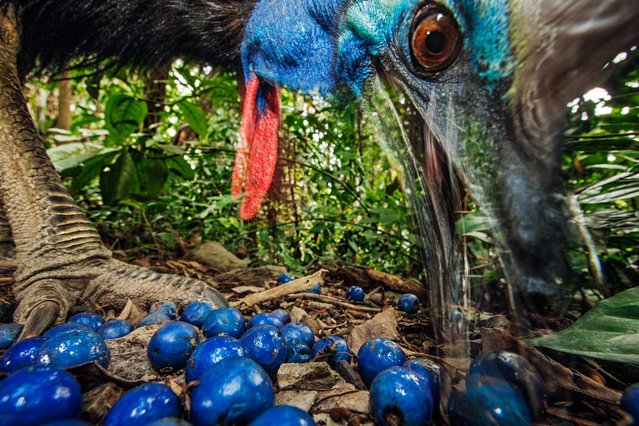
“Cassowaries are large, flightless birds related to emus and (more distantly) to ostriches, rheas, and kiwis”, writes Olivia Judson in the September issue of National Geographic magazine. How large? People-size: Adult males stand well over five foot five and top 110 pounds. Females are even taller, and can weigh more than 160 pounds. Dangerous when roused, they’re shy and peaceable when left alone. But even birds this big and tough are prey to habitat loss. The dense New Guinea and Australia rain forests where they live have dwindled. Today cassowaries might number 1,500 to 2,000. And because they help shape those same forests – by moving seeds from one place to another – “if they vanish”, Judson writes, “the structure of the forest would gradually change” too. (Photo by Christian Ziegler/National Geographic)
Details
06 Jan 2014 12:21:00
Employee of ornithological flight support service Nika Ryzhova-Alenicheva holds her hawk, which is used to control fauna to avoid bird strikes during takeoffs and landings, at Domodedovo airport outside Moscow, Russia September 2, 2016. (Photo by Maxim Zmeyev/Reuters)

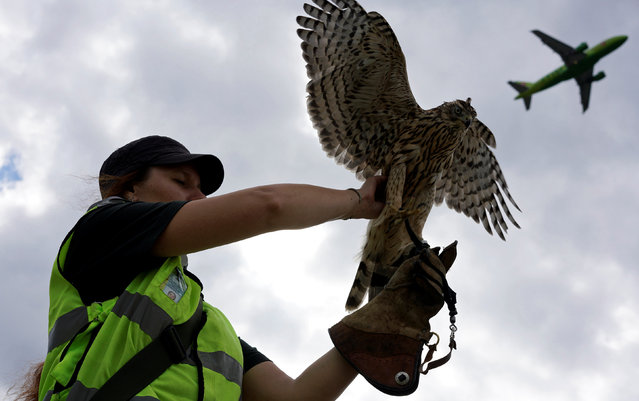
Employee of ornithological flight support service Nika Ryzhova-Alenicheva holds her hawk, which is used to control fauna to avoid bird strikes during takeoffs and landings, at Domodedovo airport outside Moscow, Russia September 2, 2016. (Photo by Maxim Zmeyev/Reuters)
Details
06 Sep 2016 10:41:00