Loading...
Done
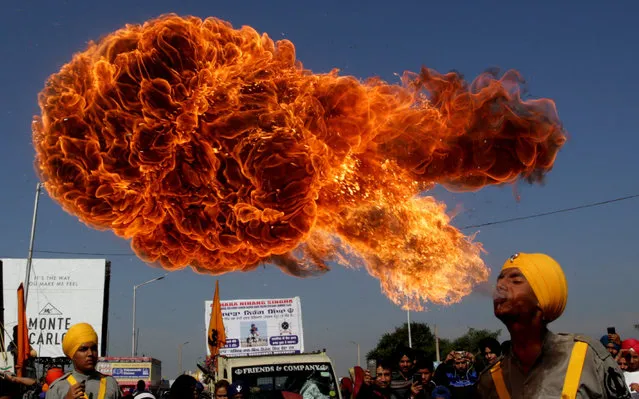
Sikh devotee take part in Nagar Keertan procession on the occasion of Guru Gobind Singh birth anniversary in Allahabad, India on December 29, 2016. (Photo by Prabhat Kumar Verma/Pacific Press via ZUMA Wire/Rex Features/Shutterstock)

Sikh devotee take part in Nagar Keertan procession on the occasion of Guru Gobind Singh birth anniversary in Allahabad, India on December 29, 2016. Guru Gobind Singh, born Gobind Rai (1666 – 1708), was the 10th Sikh Guru, a spiritual master, warrior, poet and philosopher. When his father, Guru Tegh Bahadur, was beheaded for refusing to convert to Islam, Guru Gobind Singh was formally installed as the leader of the Sikhs at age nine, becoming the last of the living Sikh Gurus. (Photo by Prabhat Kumar Verma/Pacific Press via ZUMA Wire/Rex Features/Shutterstock)
Details
31 Dec 2016 10:27:00
A devotee gestures after being flogged by a reveler dressed as a devil during a mass celebration of the “Talciguines” of Texistepeque, El Salvador on Easter Monday, April 3, 2023. In the Nahuatl, Talciguin means “deviled men”, a traditional procession performed during Easter monday to represent the fight against the devil of the Christian prophet Jesus Christ. (Photo by Camilo Freedman/SOPA Images/Rex Features/Shutterstock)

A devotee gestures after being flogged by a reveler dressed as a devil during a mass celebration of the “Talciguines” of Texistepeque, El Salvador on Easter Monday, April 3, 2023. In the Nahuatl, Talciguin means “deviled men”, a traditional procession performed during Easter monday to represent the fight against the devil of the Christian prophet Jesus Christ. (Photo by Camilo Freedman/SOPA Images/Rex Features/Shutterstock)
Details
06 Apr 2023 03:48:00
Sophia Fernandes, a member of the Kalunga quilombo, the descendants of runaway slaves, dons traditional afro braids, during the culmination of the week-long pilgrimage and celebration for the patron saint “Nossa Senhora da Abadia” or Our Lady of Abadia, in the rural area of Cavalcante in Goias state, Brazil, Saturday, August 13, 2022.  Devotees celebrate Our Lady of Abadia at this time of the year with weddings, baptisms and by crowning distinguished community members, as they maintain cultural practices originating from Africa that mix with Catholic traditions. (Photo by Eraldo Peres/AP Photo)

Sophia Fernandes, a member of the Kalunga quilombo, the descendants of runaway slaves, dons traditional afro braids, during the culmination of the week-long pilgrimage and celebration for the patron saint “Nossa Senhora da Abadia” or Our Lady of Abadia, in the rural area of Cavalcante in Goias state, Brazil, Saturday, August 13, 2022. Devotees celebrate Our Lady of Abadia at this time of the year with weddings, baptisms and by crowning distinguished community members, as they maintain cultural practices originating from Africa that mix with Catholic traditions. (Photo by Eraldo Peres/AP Photo)
Details
21 Aug 2022 03:48:00
In this photograph taken on September 22, 2016, a Pakistani devotee decorates symbolic paper boats, an offering to Muslim saint Abdulqadir Jilani as a way of giving thanks after their desire to give birth to a son was fulfilled, before dropping it into the water during an annual ceremony on the banks of the River Ravi in Lahore. The ceremony commemorates a centuries-old tale that Muslim saint Abdulqadir Jilani raised a sunken ship carrying a wedding party, at the pleading of the groom's mother, saving all the occupants. (Photo by Arif Ali/AFP Photo)

In this photograph taken on September 22, 2016, a Pakistani devotee decorates symbolic paper boats, an offering to Muslim saint Abdulqadir Jilani as a way of giving thanks after their desire to give birth to a son was fulfilled, before dropping it into the water during an annual ceremony on the banks of the River Ravi in Lahore. The ceremony commemorates a centuries-old tale that Muslim saint Abdulqadir Jilani raised a sunken ship carrying a wedding party, at the pleading of the groom's mother, saving all the occupants. (Photo by Arif Ali/AFP Photo)
Details
06 Oct 2016 09:19:00
Nepalese Hindu devotees offer oil lamps in the Bagmati River as they observe the festival of Bala Chaturdashi in the early morning hours at the Pashupati Temple in Kathmandu, Nepal, 28 November 2016. Seven kinds of seeds – paddy, barley, sesame, wheat, gram, maize and finger millet – are sown around the temple premises in the name of loved ones departed during the last three years, in the belief that the departed souls will receive salvation. (Photo by Narendra Shrestha)

Nepalese Hindu devotees offer oil lamps in the Bagmati River as they observe the festival of Bala Chaturdashi in the early morning hours at the Pashupati Temple in Kathmandu, Nepal, 28 November 2016. Seven kinds of seeds – paddy, barley, sesame, wheat, gram, maize and finger millet – are sown around the temple premises in the name of loved ones departed during the last three years, in the belief that the departed souls will receive salvation. (Photo by Narendra Shrestha)
Details
05 Dec 2016 11:28:00
A Hindu devotee lies on a road as the holy “Rath”, or the chariot of lord Jagannath, passed over her during the Rath Yatra, or chariot procession in Karachi, Pakistan, July 17, 2016. Ratha-jatra is derived from two Odia words ratha/rotho meaning “chariot” and jatra meaning “journey”. The festival involves an annual procession (journey) of a deity's idols. Other names for the festival include ratha jatra or chariot festival. (Photo by Akhtar Soomro/Reuters)

A Hindu devotee lies on a road as the holy “Rath”, or the chariot of lord Jagannath, passed over her during the Rath Yatra, or chariot procession in Karachi, Pakistan, July 17, 2016. Ratha-jatra is derived from two Odia words ratha/rotho meaning “chariot” and jatra meaning “journey”. The festival involves an annual procession (journey) of a deity's idols. Other names for the festival include ratha jatra or chariot festival. (Photo by Akhtar Soomro/Reuters)
Details
18 Jul 2016 12:42:00
An Indonesian boy waits as he prepares to catch offerings released by Hindu devotees of the Tengger tribe during the Yadnya Kasada festival, on the crater of Mount Bromo in Probolinggo on July 21, 2016. During the annual Yadnya Kasada festival the Tenggerese climb Mount Bromo, an active volcano, and seek the blessing from the main deity Hyang Widi Wasa by presenting offerings of rice, fruit, livestock and other local produce. (Photo by Juni Kriswanto/AFP Photo)

An Indonesian boy waits as he prepares to catch offerings released by Hindu devotees of the Tengger tribe during the Yadnya Kasada festival, on the crater of Mount Bromo in Probolinggo on July 21, 2016. During the annual Yadnya Kasada festival the Tenggerese climb Mount Bromo, an active volcano, and seek the blessing from the main deity Hyang Widi Wasa by presenting offerings of rice, fruit, livestock and other local produce. (Photo by Juni Kriswanto/AFP Photo)
Details
22 Jul 2016 12:33:00
An Indian Sikh devotee takes a dip in the holy sarover (water tank) at the Golden Temple on the eve of “Ghallughara Diwas”, the 29th Anniversary of Operation Bluestar, in Amritsar on June 5, 2013. The 1984 assault on the Golden Temple complex by the Indian army was conducted in an attempt to arrest separatists Sikh leader Sant Jarnail Singh Bhindranwale and his militant followers who had initiated a movement for a separate Sikh state. (Photo by Narinder Nanu/AFP Photo)

An Indian Sikh devotee takes a dip in the holy sarover (water tank) at the Golden Temple on the eve of “Ghallughara Diwas”, the 29th Anniversary of Operation Bluestar, in Amritsar on June 5, 2013. The 1984 assault on the Golden Temple complex by the Indian army was conducted in an attempt to arrest separatists Sikh leader Sant Jarnail Singh Bhindranwale and his militant followers who had initiated a movement for a separate Sikh state. (Photo by Narinder Nanu/AFP Photo)
Details
08 Jun 2013 11:00:00