Loading...
Done
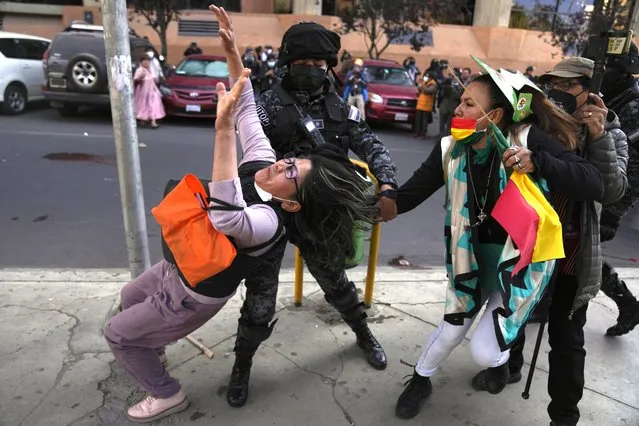
A police officer tries to prevent an anti-government protester from pulling the hair of a woman who is part of group that appeared to show their support for the government during a march of healthcare workers critical of the government, in La Paz, Bolivia, on July 21, 2022. (Photo by Juan Karita/AP Photo)

A police officer tries to prevent an anti-government protester from pulling the hair of a woman who is part of group that appeared to show their support for the government during a march of healthcare workers critical of the government, in La Paz, Bolivia, on July 21, 2022. (Photo by Juan Karita/AP Photo)
Details
06 Oct 2023 04:41:00
A Cucumber and a Chuta Cholero hug during the traditional festival “Desentierro del Pepino” (unearthing the Cucumber) to mark the beginning of carnival on January 21, 2024 in La Paz, Bolivia. People dug up the cucumber from the cemetery and walk through the streets with two characters, the Ch'uta and the Chola. (Photo by Gaston Brito/Getty Images)

A Cucumber and a Chuta Cholero hug during the traditional festival “Desentierro del Pepino” (unearthing the Cucumber) to mark the beginning of carnival on January 21, 2024 in La Paz, Bolivia. People dug up the cucumber from the cemetery and walk through the streets with two characters, the Ch'uta and the Chola. (Photo by Gaston Brito/Getty Images)
Details
29 Mar 2025 04:24:00
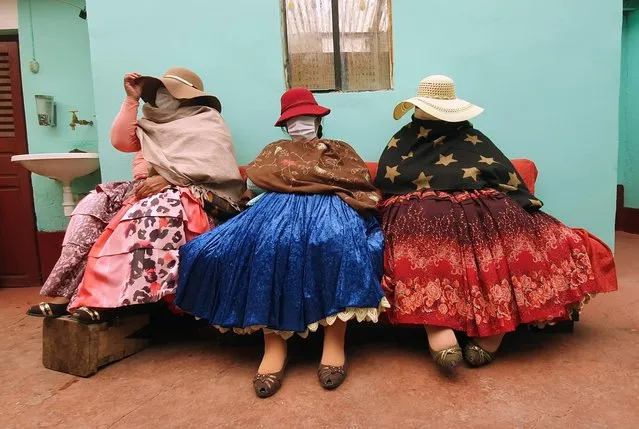
Bolivian sеx workers sit during a Reuters interview before the countrywide, two-week mandatory quarantine to combat the spread of coronavirus disease (COVID-19), decreed by Bolivia's interim government, in El Alto outskirts of La Paz, Bolivia on March 20, 2020. (Photo by Monica Machicao/Reuters)

Bolivian sеx workers sit during a Reuters interview before the countrywide, two-week mandatory quarantine to combat the spread of coronavirus disease (COVID-19), decreed by Bolivia's interim government, in El Alto outskirts of La Paz, Bolivia on March 20, 2020. (Photo by Monica Machicao/Reuters)
Details
26 Mar 2020 00:03:00
A mannequin wearing a face mask stands at the entrance of a women's clothing store in La Paz, Bolivia, Monday, June 1, 2020. After more than two months of quarantine to curb the spread of the new coronavirus the government authorized the restart of public transport and several industrial and commercial activities. (Photo by Juan Karita/AP Photo)

A mannequin wearing a face mask stands at the entrance of a women's clothing store in La Paz, Bolivia, Monday, June 1, 2020. After more than two months of quarantine to curb the spread of the new coronavirus the government authorized the restart of public transport and several industrial and commercial activities. (Photo by Juan Karita/AP Photo)
Details
03 Jul 2020 00:03:00
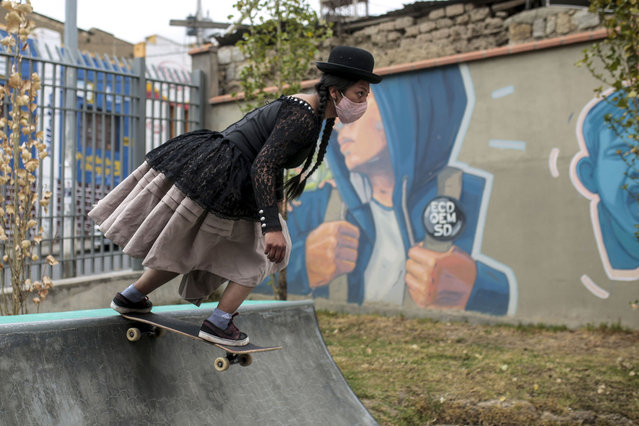
A woman dressing the traditional clothes of a “cholita”,  skates  during a skate festival on September 30, 2020 in La Paz, Bolivia. According to the Johns Hopkins University Resource Center, Bolivia has over 130,000 confirmed cases of Covid-19 and more than 7,500 deceases. (Photo by Gaston Brito/Getty Images)

A woman dressing the traditional clothes of a “cholita”, skates during a skate festival on September 30, 2020 in La Paz, Bolivia. According to the Johns Hopkins University Resource Center, Bolivia has over 130,000 confirmed cases of Covid-19 and more than 7,500 deceases. (Photo by Gaston Brito/Getty Images)
Details
12 Oct 2020 00:03:00
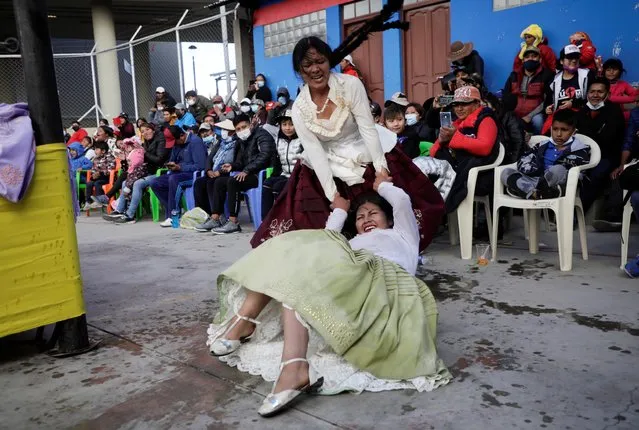
Barbara Quisbert and Susana La Bonita, cholitas wrestlers, fight during their return to the ring after the coronavirus disease (COVID-19) restrictions, in El Alto outskirts of La Paz, November 29, 2020. (Photo by David Mercado/Reuters)

The Fighting Cholitas are a group of female wrestlers who perform in El Alto, Bolivia. Tickets to the exhibitions cost $1. Like the general population of El Alto, which consists almost entirely of Aymara and Quechua residents, the Cholitas are indigenous. They wear braided hair, bowler hats and multilayered skirts in the ring. Here: Barbara Quisbert and Susana La Bonita, cholitas wrestlers, fight during their return to the ring after the coronavirus disease (COVID-19) restrictions, in El Alto outskirts of La Paz, November 29, 2020. (Photo by David Mercado/Reuters)
Details
12 Dec 2020 00:03:00
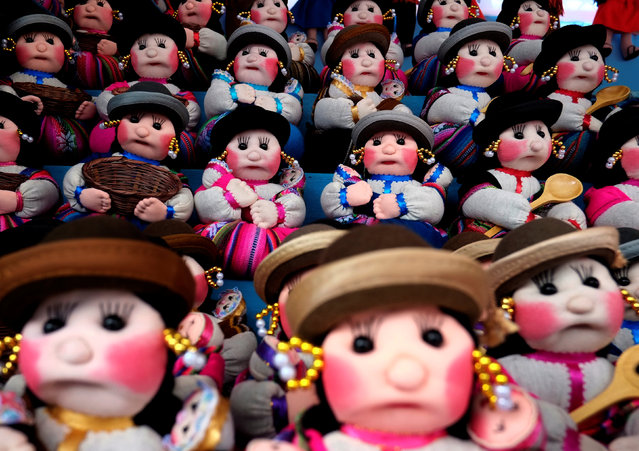
Aymara dolls are seen during the “Alasitas” fair, where people buy miniature versions of goods they hope to acquire in real life, in La Paz, Bolivia, January 24, 2017. Shoppers fill their baskets with miniature versions of things they desire – everything from cars, houses computers – to give to Ekeko the God of abundance, in the hope he will being therm good fortune. And it is all carried out with a priest’s blessing. Originally, the Festival of Alasitas was a celebration by farmers praying for plentiful crops.Today, the meaning amounts to the same only locals hope for more material goods. (Photo by David Mercado/Reuters)

Aymara dolls are seen during the “Alasitas” fair, where people buy miniature versions of goods they hope to acquire in real life, in La Paz, Bolivia, January 24, 2017. Shoppers fill their baskets with miniature versions of things they desire – everything from cars, houses computers – to give to Ekeko the God of abundance, in the hope he will being therm good fortune. (Photo by David Mercado/Reuters)
Details
26 Jan 2017 12:56:00
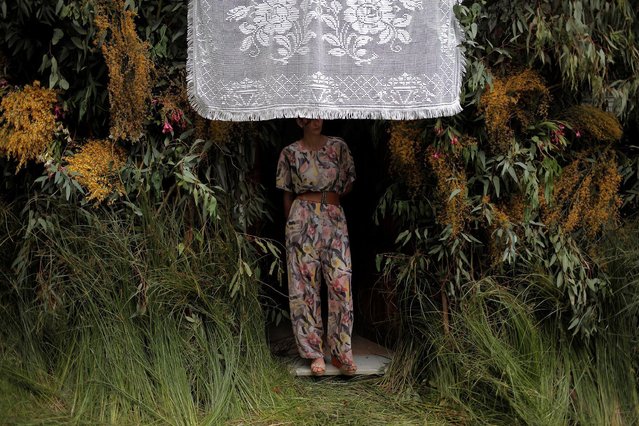
A woman looks out of her house with a decorated doorway during Corpus Christi day in Zahara de la Sierra, southern Spain, May 29, 2016. The village of Zahara de la Sierra celebrated the feast of Corpus Christi (or Body of Christ in Latin) by covering the streets and facades of houses with the branches of trees and grass. (Photo by Jon Nazca/Reuters)

A woman looks out of her house with a decorated doorway during Corpus Christi day in Zahara de la Sierra, southern Spain, May 29, 2016. The village of Zahara de la Sierra celebrated the feast of Corpus Christi (or Body of Christ in Latin) by covering the streets and facades of houses with the branches of trees and grass. (Photo by Jon Nazca/Reuters)
Details
30 May 2016 08:49:00