“Atzeries”, a fire beast sets off his fire crackers during a “Correfocs” in Barcelona's Gracia neighborhood, Spain on May 27, 2023. (Photo by Matthias Oesterle/Alamy Live News)
A Firefighter walks in a evacuated home in flames at El Cariso Village as the Airport Fire burns on September 10, 2024 in Lake Elsinore, California. The fast-moving Airport Fire that started on September 9 in Orange County grew up to more than 10,000 acres by this afternoon, fire officials said. (Photo by Apu Gomes/Getty Images)
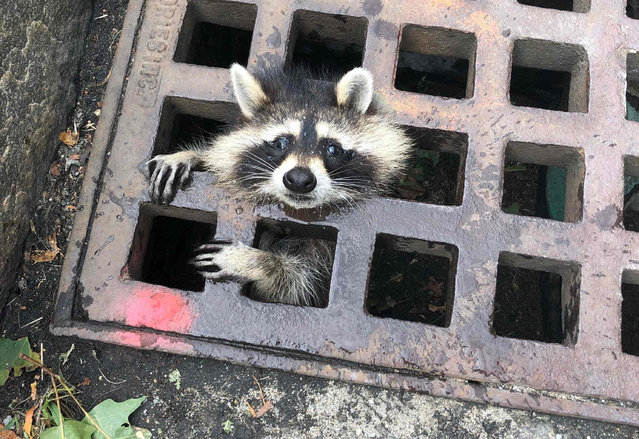
In this photo released by the Newton Fire department, a juvenile raccoon looks out from a grate after getting stuck in Newton, Massachusetts on August 1, 2019. The fire department was able to rescue the raccoon and free him from the grate. (Photo by HO/Newton Fire Department/AFP Photo)
Performers take part in a procession as part of the Samhuinn Fire Festival on October 31, 2024 in Edinburgh, Scotland. The Samhuinn Fire Festival is a modern take on an ancient Celtic festival, marking the transition between summer and winter with fire-dancing, drums, acrobatics, and theatre performances. (Photo by Jeff J. Mitchell/Getty Images)
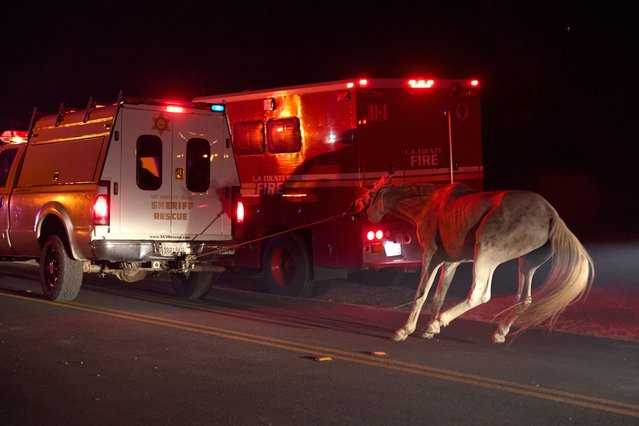
A horse is evacuated as the Canyon Fire burns in brush-filled hillsides in Castaic, California, 07 August 2025. The Canyon Fire near Lake Piru, a reservoir about 60 miles northwest of downtown LA, has forced thousands to evacute and has grown to more than 1,000 acres according to Cal Fire. (Photo by Allison Dinner/EPA)
Fire photographer Tod Sudmeier gets hit with flying embers from strong winds at the Solimar brush fire that started early Saturday morning in Ventura County, California December 26, 2015. (Photo by Gene Blevins/Reuters)
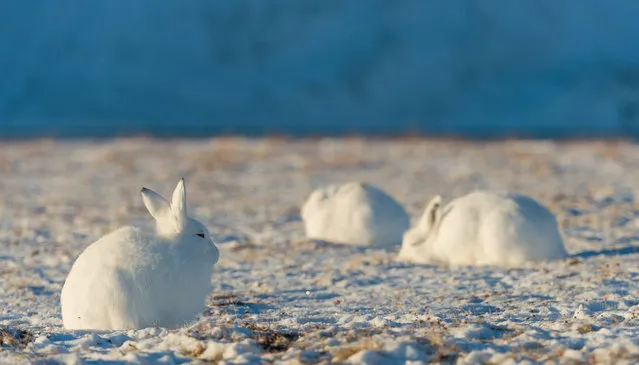
The arctic hare, or polar rabbit, is a species of hare which is adapted largely to polar and mountainous habitats. The arctic hare survives with a thick coat of fur and usually digs holes in the ground or under snow to keep warm and sleep. Arctic hares look like rabbits but have shorter ears, are taller when standing, and, unlike rabbits, can thrive in cold climates. They can travel together with many other hares, sometimes huddling with dozens or more, but are usually found alone, taking, in some cases, more than one partner. The arctic hare can run up to 60 kilometres per hour (40 mph). Its predators include the arctic wolf, arctic fox, and ermine.
A milk custard bun made to resemble one of the popular Japanese “Kobitos” characters is squeezed during a display for the photographer at Dim Sum Icon restaurant in Hong Kong, China July 25, 2016. A dim sum restaurant in Hong Kong encourages diners to play with their food, and the result will either disgust or delight you. At Dim Sum Icon customers can squeeze a strange creature to poo or vomit on their plate before eating it. Hungry punters poke a hole into the mouth – or the rear – of the dim sum with a chopstick, squeeze it and watch the brown or white cream ooze out. The unique dim sums are made with a face to resemble Japanese Kobitos characters. (Photo by Bobby Yip/Reuters)