Loading...
Done
A devotee gest pierced at the Bang Neow shrine in Phuket. (Photo by Paula Bronstein/Getty Images)

“The Nine Emperor Gods Festival is a nine-day Taoist celebration beginning on the eve of 9th lunar month of the Chinese calendar, which is observed primarily in Southeast Asian countries like Myanmar, Singapore, Malaysia, Thailand and also the Riau Islands. In Thailand, this festival is called Tesagan Gin Je, the Vegetarian Festival. It is celebrated throughout the entire country, but the festivities are at their height in Phuket, where about 35% of the population is Chinese. It attracts crowds of spectators because of many of the unusual religious rituals that are performed”. – Wikipedia. Photo: A devotee gest pierced at the Bang Neow shrine in Phuket. (Photo by Paula Bronstein)
Details
11 Oct 2013 07:49:00
A woman offers a prayer at Pashupatinath Temple during the Teej festival in Kathmandu, Nepal September 4, 2016. (Photo by Navesh Chitrakar/Reuters)

A woman offers a prayer at Pashupatinath Temple during the Teej festival in Kathmandu, Nepal September 4, 2016. During this festival, married Hindu women observe day-long fast and pray for a happy married life while those unmarried pray for a good husband. (Photo by Navesh Chitrakar/Reuters)
Details
05 Sep 2016 11:44:00
An empty cell block is pictured within Joint Task Force Guantanamo's Camp VI at the U.S. Naval Base in Guantanamo Bay, Cuba March 22, 2016. (Photo by Lucas Jackson/Reuters)

An empty cell block is pictured within Joint Task Force Guantanamo's Camp VI at the U.S. Naval Base in Guantanamo Bay, Cuba March 22, 2016. (Photo by Lucas Jackson/Reuters)
Details
24 Mar 2016 12:02:00
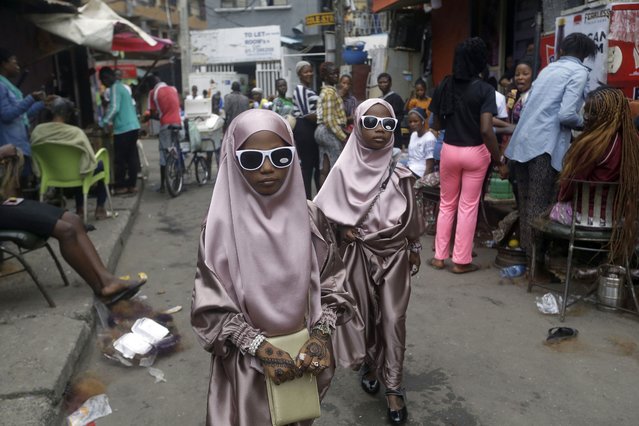
Muslim girls are seen after prayers, in Lagos, Nigeria, Friday, July 31, 2020. Small groups of pilgrims performed one of the final rites of the Islamic hajj on Friday as Muslims worldwide marked the start of the Eid al-Adha holiday amid a global pandemic that has impacted nearly every aspect of this year's pilgrimage and celebrations. The last days of hajj coincide with the four-day Eid al-Adha, or “Feast of Sacrifice”, in which Muslims slaughter livestock and distribute the meat to the poor. (Photo by Sunday Alamba/AP Photo)

Muslim girls are seen after prayers, in Lagos, Nigeria, Friday, July 31, 2020. Small groups of pilgrims performed one of the final rites of the Islamic hajj on Friday as Muslims worldwide marked the start of the Eid al-Adha holiday amid a global pandemic that has impacted nearly every aspect of this year's pilgrimage and celebrations. The last days of hajj coincide with the four-day Eid al-Adha, or “Feast of Sacrifice”, in which Muslims slaughter livestock and distribute the meat to the poor. (Photo by Sunday Alamba/AP Photo)
Details
14 Aug 2020 00:01:00
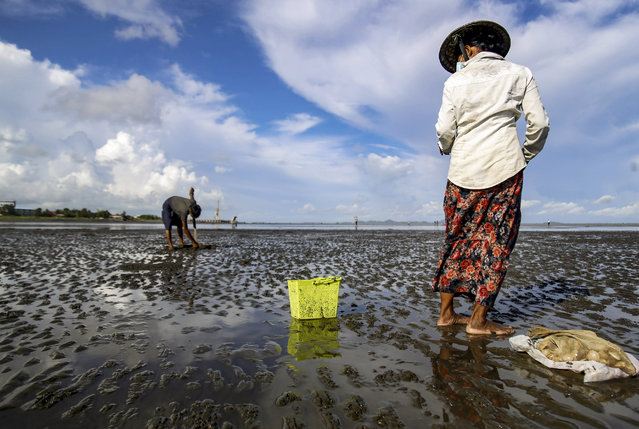
People search for shells on a beach in Sittwe, Rakhine State, Myanmar, 17 September 2020. International Coastal Cleanup Day is observed annually on the third Saturday of September and will occur on 19 September this year. The day was established to encourage global efforts to clean up garbage on beaches and coastal areas and raise awareness on protecting the world's oceans and waterways. According to a report released by the US-based nonprofit environmental advocacy group Ocean Conservancy on 08 September 2020, plastic food packaging topped the list of most common items found in beach trash. Close to five million food wrappers were collected in a single day during the International Coastal Cleanup Day in 2019. An approximate 11 million metric tons of plastic enters the ocean every year according to a 2016 analysis, affecting more than 800 marine species and causing contamination to human food chains and drinking water. (Photo by Nyunt Win/EPA/EFE/Rex Features/Shutterstock)

People search for shells on a beach in Sittwe, Rakhine State, Myanmar, 17 September 2020. International Coastal Cleanup Day is observed annually on the third Saturday of September and will occur on 19 September this year. (Photo by Nyunt Win/EPA/EFE/Rex Features/Shutterstock)
Details
24 Oct 2020 00:05:00
A GDR Trabant car drives through the city during the local coronavirus disease (COVID-19) lockdown in Dresden, Germany, December 14, 2020. (Photo by Matthias Rietschel/Reuters)

A GDR Trabant car drives through the city during the local coronavirus disease (COVID-19) lockdown in Dresden, Germany, December 14, 2020. (Photo by Matthias Rietschel/Reuters)
Details
16 Dec 2020 00:07:00
A robot used to assist Covid-19 patients is seen in an elevator on December 5, 2020 in New Delhi, India. The “Mitra” robot can connect patients with their loved ones, and can assist healthcare workers on the frontlines of the pandemic by minimisng the risk of infections caused by close contact. The Yatharth Hospital, which is treating Covid-19 patients in Noida, on the outskirts of New Delhi, is one of a handful of hospitals in India that has started to use robots. (Photo by Anindito Mukherjee/Getty Images)

A robot used to assist Covid-19 patients is seen in an elevator on December 5, 2020 in New Delhi, India. The “Mitra” robot can connect patients with their loved ones, and can assist healthcare workers on the frontlines of the pandemic by minimisng the risk of infections caused by close contact. The Yatharth Hospital, which is treating Covid-19 patients in Noida, on the outskirts of New Delhi, is one of a handful of hospitals in India that has started to use robots. (Photo by Anindito Mukherjee/Getty Images)
Details
21 Dec 2020 00:05:00
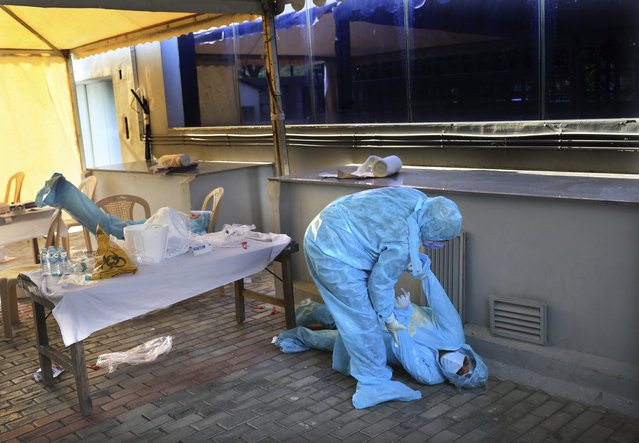
In this April 27, 2020 photo, a health worker helps another as she fainted because of exhaustion and long working hours during a swab test drive for COVID 19, in New Delhi, India. Two and a half months of nationwide lockdown kept numbers of infections relatively low in India. But with restrictions easing in recent weeks, cases have shot up, raising questions about whether authorities have done enough to avert catastrophe. Half of Delhi’s 8,200 hospital beds dedicated to COVID-19 patients are already full and officials are projecting more than half a million cases in the city alone by July 31. (Photo by Manish Swarup/AP Photo)

In this April 27, 2020 photo, a health worker helps another as she fainted because of exhaustion and long working hours during a swab test drive for COVID 19, in New Delhi, India. Two and a half months of nationwide lockdown kept numbers of infections relatively low in India. But with restrictions easing in recent weeks, cases have shot up, raising questions about whether authorities have done enough to avert catastrophe. Half of Delhi’s 8,200 hospital beds dedicated to COVID-19 patients are already full and officials are projecting more than half a million cases in the city alone by July 31. (Photo by Manish Swarup/AP Photo)
Details
08 Jan 2021 00:01:00