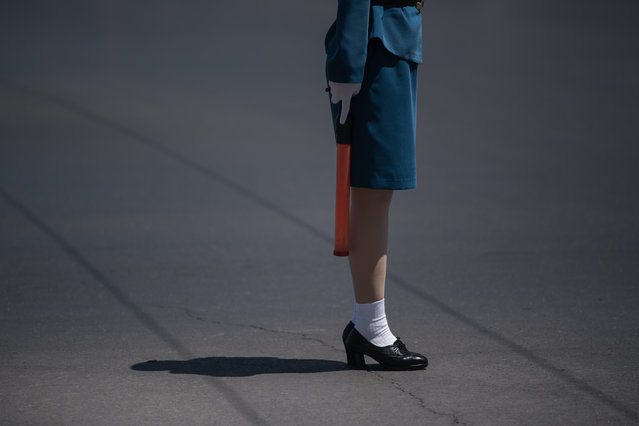
In a photo taken on June 5, 2017 a traffic security officer stands on duty at an intersection in Pyongyang. Officially known as traffic security officers but universally referred to as traffic ladies, they are chosen for their looks in a society that remains traditionalist in many respects. They must leave the role if they marry, and have a finite shelf-life, with compulsory retirement looming at just 26. (Photo by Ed Jones/AFP Photo)
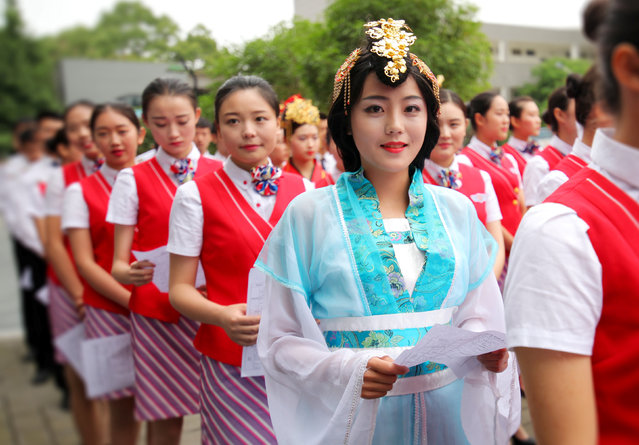
A student, wearing a traditional costume and headdress, stands in line for interviews during a recruitment held by an airline company, hoping to stand out from more than 500 candidates for airline stewardess positions, in Chengdu, Sichuan Province, China, May 27, 2016. (Photo by Reuters/Stringer)
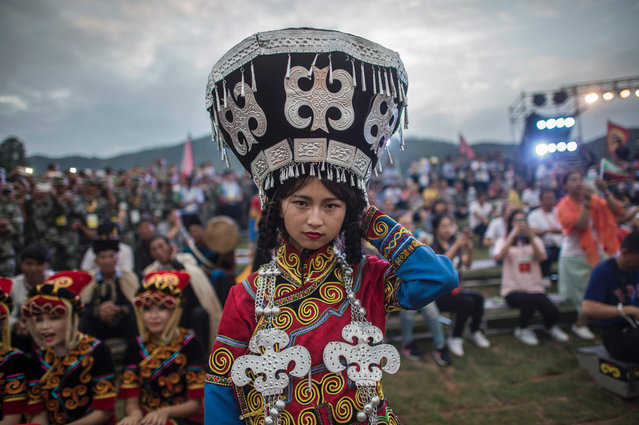
A Dancer, dressed with the traditional Yi costume, waits to perform at the Torch Festival, in Xichang, China's Sichuan province on July 27, 2016. As a result of fast urbanisation in the rural area of China Like Lienchang prefecture, the traditional costume is fading away for the Yi people in daily life. (Photo by Fred Dufour/AFP Photo)
Contestants of a tourism beauty pageant balance eggs on their collarbones as they cruise along the Yellow River in Jiyuan, Henan province, China, June 22, 2015. The contestants believe that if they are slim enough, their collarbones will allow them to balance the eggs securely on their bodies. (Photo by Reuters/Stringer)
Students training to be flight attendants hold books on their heads, chopsticks in their mouths, and papers in between their knees, as they take part in a standing posture practice at a vocational school in Shijiazhuang, Hebei province, China May 4, 2017. (Photo by Reuters/Stringer)
A woman mourns the loss of her husband, next to a placard which reads “I'm a pusher”, who was shot dead by an unidentified gunman in Manila on July 23, 2016. Philippine President Rodrigo Duterte swept to power in May on a promise to clampdown on drugs, and police have since confirmed killing nearly 200 people in a two-month crime blitz. There has also been a surge in killings by anti-drug vigilantes who leave victims' corpses on city streets wrapped in packaging tape with signs accusing them of being drug dealers. (Photo by Noel Celis/AFP Photo)
Growing cities, overuse of fertilizers and factory wastewater have degraded China's water supplies to the extent that half the nation's rivers and lakes are severely polluted. China aims to spend $850 billion to improve filthy water supplies over the next decade, but even such huge outlays may do little to reverse damage caused by decades of pollution and overuse in Beijing's push for rapid economic growth. Photo: Fishermen row a boat in the algae-filled Chaohu Lake in Hefei, Anhui province, June 19, 2009. (Photo by Jianan Yu/Reuters)