Loading...
Done
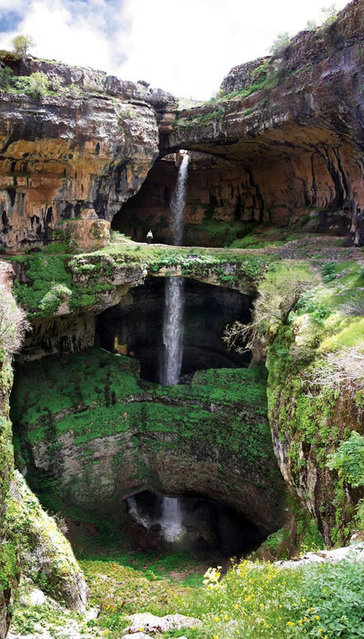
Baatara Gorge Waterfall

Discovered in 1952 by French bio-speleologist Henri Coiffait, the waterfall and accompanying sinkhole were fully mapped in the 1980s by the Spéléo club du Liban. The cave is also known as the "Cave of the Three Bridges." Traveling from Laklouk to Tannourine one passes the village of Balaa, and the "Three Bridges Chasm" (in French "Gouffre des Trois Ponts") is a five-minute journey into the valley below where one sees three natural bridges, rising one above the other and overhanging a chasm descending into Mount Lebanon. During the spring melt, a 90–100-metre (300–330 ft) cascade falls behind the three bridges and then down into the 250-metre (820 ft) chasm. A 1988 fluorescent dye test demonstrated that the water emerged at the spring of Dalleh in Mgharet al-Ghaouaghir.
Details
31 Aug 2013 11:27:00
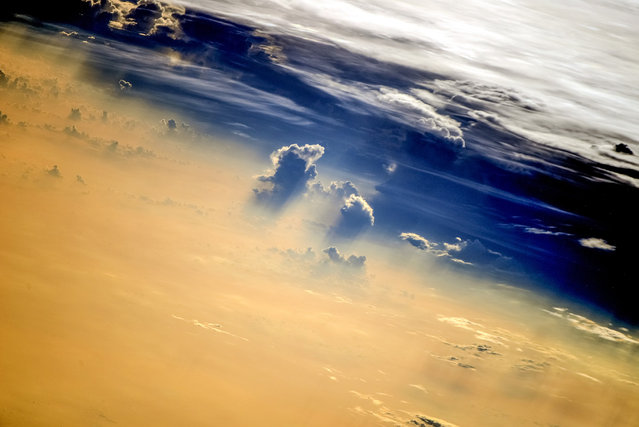
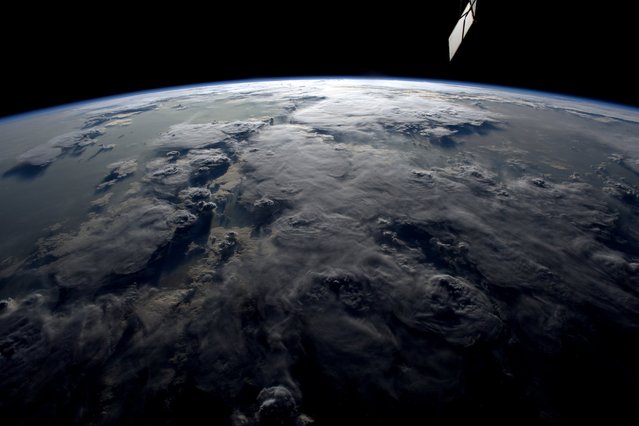
Image of the Clouds taken in August 2014 by astronauts on board the International Space Station (ISS).  A year from space photographs of hurricanes, typhoons and meteorite craters show an astronauts-eye view of our planet from hundreds of miles above the earth. The illuminating images were taken by astronauts onboard the International Space Station (ISS) over the course of 2014. (Photo by NASA/SPL/Barcroft Media)

Image of the Clouds taken in August 2014 by astronauts on board the International Space Station (ISS). A year from space photographs of hurricanes, typhoons and meteorite craters show an astronauts-eye view of our planet from hundreds of miles above the earth. The illuminating images were taken by astronauts onboard the International Space Station (ISS) over the course of 2014. (Photo by NASA/SPL/Barcroft Media)
Details
31 Dec 2014 14:47:00
Revelers dance during the “Ceu na Terra”, or Heaven on earth, carnival parade in Rio de Janeiro, Brazil, Saturday, February 7, 2015. Rio's over-the-top Carnival is the highlight of the year for many local residents. Hundreds of thousands of merrymakers are beginning to take to the streets in open-air “blocos” parties. (Photo by Felipe Dana/AP Photo)

Revelers dance during the “Ceu na Terra”, or Heaven on earth, carnival parade in Rio de Janeiro, Brazil, Saturday, February 7, 2015. Rio's over-the-top Carnival is the highlight of the year for many local residents. Hundreds of thousands of merrymakers are beginning to take to the streets in open-air “blocos” parties. (Photo by Felipe Dana/AP Photo)
Details
10 Feb 2015 12:33:00
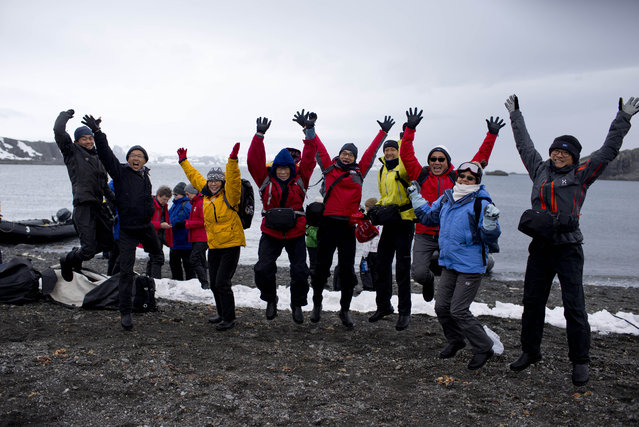
In this February 2, 2015 photo, tourists jump as they pose for a picture, after disembarking from the Ocean Nova cruise ship, on King George Island, Antarctica. This tourist season, which runs November through March, more than 37,000 visitors are expected to walk on the coldest continent on Earth, about 10 percent more than the year before. (Photo by Natacha Pisarenko/AP Photo)

In this February 2, 2015 photo, tourists jump as they pose for a picture, after disembarking from the Ocean Nova cruise ship, on King George Island, Antarctica. This tourist season, which runs November through March, more than 37,000 visitors are expected to walk on the coldest continent on Earth, about 10 percent more than the year before. (Photo by Natacha Pisarenko/AP Photo)
Details
22 Mar 2015 11:31:00
Britain's BASE jumper Sam Hardy lives up to his name after throwing himself off the top of the 335m-high Kuala Lumpur Tower during the KL Tower International Jump in Kuala Lumpur, Malaysia, Saturday, September 27, 2014. BASE stands for the places such jumpers usually jump from: buildings, antennas, spans (bridges) and earth (cliffs). (Photo by Lai Seng Sin/AP Photo)

Britain's BASE jumper Sam Hardy lives up to his name after throwing himself off the top of the 335m-high Kuala Lumpur Tower during the KL Tower International Jump in Kuala Lumpur, Malaysia, Saturday, September 27, 2014. BASE stands for the places such jumpers usually jump from: buildings, antennas, spans (bridges) and earth (cliffs). (Photo by Lai Seng Sin/AP Photo)
Details
29 Sep 2014 10:41:00
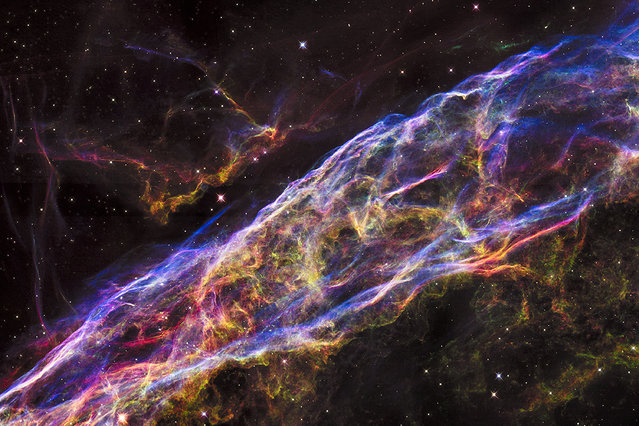
A small section of the expanding remains of the Veil Nebula, a massive star that exploded about 8,000 years ago. The entire nebula is 110 light-years across, covering six full moons on the sky as seen from Earth, and resides about 2,100 light-years away in the constellation Cygnus, the Swan. Image taken by NASA's Hubble Space Telescope. Released September 24, 2015. (Photo by Reuters/NASA/ESA/Hubble Heritage Team)

A small section of the expanding remains of the Veil Nebula, a massive star that exploded about 8,000 years ago. The entire nebula is 110 light-years across, covering six full moons on the sky as seen from Earth, and resides about 2,100 light-years away in the constellation Cygnus, the Swan. Image taken by NASA's Hubble Space Telescope. Released September 24, 2015. (Photo by Reuters/NASA/ESA/Hubble Heritage Team)
Details
10 Dec 2015 08:01:00
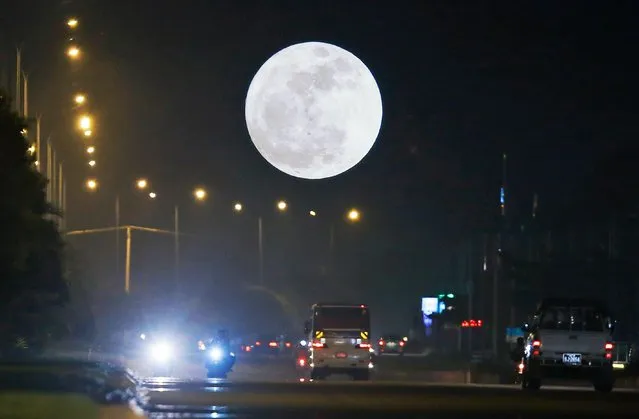
A so-called “Supermoon” dominates the sky while traffic rolls in the streets in Naypyitaw, Myanmar, 03 December 2017. According to the National Aeronautics and Space Administration (NASA) a series of three “Supermoons” – dubbed the “Supermoon trilogy” – will appear in the sky on 03 December 2017, on 01 January 2018 and and 31 January 2018. A 'Supermoon' commonly is a full moon at its closest distance to the earth with the moon appearing larger than usual. (Photo by Hein Htet/EPA/EFE)

A so-called “Supermoon” dominates the sky while traffic rolls in the streets in Naypyitaw, Myanmar, 03 December 2017. According to the National Aeronautics and Space Administration (NASA) a series of three “Supermoons” – dubbed the “Supermoon trilogy” – will appear in the sky on 03 December 2017, on 01 January 2018 and and 31 January 2018. A “Supermoon” commonly is a full moon at its closest distance to the earth with the moon appearing larger than usual. (Photo by Hein Htet/EPA/EFE)
Details
05 Dec 2017 07:45:00
European Space Agency astronaut Tim Peake will return home after a six-month long mission on the International Space Station,on June 18, 2016. Peake was the first British ESA astronaut to visit the ISS and captured hundreds of photographs of the Earth during his mission. Here: “Lots of sun-glint right now during our whole orbit – we haven't seen a sunset for over 3 days”, he wrote. (Photo by Tim Peake/ESA/NASA)

European Space Agency astronaut Tim Peake will return home after a six-month long mission on the International Space Station,on June 18, 2016. Peake was the first British ESA astronaut to visit the ISS and captured hundreds of photographs of the Earth during his mission. Here: “Lots of sun-glint right now during our whole orbit – we haven't seen a sunset for over 3 days”, he wrote. (Photo by Tim Peake/ESA/NASA)
Details
18 Jun 2016 13:08:00