A woman poses for a photo shoot with the blossom flowers decorated at Ritan Park during the Spring season in Beijing, Sunday, March 30, 2025. (Photo by Andy Wong/AP Photo)
A media member looks at a humanoid robot portraying the Qin emperor Qin Shi Huang, during an organised media tour to Robot Mall, a store selling humanoid and other robots, in Beijing, China on August 6, 2025. (Photo by Florence Lo/Reuters)
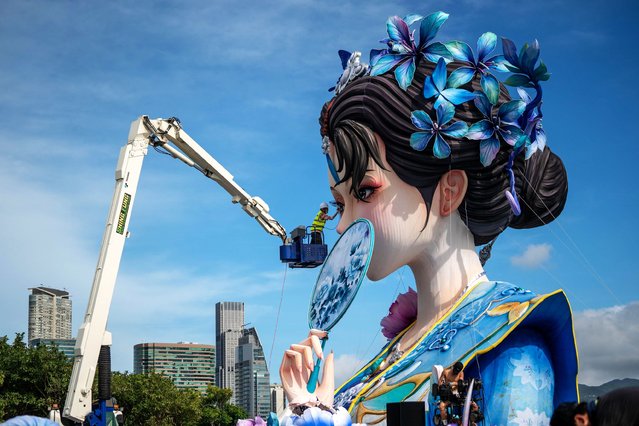
A Construction worker pinging the eye of a large woman Hanfu sculpture in front of the Hong Kong Skyline on September 28, 2025 in Hong Kong. (Photo by Vernon Yuen/Nexpher Images via ZUMA Press Wire/Alamy Live News)
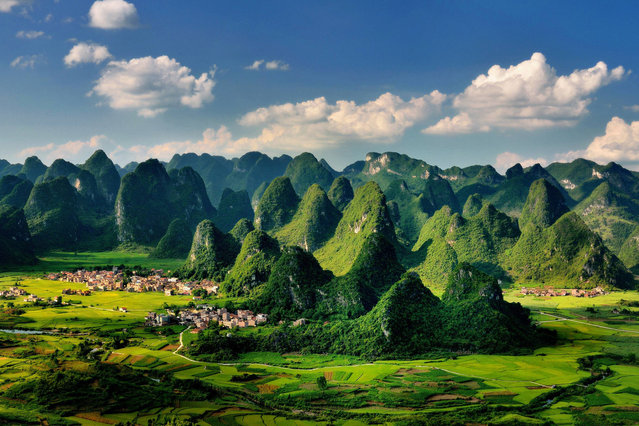
File photo taken on July 24, 2011 shows the scenery of karst landform in Dacai Township under Maonan Autonomous County of Huaijiang, south China's Guangxi Zhuang Autonomous Region. The World Heritage Committee on Monday inscribed an extension of South China Karst, a natural World Heritage Site since 2007, into the UNESCO's World Heritage List. (Photo by Wang Xiufa/Xinhua)
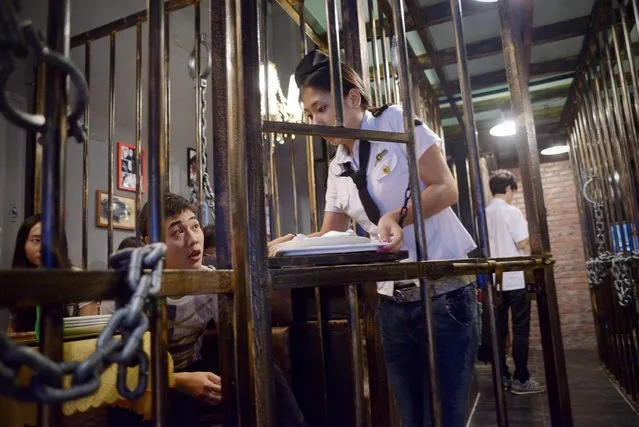
This picture taken on September 9, 2014 shows a waiteress handing over food to customers at a prison themed restaurant in Tianjin. As more themed restaurants are popular in China, a “prison style” restaurent in Tianjin is aimed at reminding people to observe the law and to be good citizens. (Photo by Wang Zhao/AFP Photo)
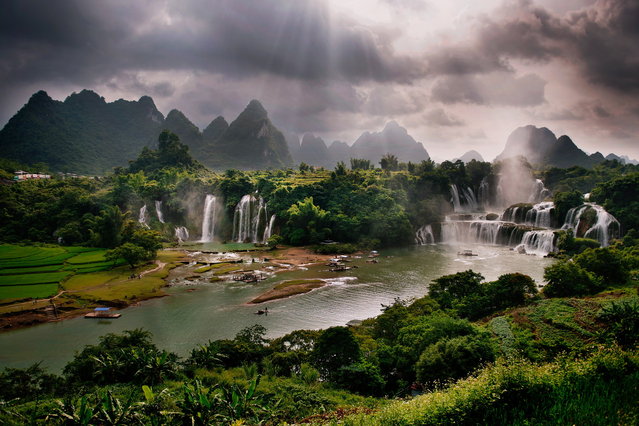
Ban Gioc – Detian Falls are two waterfalls on the Quây Sơn River, in Chinese Guichun River, straddling the Sino-Vietnamese border, located in the Karst hills of Daxin County, Guangxi (Chinese side), and in Trùng Khánh District, Cao Bằng province on the Vietnamese side, 272 km (169 mi) north of Hanoi. In Vietnamese, the two falls are considered as two parts of one waterfall with the sole name Bản Giốc. The two parts are called as: thác chính (Main waterfall) and thác phụ (Subordinate waterfall). Chinese texts sometimes name both falls from the Détiān falls on the Chinese side. During the summer rains the two waterfalls may join together.