Loading...
Done
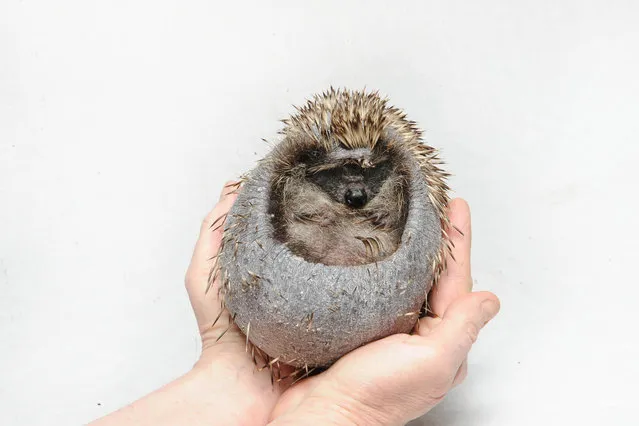
This tiny hedgehog is in a prickly position as hes unable to grow spikes, leaving him needing round-the-clock care. The woodland critter was found with no spikes and has been taken in by a family hoping to nurse him back to health so he can be released into the wild. Named Mr Prickleless, the hedgehog was rescued by Dina Nixon and her daughter Jennifer, 25, after being taken into a rescue centre in December last year. (Photo by Caters News Agency)

This tiny hedgehog is in a prickly position as hes unable to grow spikes, leaving him needing round-the-clock care. The woodland critter was found with no spikes and has been taken in by a family hoping to nurse him back to health so he can be released into the wild. Named Mr Prickleless, the hedgehog was rescued by Dina Nixon and her daughter Jennifer, 25, after being taken into a rescue centre in December last year. It is not known what happened to his spikes, but Dina has vowed that if they ever do return he will be returned to the wild. But for now the hedgehog has taken shelter in a rabbit hutch in her garden. (Photo by Caters News Agency)
Details
19 Jul 2014 11:03:00


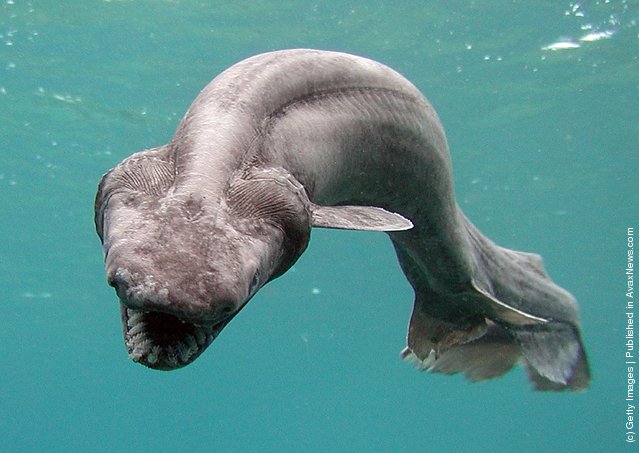
“The frilled shark (Chlamydoselachus anguineus) is one of two extant species of shark in the family Chlamydoselachidae, with a wide but patchy distribution in the Atlantic and Pacific Oceans. This uncommon species is found over the outer continental shelf and upper continental slope, generally near the bottom though there is evidence of substantial upward movements. It has been caught as deep as 1,570 m (5,150 ft), whereas in Suruga Bay, Japan it is most common at depths of 50–200 m (160–660 ft). Exhibiting several “primitive” features, the frilled shark has often been termed a «living fossil»”. – Wikipedia

Photo: A 1.6 meter long Frill shark swims in a tank after being found by a fisherman at a bay in Numazu, on January 21, 2007 in Numazu, Japan. The frill shark, also known as a Frilled shark usually lives in waters of a depth of 600 meters and so it is very rare that this shark is found alive at sea-level. It's body shape and the number of gill are similar to fossils of sharks which lived 350,000,000 years ago. (Photo by Awashima Marine Park/Getty Images)
Details
05 May 2011 10:01:00
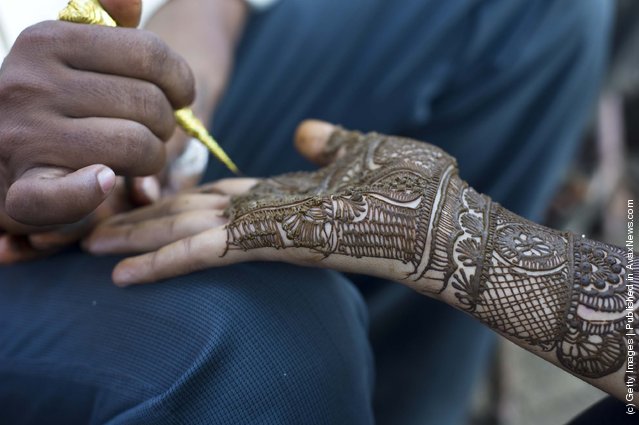
Application of henna or “Mehndi”  to a girls hand in a market in Jaipur, India

“Mehndi or menhdi is the application of henna as a temporary form of skin decoration in India, as well as by expatriate communities from the country. The word mehndi is derived from the Sanskrit word mendhikā. The use of mehndi and turmeric is described in the earliest Vedic ritual books. Haldi (Staining oneself with turmeric paste) as well as mehndi are important Vedic customs as a symbolic representation of the Outer and the Inner Sun. Vedic customs are meant to awaken the “inner light” and so the gold of the inner Sun has an important symbolic function”. – Wikipedia

Photo: Application of henna or “Mehndi” to a girls hand in a market on October 18, 2010 in Jaipur, India. (Photo by Simon de Trey-White/Getty Images)
Details
23 Nov 2011 13:33:00
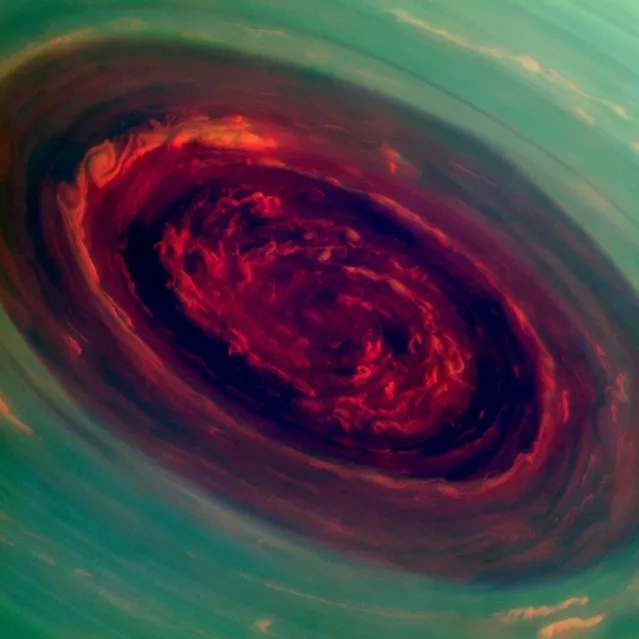
The spinning vortex of Saturn's north polar storm resembles a deep red rose of giant proportions surrounded by green foliage in this false-color image from NASA's Cassini spacecraft. (Photo by NASA/JPL-Caltech/SSI)

NASA's Cassini spacecraft has provided scientists the first close-up, visible-light views of a behemoth hurricane swirling around Saturn's north pole. In high-resolution pictures and video, scientists see the hurricane's eye is about 1,250 miles (2,000 kilometers) wide, 20 times larger than the average hurricane eye on Earth. Thin, bright clouds at the outer edge of the hurricane are traveling 330 mph(150 meters per second). The hurricane swirls inside a large, mysterious, six-sided weather pattern known as the hexagon. Photo: The spinning vortex of Saturn's north polar storm resembles a deep red rose of giant proportions surrounded by green foliage in this false-color image from NASA's Cassini spacecraft. (Photo by NASA/JPL-Caltech/SSI)
Details
31 May 2015 09:11:00
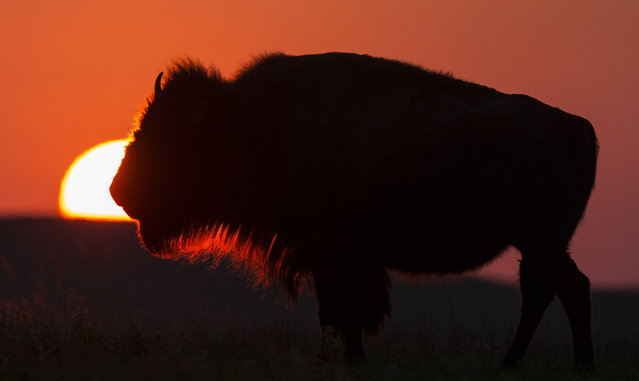
Framed by the setting sun, an American Bison grazes at the Tallgrass Prairie National Preserve on Tuesday, April 28, 2015, near Strong City, Kan. The buffalo herd at Tallgrass is one of the few herds of wild bison left in the United States. (Photo by Travis Heying/The Wichita Eagle via AP Photo)

Framed by the setting sun, an American Bison grazes at the Tallgrass Prairie National Preserve on Tuesday, April 28, 2015, near Strong City, Kan. The buffalo herd at Tallgrass is one of the few herds of wild bison left in the United States. (Photo by Travis Heying/The Wichita Eagle via AP Photo)
Details
13 May 2015 11:51:00
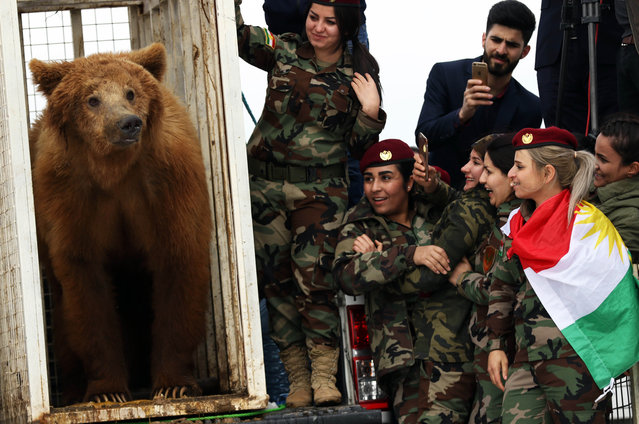
Female Iraqi Kurdish peshmerga fighters watch on as they release a bear into the wild in the Gara Mountains near the northern Iraqi city of Dohuk on March 4, 2018, after Iraqi Kurdish Animal rights activists from a local NGO rescued it from a private home. (Photo by Safin Hamed/AFP Photo)

Female Iraqi Kurdish peshmerga fighters watch on as they release a bear into the wild in the Gara Mountains near the northern Iraqi city of Dohuk on March 4, 2018, after Iraqi Kurdish Animal rights activists from a local NGO rescued it from a private home. (Photo by Safin Hamed/AFP Photo)
Details
06 Mar 2018 09:27:00
In this photo taken Saturday, September 23, 2017, a mouse is cooked on a fire after being caught in a cornfield in Chidza, Masvingo Province, Zimbabwe. Considered a delicacy, the field mice are hunted in cornfields where they have grown plump on the grains, grass and wild fruits. (Photo by Tsvangirayi Mukwazhi/AP Photo)

In this photo taken Saturday, September 23, 2017, a mouse is cooked on a fire after being caught in a cornfield in Chidza, Masvingo Province, Zimbabwe. Considered a delicacy, the field mice are hunted in cornfields where they have grown plump on the grains, grass and wild fruits. (Photo by Tsvangirayi Mukwazhi/AP Photo)
Details
02 Oct 2017 08:20:00
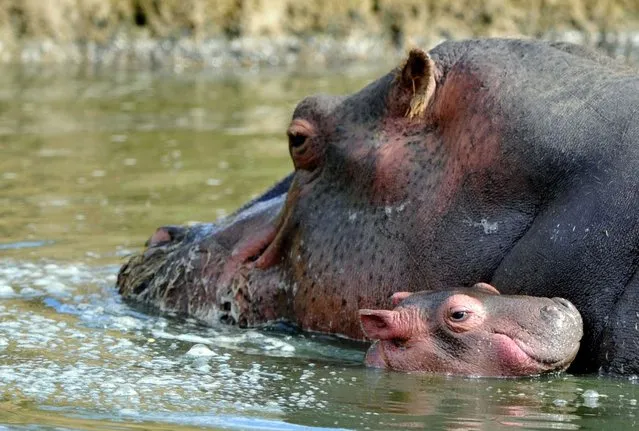
A six-day-old hippopotamus is pictured next to his mother, Kara, aged 21, on September 12, 2012 at “Planet sauvage” (“Wild planet”) Zoo in Port-Saint-Pere, western France. The birth, a rare event for this species in captivity, occured on September 7, 2012 in the Zoo. (Photo by Frank Perry/AFP Photo)

A six-day-old hippopotamus is pictured next to his mother, Kara, aged 21, on September 12, 2012 at “Planet sauvage” (“Wild planet”) Zoo in Port-Saint-Pere, western France. The birth, a rare event for this species in captivity, occured on September 7, 2012 in the Zoo. (Photo by Frank Perry/AFP Photo)
Details
13 Sep 2012 08:57:00