Loading...
Done
A devotee takes a holy bath at the Balaju Baise Dhara (22 water spouts) during the Baishak Asnan festival in Kathmandu April 4, 2015. Devotees believe that the water from these stone spouts, which is collected from the catchment area of the Nagarjun forest behind the spouts, will cure pains and skin diseases. (Photo by Navesh Chitrakar/Reuters)

A devotee takes a holy bath at the Balaju Baise Dhara (22 water spouts) during the Baishak Asnan festival in Kathmandu April 4, 2015. Devotees believe that the water from these stone spouts, which is collected from the catchment area of the Nagarjun forest behind the spouts, will cure pains and skin diseases. (Photo by Navesh Chitrakar/Reuters)
Details
04 Apr 2015 10:53:00
An officer wipes sweat off the face of a Chinese People's Liberation Army (PLA) honor guard soldier as they rehearse for a welcoming ceremony for New Zealand's Governor-General Sir Jerry Mateparae at the Great Hall of the People in Beijing, Tuesday, July 21, 2015. (Photo by Mark Schiefelbein/AP Photo)

An officer wipes sweat off the face of a Chinese People's Liberation Army (PLA) honor guard soldier as they rehearse for a welcoming ceremony for New Zealand's Governor-General Sir Jerry Mateparae at the Great Hall of the People in Beijing, Tuesday, July 21, 2015. (Photo by Mark Schiefelbein/AP Photo)
Details
22 Jul 2015 11:52:00
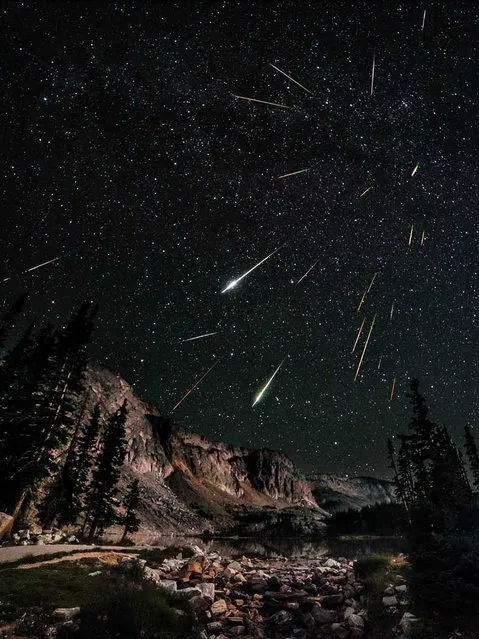
Photographer David Kingham created this composite image from 23 photos on August 12, 2012. He writes, “Last night I went out to Snowy Range in Wyoming in search of dark skies for the Perseid meteor shower.”. (Photo by David Kingham)

Starting on Monday, August 12, Perseid meteors will streak across the summer sky for a couple of nights, offering casual stargazers and serious nighttime photographers a chance to capture a glimpse of the annual meteor shower. Photo: Photographer David Kingham created this composite image from 23 photos on August 12, 2012. (Photo by David Kingham)
Details
08 Aug 2013 12:50:00


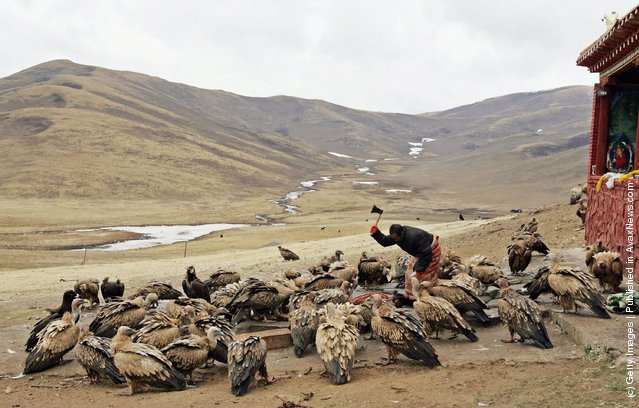
“Sky burial or ritual dissection was once a common funerary practice in Tibet wherein a human corpse is cut in specific locations and placed on a mountaintop, exposing it to the elements or the mahabhuta and animals – especially to birds of prey. The location of the sky burial preparation and place of execution are understood in the Vajrayana traditions as charnel grounds. In Tibet the practice is known as jhator, which literally means, «giving alms to the birds»”. – Wikipedia

Photo: A burial master chops bones of a body to feed vultures during a celestial burial ceremony on April 19, 2006 in Dari County of Guoluo Prefecture, Qinghai Province, northwest China. Celestial burial is a traditional funeral of Tibetan people, which began in the 7th century. (Photo by China Photos/Getty Images)
Details
18 Jun 2011 12:12:00
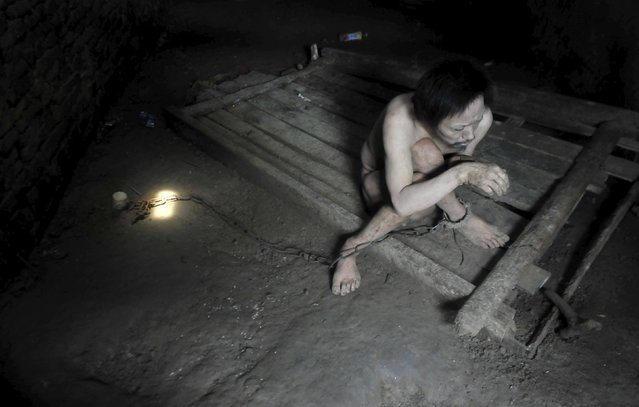
Tong Jieping, 44-year-old mentally disabled patient, is chained by his foot inside his room, in Qunxing village of Wangjiang county, Anhui province, China, July 14, 2015. Tong was diagnosed mentally ill when he was in his 20s. His parents, both in their 70s, could not afford the medical treatments so they had to lock him up in chains to prevent him from running away, according to Tong's family. (Photo by Reuters/Stringer)

Tong Jieping, 44-year-old mentally disabled patient, is chained by his foot inside his room, in Qunxing village of Wangjiang county, Anhui province, China, July 14, 2015. Tong was diagnosed mentally ill when he was in his 20s. His parents, both in their 70s, could not afford the medical treatments so they had to lock him up in chains to prevent him from running away, according to Tong's family. (Photo by Reuters/Stringer)
Details
15 Jul 2015 11:33:00


A painting of a Trabant car bursting through a wall in post unification Berlin, August 1993. (Photo by Steve Eason/Hulton Archive/Getty Images)
Details
27 Mar 2011 11:02:00


“Custer” the smallest car in the US. (Photo by Topical Press Agency/Getty Images). 1920
Details
28 Mar 2011 14:10:00


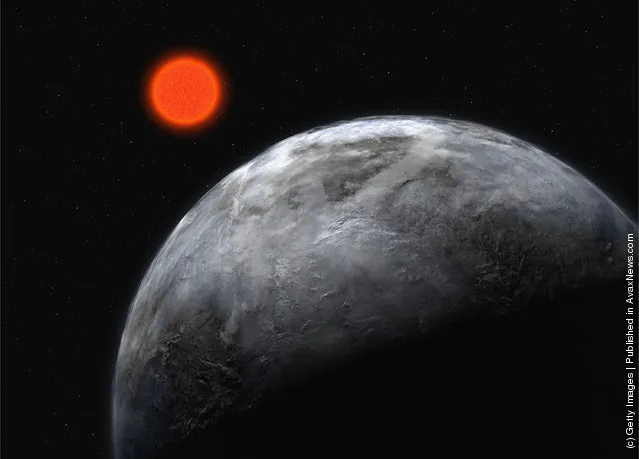
In this artist's impression supplied by the ESO (European Southern Observatory) on April 25, 2007, the planetary system around the red dwarf, Gliese 581, is pictured showing what astronomers believe is the most earth like planet found outside our solar system to date. Using the ESO 3.6-m telescope in Chile, astronomers have uncovered the planet which could have water running on its surface. The planet orbits the faint star Gliese 581, which is 20.5 light-years away in the constellation Libra. (Photo by ESO via Getty Images)
Details
12 Apr 2011 11:00:00