Loading...
Done


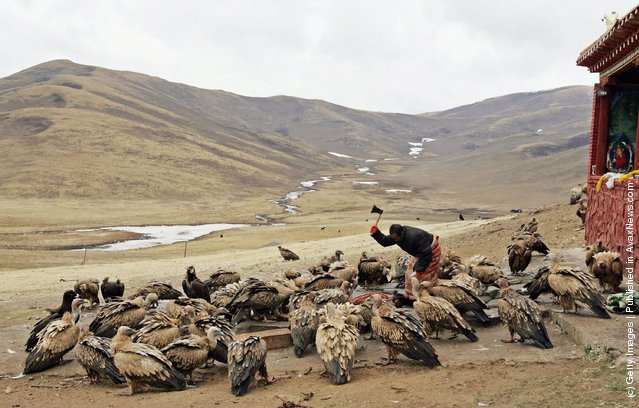
“Sky burial or ritual dissection was once a common funerary practice in Tibet wherein a human corpse is cut in specific locations and placed on a mountaintop, exposing it to the elements or the mahabhuta and animals – especially to birds of prey. The location of the sky burial preparation and place of execution are understood in the Vajrayana traditions as charnel grounds. In Tibet the practice is known as jhator, which literally means, «giving alms to the birds»”. – Wikipedia

Photo: A burial master chops bones of a body to feed vultures during a celestial burial ceremony on April 19, 2006 in Dari County of Guoluo Prefecture, Qinghai Province, northwest China. Celestial burial is a traditional funeral of Tibetan people, which began in the 7th century. (Photo by China Photos/Getty Images)
Details
18 Jun 2011 12:12:00
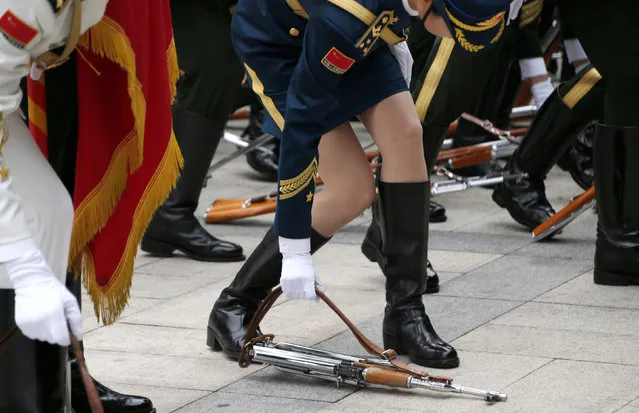
A female soldier from the honour guards prepares for a welcoming ceremony for Uruguay's President Tabare Vazquez at the Great Hall of the People in Beijing, China, October 18, 2016. (Photo by Jason Lee/Reuters)

A female soldier from the honour guards prepares for a welcoming ceremony for Uruguay's President Tabare Vazquez at the Great Hall of the People in Beijing, China, October 18, 2016. (Photo by Jason Lee/Reuters)
Details
19 Oct 2016 12:29:00
An officer wipes sweat off the face of a Chinese People's Liberation Army (PLA) honor guard soldier as they rehearse for a welcoming ceremony for New Zealand's Governor-General Sir Jerry Mateparae at the Great Hall of the People in Beijing, Tuesday, July 21, 2015. (Photo by Mark Schiefelbein/AP Photo)

An officer wipes sweat off the face of a Chinese People's Liberation Army (PLA) honor guard soldier as they rehearse for a welcoming ceremony for New Zealand's Governor-General Sir Jerry Mateparae at the Great Hall of the People in Beijing, Tuesday, July 21, 2015. (Photo by Mark Schiefelbein/AP Photo)
Details
22 Jul 2015 11:52:00
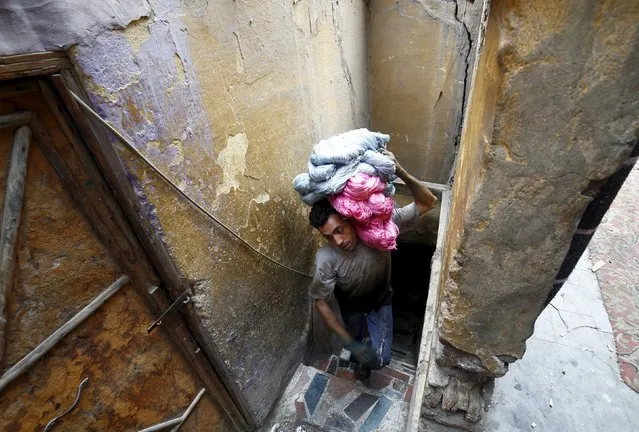
Mohamed Mostafa, 35, carries dyed yarns at a dye workshop in old Cairo, Egypt, March 17, 2016. (Photo by Amr Abdallah Dalsh/Reuters)

Mohamed Mostafa, 35, carries dyed yarns at a dye workshop in old Cairo, Egypt, March 17, 2016. Egypt's hard currency crisis and competition from modern factories in Asia and at home threaten one of the last dye workshops in Egypt. But one of its owners takes comfort in the trade's ancient resilience. Mohamed Mostafa boasts that the profession dates back 3,000 years, so it can survive anything. (Photo by Amr Abdallah Dalsh/Reuters)
Details
09 Apr 2016 13:26:00
A devotee takes a holy bath at the Balaju Baise Dhara (22 water spouts) during the Baishak Asnan festival in Kathmandu April 4, 2015. Devotees believe that the water from these stone spouts, which is collected from the catchment area of the Nagarjun forest behind the spouts, will cure pains and skin diseases. (Photo by Navesh Chitrakar/Reuters)

A devotee takes a holy bath at the Balaju Baise Dhara (22 water spouts) during the Baishak Asnan festival in Kathmandu April 4, 2015. Devotees believe that the water from these stone spouts, which is collected from the catchment area of the Nagarjun forest behind the spouts, will cure pains and skin diseases. (Photo by Navesh Chitrakar/Reuters)
Details
04 Apr 2015 10:53:00
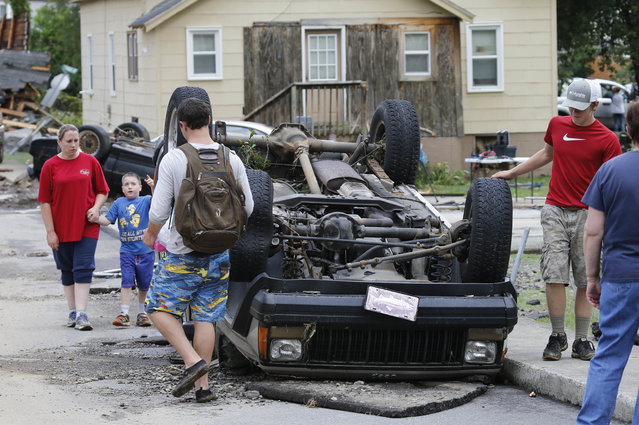
Residents walk past an overturned car as the cleanup begins from severe flooding in White Sulphur Springs, W. Va., Friday, June 24, 2016. (Photo by Steve Helber/AP Photo)

Residents walk past an overturned car as the cleanup begins from severe flooding in White Sulphur Springs, W. Va., Friday, June 24, 2016. (Photo by Steve Helber/AP Photo)
Details
25 Jun 2016 12:11:00
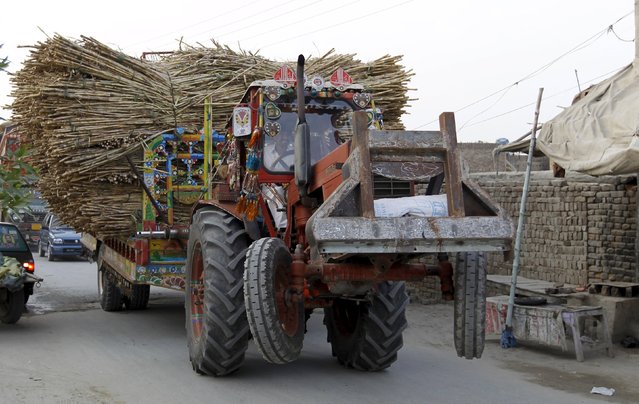
The front wheels of a tractor, pulling a trailer overloaded with sugarcane, are seen lifted off the ground as it passes through the streets of Karor Lan Esan, Pakistan December 6, 2015. (Photo by Caren Firouz/Reuters)

The front wheels of a tractor, pulling a trailer overloaded with sugarcane, are seen lifted off the ground as it passes through the streets of Karor Lan Esan, Pakistan December 6, 2015. (Photo by Caren Firouz/Reuters)
Details
17 Jan 2016 08:01:00
An Zi, is squashed amongst other commuters in a subway train on his way to work in Beijing, China, November 12, 2015. An, a movie producer, moved to Dongsanqi village in Changping this year. His commute to work can take about 2 hours, with transportation costs topping 200 yuan a month, or about a fifth of his monthly rent. (Photo by Jason Lee/Reuters)

An Zi, is squashed amongst other commuters in a subway train on his way to work in Beijing, China, November 12, 2015. An, a movie producer, moved to Dongsanqi village in Changping this year. His commute to work can take about 2 hours, with transportation costs topping 200 yuan a month, or about a fifth of his monthly rent. (Photo by Jason Lee/Reuters)
Details
28 Nov 2015 08:00:00