Loading...
Done
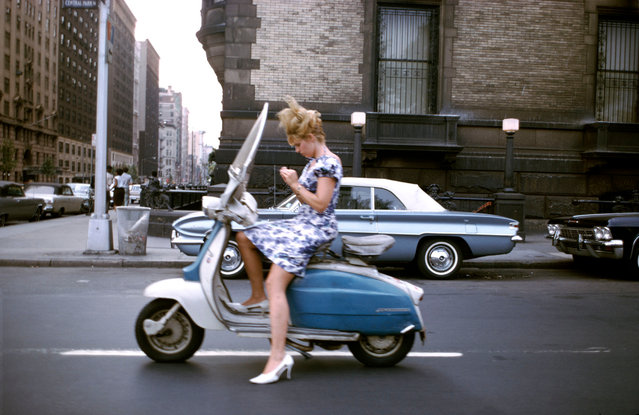
New York City, 1965, by Joel Meyerowitz. “A girl on a Vespa on her way to who knows where, when the light stopped her at the 72nd street crossing near the Dakota, where John Lennon would one day cross paths with his fate. She takes this moment to finesse a fingernail before she resumes her downtown journey, while I, stopping at the same crossing, but on foot, leap into the street to capture this vision of a dream girl before time takes her on her way”. (Photo by Joel Meyerowitz/Courtesy Aperture)

The November 2018 Square Print Sale, presented by Magnum Photos and Aperture, brings together over 100 images to explore perspectives on transition and transformation in photography. Here: New York City, 1965, by Joel Meyerowitz. “A girl on a Vespa on her way to who knows where, when the light stopped her at the 72nd street crossing near the Dakota, where John Lennon would one day cross paths with his fate. She takes this moment to finesse a fingernail before she resumes her downtown journey, while I, stopping at the same crossing, but on foot, leap into the street to capture this vision of a dream girl before time takes her on her way”. (Photo by Joel Meyerowitz/Courtesy Aperture)
Details
31 Oct 2018 00:05:00
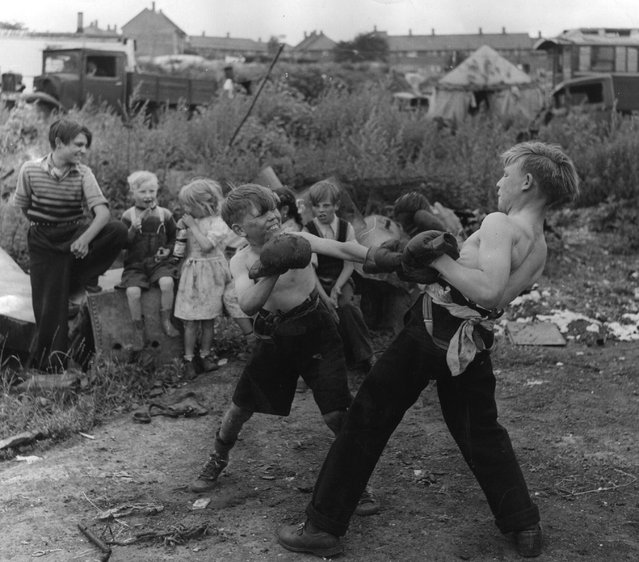
The unromantic gypsies. Children boxing in a gypsy camp in Kent, England on July 1, 1951. Like all boys these gypsy lads like to try their hand at boxing. Encouraged by their friends they fight it out on Corke's Meadow. Few Romanies now live a life of wandering romance. Most are like the three hundred squatters of Corke's Meadow, Kent, which is part of a “gypsy problem” that involves about 100,000 today. Of those about 25,000 can be rightly called gypsies, the rest are Mumpers and Posh-rats and Hobos. Corke's Meadow has both kinds. “Picture Post” cameraman Bert Hardy photographs the Corke's Meadow gypsies in their encampment. (Photo by Hulton-Deutsch Collection/Corbis via Getty Images)

The unromantic gypsies. Children boxing in a gypsy camp in Kent, England on July 1, 1951. Like all boys these gypsy lads like to try their hand at boxing. Encouraged by their friends they fight it out on Corke's Meadow. Few Romanies now live a life of wandering romance. Most are like the three hundred squatters of Corke's Meadow, Kent, which is part of a “gypsy problem” that involves about 100,000 today. Of those about 25,000 can be rightly called gypsies, the rest are Mumpers and Posh-rats and Hobos. Corke's Meadow has both kinds. “Picture Post” cameraman Bert Hardy photographs the Corke's Meadow gypsies in their encampment. (Photo by Hulton-Deutsch Collection/Corbis via Getty Images)
Details
12 Mar 2017 00:01:00
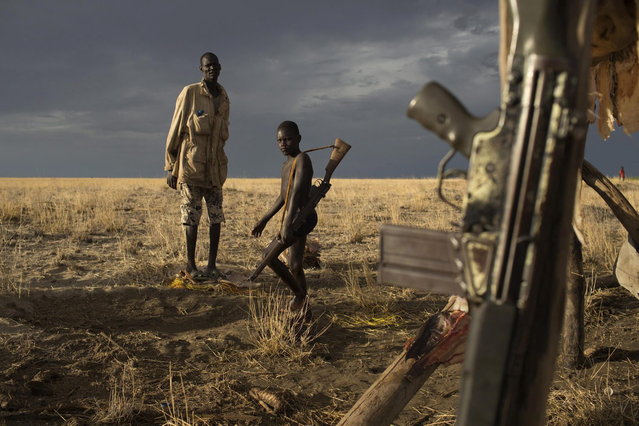
A Turkana man and a boy carrying a gun look on as a G3 battle rifle hangs from a structure used to dry fish at a fishing camp on the shores of Lake Turkana, some kilometres from Todonyang near the Kenya-Ethiopia border in northwestern Kenya October 12, 2013. (Photo by Siegfried Modola/Reuters)

A Turkana man and a boy carrying a gun look on as a G3 battle rifle hangs from a structure used to dry fish at a fishing camp on the shores of Lake Turkana, some kilometres from Todonyang near the Kenya-Ethiopia border in northwestern Kenya October 12, 2013The Turkana are traditionally nomadic pastoralists, but they have seen the pasture that they need to feed their herds suffer from recurring droughts and many have turned to fishing. However, Lake Turkana is overfished, and scarcity of food and pastureland is fuelling long-standing conflict with Ethiopian indigenous Dhaasanac, who have seen grazing grounds squeezed by large-scale government agricultural schemes in southern Ethiopia. The Dhaasanac now venture ever deeper into Kenyan territory in search of fish and grass, clashing with neighbours. Fighting between the communities has a long history, but the conflict has become ever more fatal as automatic weapons from other regional conflicts seep into the area. While the Turkana region is short of basics like grass and ground-water, it contains other resources including oil reserves and massive, newly discovered underground aquifers. (Photo by Siegfried Modola/Reuters)
Details
05 Dec 2013 12:08:00
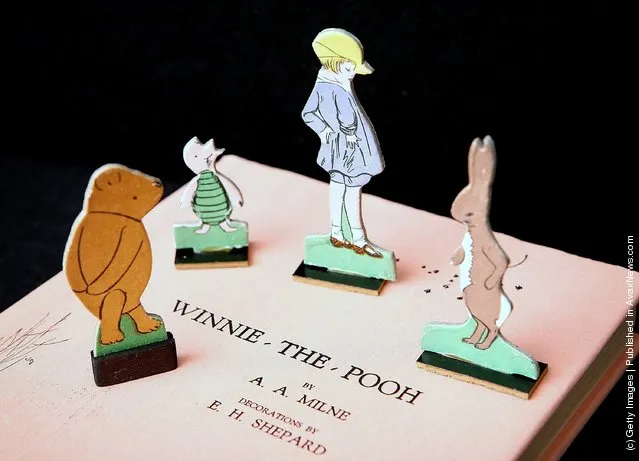
Winnie-The-Pooh

“Alan Alexander “A. A.” Milne (18 January 1882 – 31 January 1956) was an English author. Milne is most famous for his two Pooh books about a boy named Christopher Robin after his son, and various characters inspired by his son's stuffed animals, most notably the bear named Winnie-the-Pooh”. – Wikipedia

Photo: A rare American first edition of a Winnie-the-Pooh book signed by the author A.A. Milne and illustrator E. H. Shephard is displayed with Pooh characters form a 1930's game at a press preview at Sotheby's Auctioneers on December 15, 2008 in London. (Photo by Peter Macdiarmid/Getty Images)
Details
28 Aug 2011 13:34:00
Volunteers wearing face masks, gloves and protective gear to protect against coronavirus, gather to clean an area of an outdoor book market set up at Red Square with GUM, State Department store, left, St. Basil's Cathedral, center, Spasskaya Tower, second with, and the Kremlin Wall, right, in Moscow, Russia, Saturday, June 6, 2020. Muscovites clad in face masks and gloves ventured into Red Square for an outdoor book market, a small sign of the Russian capital's gradual efforts to open up amid coronavirus concerns. (Photo by Alexander Zemlianichenko/AP Photo)

Volunteers wearing face masks, gloves and protective gear to protect against coronavirus, gather to clean an area of an outdoor book market set up at Red Square with GUM, State Department store, left, St. Basil's Cathedral, center, Spasskaya Tower, second with, and the Kremlin Wall, right, in Moscow, Russia, Saturday, June 6, 2020. Muscovites clad in face masks and gloves ventured into Red Square for an outdoor book market, a small sign of the Russian capital's gradual efforts to open up amid coronavirus concerns. (Photo by Alexander Zemlianichenko/AP Photo)
Details
08 Jun 2020 00:01:00
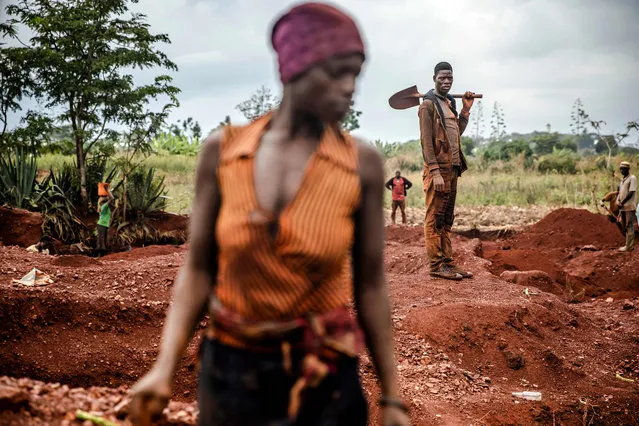
A gold miner observes from the distance how some women miners work at an open-pit gold mine in Nyarugusu, Geita Region, Tanzania on May 27, 2022. Tanzania is a land rich in minerals and one of the main gold producers in Africa, with gold representing more than 90% of the country's mineral exports. Artisanal and small-scale gold mining have culturally and historically relegated women's participation. The extractive sector in Tanzania has historically been a male-dominated industry with high levels of harassment, sеxual abuse, discrimination and misconceptions over women's involvement, and contributions following traditional beliefs. (Photo by Luis Tato/AFP Photo)

A gold miner observes from the distance how some women miners work at an open-pit gold mine in Nyarugusu, Geita Region, Tanzania on May 27, 2022. Tanzania is a land rich in minerals and one of the main gold producers in Africa, with gold representing more than 90% of the country's mineral exports. Artisanal and small-scale gold mining have culturally and historically relegated women's participation. The extractive sector in Tanzania has historically been a male-dominated industry with high levels of harassment, sеxual abuse, discrimination and misconceptions over women's involvement, and contributions following traditional beliefs. (Photo by Luis Tato/AFP Photo)
Details
13 Jun 2022 04:31:00
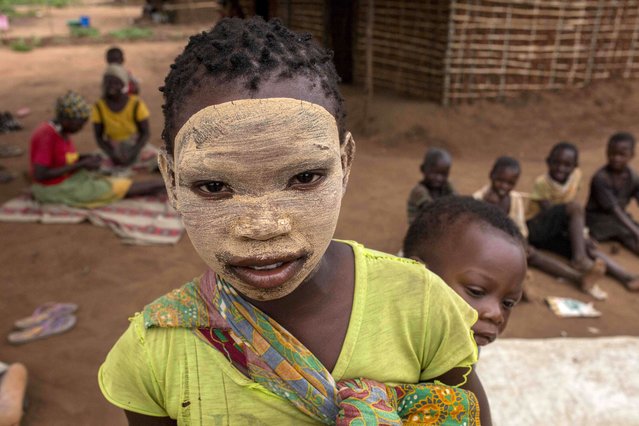
A young girl from the Makonde ethnic group wearing earth makeup on her facen, a beauty symbol, carries a baby on her back as she poses for pictures in the community of Marupa, a relocation center for internally displaced families in the Chiure district, on February 23, 2021. Thousands of families from different districts of the Cabo Delgado province who have been displaced have been located by the government in different areas of the province. (Photo by Alfredo Zuniga/AFP Photo)

A young girl from the Makonde ethnic group wearing earth makeup on her facen, a beauty symbol, carries a baby on her back as she poses for pictures in the community of Marupa, a relocation center for internally displaced families in the Chiure district, on February 23, 2021. Thousands of families from different districts of the Cabo Delgado province who have been displaced have been located by the government in different areas of the province. (Photo by Alfredo Zuniga/AFP Photo)
Details
04 Mar 2021 08:40:00
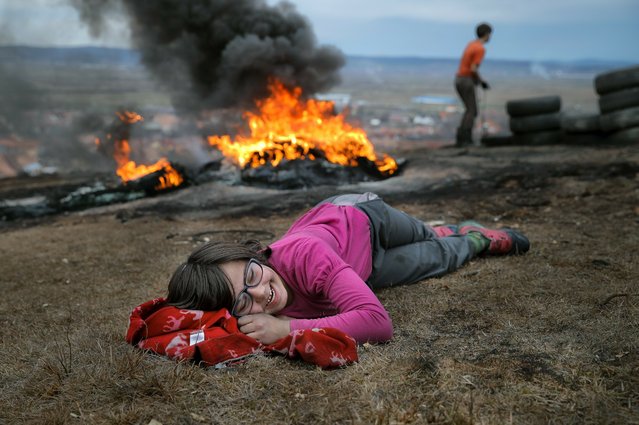
In this photo taken on Sunday, March 10, 2019, a little girl laughs during a ritual marking the upcoming Clean Monday, the beginning of the Great Lent, 40 days ahead of Orthodox Easter, on the hills surrounding the village of Poplaca, in central Romania's Transylvania region. Romanian villagers burn piles of used tires then spin them in the Transylvanian hills in a ritual they believe will ward off evil spirits as they begin a period of 40 days of abstention, when Orthodox Christians cut out meat, fish, eggs, and dairy. (Photo by Vadim Ghirda/AP Photo)

In this photo taken on Sunday, March 10, 2019, a little girl laughs during a ritual marking the upcoming Clean Monday, the beginning of the Great Lent, 40 days ahead of Orthodox Easter, on the hills surrounding the village of Poplaca, in central Romania's Transylvania region. Romanian villagers burn piles of used tires then spin them in the Transylvanian hills in a ritual they believe will ward off evil spirits as they begin a period of 40 days of abstention, when Orthodox Christians cut out meat, fish, eggs, and dairy. (Photo by Vadim Ghirda/AP Photo)
Details
01 Jun 2019 00:03:00