Loading...
Done
1924:  Vladimir Ilyich Lenin lying in state in the Kremlin

Photo: Vladimir Ilyich Lenin (1870 – 1924) lying in state in the Kremlin. (Photo by Hulton Archive/Getty Images). 1924

Important! For the same article in Russian language click here.

Something quite intriguing is happening within Russian-speaking internet during the last few – should you type a fully academic inquiry (at least, according to Russian academic requirements) in national search engines for "Lenin's mausoleum" – the first thing you get (even in top 10 searches) is website pages talking about black magic and occult. Website authors view this construction differently, but unconditionally agree on one thing: the mausoleum of the "leader of the world proletariat” – the essence of a magical artifact, a sort of “energy vampire”. It was built with a certain purpose: to drain the energy out of miserable Soviet citizens on one hand; and to poison the anthroposphere of one-sixth part of the earth with its vibes (the exact territory that was occupied by the former Soviet Union), depriving the Russian people of will to resist on the other hand. Complete nonsense? No doubt. Nevertheless, an intriguing one. Well, probably because some oddities do exist in mausoleum's history. These oddities are the thing we are going to discuss this time. First, let me refresh you memory on the subject.
Details
16 Oct 2011 11:27:00
Canada's Mandy Marchak (R) is taken down by France's Pauline Biscarat during the final match of the Hong Kong Sevens rugby women's invitational cup in Hong Kong March 28, 2014. (Photo by Tyrone Siu/Reuters)

Canada's Mandy Marchak (R) is taken down by France's Pauline Biscarat during the final match of the Hong Kong Sevens rugby women's invitational cup in Hong Kong March 28, 2014. (Photo by Tyrone Siu/Reuters)
Details
29 Mar 2014 13:22:00
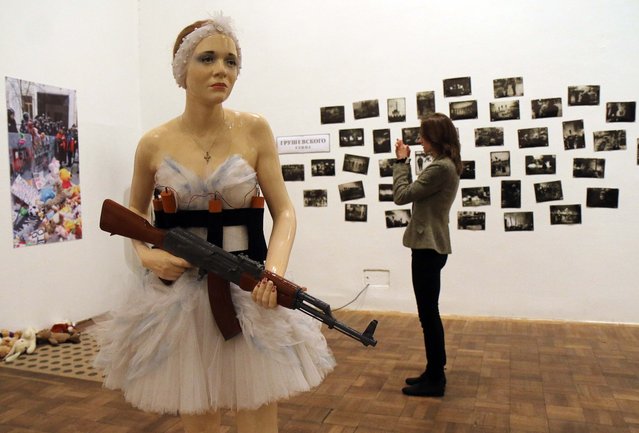
A visitor stands in the exhibition “I Am A Drop In The Ocean” dedicated to the artistic and visual expressions of the protests that shook the Ukraine from November 2013 until February 2014 at the Kuenstlerhaus gallery in Vienna, Austria, Thursday, April 10, 2014. The exhibition opens its doors from April 11 until May 23, 2014. (Photo by Ronald Zak/AP Photo)

A visitor stands in the exhibition “I Am A Drop In The Ocean” dedicated to the artistic and visual expressions of the protests that shook the Ukraine from November 2013 until February 2014 at the Kuenstlerhaus gallery in Vienna, Austria, Thursday, April 10, 2014. The exhibition opens its doors from April 11 until May 23, 2014. (Photo by Ronald Zak/AP Photo)
Details
12 Apr 2014 12:30:00
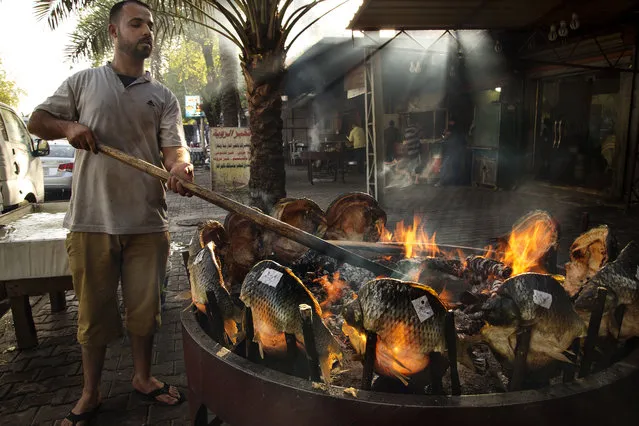
An Iraqi man cooks traditional Masgouf fish on a barbecue for sale in the Karada market July 02, 2014.  Masgouf, one of the national dishes of Iraq is a grilled carp seasoned with olive oil, rock salt, tamarind and ground turmeric. (Photo by Scott Nelson for the Washington Post)

An Iraqi man cooks traditional Masgouf fish on a barbecue for sale in the Karada market July 02, 2014. Masgouf, one of the national dishes of Iraq is a grilled carp seasoned with olive oil, rock salt, tamarind and ground turmeric. (Photo by Scott Nelson for the Washington Post)
Details
04 Aug 2014 13:43:00
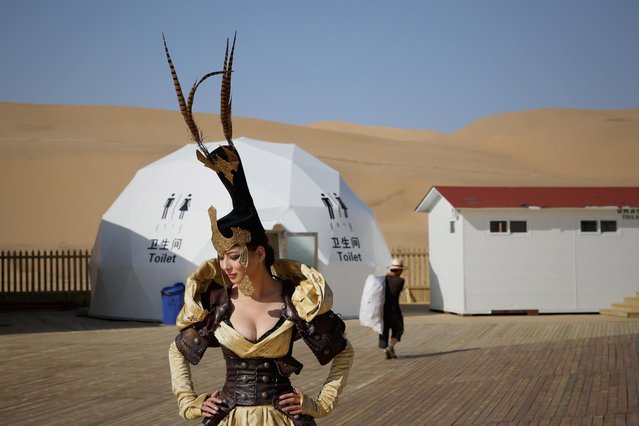
A model in Mongolia costumes prepares backstage in Xiangshawan Desert, also called Sounding Sand Desert on July 18, 2013 in Ordos of Inner Mongolia Autonomous Region, China. Xiangshawan is China's famous tourist resort in the desert. It is located along the middle section of Kubuqi Desert on the south tip of Dalate League under Ordos City. Sliding down from the 110-metre-high, 45-degree sand hill, running a course of 200 metres, the sands produce the sound of automobile engines, a natural phenomenon that nobody can explain. (Photo by Feng Li/Getty Images)

A model in Mongolia costumes prepares backstage in Xiangshawan Desert, also called Sounding Sand Desert on July 18, 2013 in Ordos of Inner Mongolia Autonomous Region, China. Xiangshawan is China's famous tourist resort in the desert. It is located along the middle section of Kubuqi Desert on the south tip of Dalate League under Ordos City. Sliding down from the 110-metre-high, 45-degree sand hill, running a course of 200 metres, the sands produce the sound of automobile engines, a natural phenomenon that nobody can explain. (Photo by Feng Li)
Details
26 Aug 2013 08:43:00
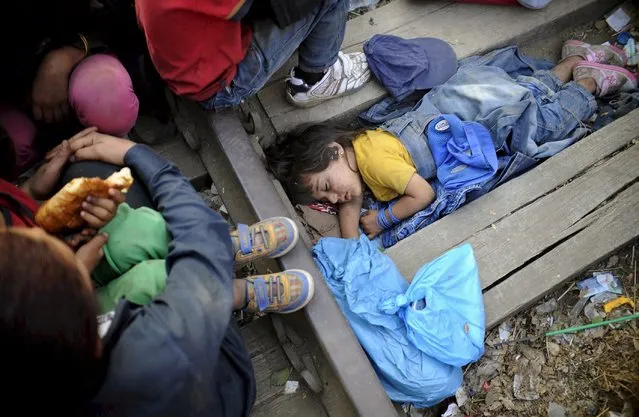
Four-year-old Rashida from Kobani, Syria, part of a new group of more than a thousand immigrants, sleeps as they wait at border line of Macedonia and Greece to enter into Macedonia near Gevgelija railway station August 20, 2015. (Photo by Ognen Teofilovski/Reuters)

Four-year-old Rashida from Kobani, Syria, part of a new group of more than a thousand immigrants, sleeps as they wait at border line of Macedonia and Greece to enter into Macedonia near Gevgelija railway station August 20, 2015. (Photo by Ognen Teofilovski/Reuters)
Details
12 Dec 2015 08:03:00
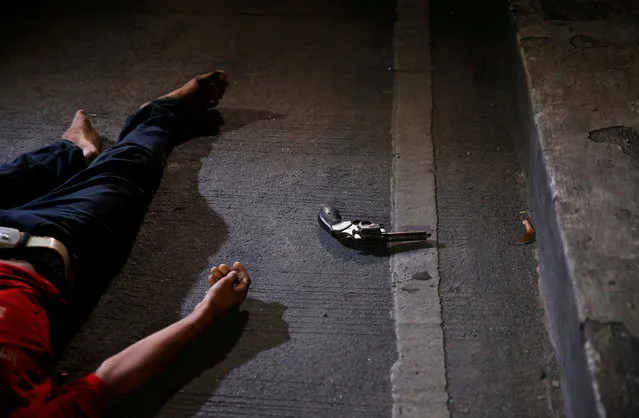
A rusty revolver is seen near the body of a man, who police said was killed by police operatives, and two sachets of “Shabu” or methampethamine chloride were found on his pockets in Manila, Philippines August 17, 2017. (Photo by Erik De Castro/Reuters)

A rusty revolver is seen near the body of a man, who police said was killed by police operatives, and two sachets of “Shabu” or methampethamine chloride were found on his pockets in Manila, Philippines August 17, 2017. (Photo by Erik De Castro/Reuters)
Details
19 Aug 2017 08:54:00
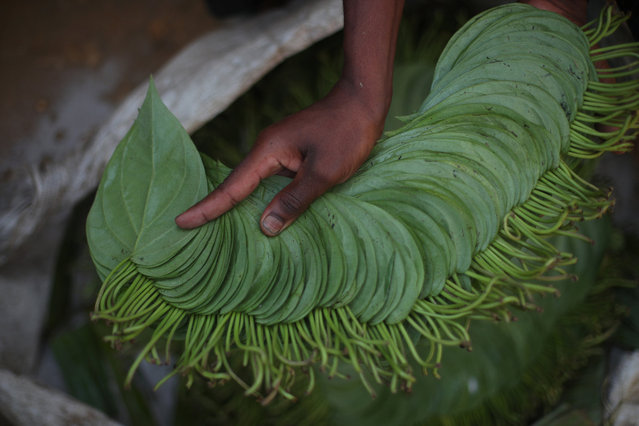
Faruk, 17, a Rohingya refugee trader holds betel leaves which are on sale at a stall in Palong Khali refugee camp near Cox's Bazar, Bangladesh, November 3, 2017. He left his village in Myanmar when the military opened fire towards the Rohingya. “I buy this betel leaf from Palong Khali market, in one bundle there are 160 pieces, I buy it for 80 taka and I sell it for 100 taka. Bangladeshi's and I sell for the same rate in the camp. Outside in the local market it is 80 taka per bundle. My problem is that I don't have money so I can't buy anything to eat, I can't buy fish to eat”, he said. (Photo by Hannah McKay/Reuters)

Faruk, 17, a Rohingya refugee trader holds betel leaves which are on sale at a stall in Palong Khali refugee camp near Cox's Bazar, Bangladesh, November 3, 2017. He left his village in Myanmar when the military opened fire towards the Rohingya. “I buy this betel leaf from Palong Khali market, in one bundle there are 160 pieces, I buy it for 80 taka and I sell it for 100 taka (1 Bangladeshi Taka = 0.012 US Dollar). Bangladeshi's and I sell for the same rate in the camp. Outside in the local market it is 80 taka per bundle. My problem is that I don't have money so I can't buy anything to eat, I can't buy fish to eat”, he said. (Photo by Hannah McKay/Reuters)
Details
27 Nov 2017 08:54:00